





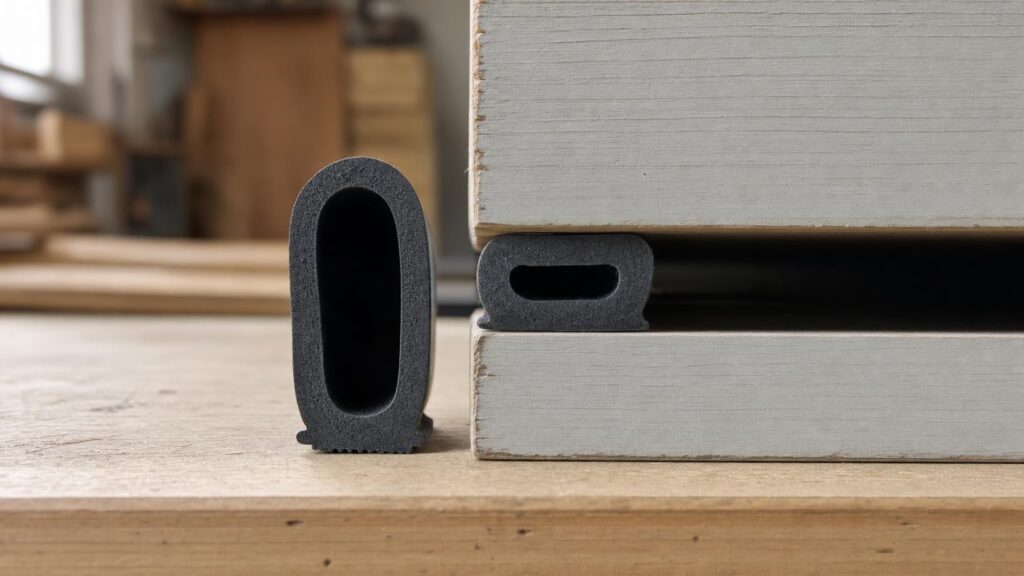
Weatherstripping is often sold with a prominent thickness, height or outside dimension. It is tempting to treat that figure as the size of gap the strip will seal, but the two measurements are not interchangeable. A 10 mm seal, for example, is not necessarily designed to fill a 10 mm clearance when a door or window is closed.
The working fit depends on how the material moves. Foam is compressed, hollow rubber profiles collapse or flex, and brush fibres deflect and overlap. Profile geometry, material density, mounting position and closing pressure all affect the useful range. Understanding these factors helps avoid both an ineffective seal and a door or window that becomes difficult to close.
Three measurements shoppers should keep separate
Choosing weatherstripping becomes easier when three different measurements are considered separately:
- Uncompressed thickness or height: the seal’s physical size before it is fitted and loaded.
- Closed gap: the available clearance between the moving panel and the frame when the door or window is fully closed and latched.
- Working compression or deflection: the amount by which the seal is intended to squash, collapse, bend or overlap during use.
A seal generally needs to be taller than the final space it occupies because some deformation creates contact. However, that does not mean that more thickness is always better. If too little of the profile engages, air may pass around it. If too much is squeezed into the clearance, it may produce excessive closing force or fail prematurely.
The relevant product information may be expressed as a recommended gap range rather than as a simple thickness. When such guidance is available, it is usually more useful than the largest outside dimension. The overall size still matters for mounting space, but it does not describe working behaviour by itself.
How foam seals close a gap by compressing
Flat foam tape works by being thicker than the remaining clearance and then compressing as the door or window closes. The foam pushes back against both surfaces, helping interrupt the path through which air, dust or noise can travel.
Different foams do not compress equally. A soft, low-density strip may accommodate irregular surfaces with relatively little closing force, but it can also be crushed too far if used in a narrow gap. A firmer or denser strip may resist deformation and recover more strongly, yet require greater pressure from the latch or closing mechanism.
Open-cell and closed-cell structures can also feel different in use. Open-cell foam commonly compresses readily because air can move through its cell structure. Closed-cell foam tends to resist compression more strongly and can offer a more substantial barrier to moisture and air movement, depending on its formulation and installation. Neither category has one universal firmness, so the material label alone does not reveal the required closing pressure.
The aim is controlled compression: enough contact to close the draught path, but not so much that the foam becomes a hard obstruction. Adhesive-backed foam also depends on secure mounting. If the strip is continually dragged sideways, heavily crushed or applied to dusty, greasy or flaking paint, the adhesive may lift even if the foam itself is suitable.
How rubber profiles behave differently from flat foam
Rubber and elastomeric seals are available as solid strips, hollow bulbs, tubes, fins and more complex profiles. Their outside dimensions can look similar while their behaviour differs substantially.
A hollow bulb can collapse into its internal space, allowing a relatively tall profile to fit a smaller closed clearance. A thin-walled tube may deform easily, while a profile with thicker walls or internal ribs may resist closing pressure. A fin bends mainly at its base or along its length rather than compressing evenly through its full thickness. A solid rubber strip has less empty space into which it can collapse and may feel much firmer than a hollow profile of the same height.
Cross-sectional shape therefore controls both working range and closing resistance. It also affects tolerance of uneven gaps. A flexible bulb may maintain contact where the clearance changes gradually, while a stiff solid profile may seal one section but hold another section open.
The direction of force matters too. Some profiles are designed for face compression, with the moving panel pressing directly towards the mounting surface. Others are intended to flex as an edge passes them. Installing a profile in a different orientation can cause it to roll, buckle unpredictably or be pulled away from its adhesive or retaining channel.
How brush and pile seals work through deflection
Brush and pile weatherstripping uses fibres rather than a compressible block. As the moving surface closes or slides, the fibres bend, spread and overlap. Pile height is therefore not a direct statement of the gap that will be sealed.
A brush slightly taller than the clearance may make light, continuous contact while still allowing movement. If the fibres are forced too far over, friction can increase and the pile may remain swept in one direction. If the pile barely reaches the opposing surface, small changes in alignment may open a path for air.
Other features matter alongside height. Dense fibres can interrupt air movement more effectively than sparse fibres, while backing width determines how broad an area is covered. Mounting angle changes the amount and direction of bending. Some pile seals also include a central fin, but performance still depends on correct contact and alignment.
Brush seals are especially useful where surfaces slide or where a low-friction, tolerant contact is needed. They should not automatically be treated as fully airtight. Their role is often to reduce airflow, dust or light through a moving joint while preserving easy operation.
Why a thicker seal can make the result worse
An oversized strip can create problems that resemble faulty hardware. The door may need to be slammed, a window handle may become hard to turn, or the latch may no longer align with its keep. Extra pressure can also make the closing edge rebound instead of remaining seated.
Excessive compression may place avoidable load on handles, hinges, latches and adhesive. Foam can be crushed beyond its useful working state, hollow profiles can fold sideways, and self-adhesive strips may peel where the moving panel drags across them. A thick strip fitted at the hinge side can be particularly disruptive because a small obstruction there may alter how the closing edge approaches the frame.
Weatherstripping should not be used to disguise an underlying alignment problem. Loose or worn hinges, a dropped door, a distorted sash, swollen timber or misaligned hardware can all produce uneven closure. If the panel does not close correctly before a seal is fitted, adding a larger strip may make the cause harder to identify.
Profile shape, mounting position and gap geometry
The same seal can behave differently depending on where it is installed. A strip on a frame stop is usually pressed face-on as the panel closes. A seal on a jamb or meeting edge may experience wiping or sideways movement. Sliding windows and doors often require a profile that deflects with low friction rather than one that depends on substantial direct compression.
Real gaps are rarely perfectly uniform. They may taper from top to bottom, curve around a warped surface or widen locally near hardware. A single uniformly thick strip must accommodate the smallest clearance without losing contact at the largest one. This is why a forgiving hollow profile or brush may work better than a firm rectangular strip in some uneven openings.
Targeted treatment can also be preferable to covering every edge with the thickest available material. Different sides of an opening may have different clearances and directions of movement. The hinge side, latch side and sill do not necessarily need the same profile.
Measuring the gap under real closing conditions
Measure with the door or window fully closed and latched, because that is the position in which the seal must work. An unlatched panel may sit differently and give a misleading clearance.
- Inspect the opening first. Check whether hinges, catches, handles and frame surfaces are secure and correctly aligned.
- Sample several points. Measure near corners, at the centre of each edge and around any visible changes in the gap. Suitable non-damaging gauges or pieces of card with known thicknesses can help where direct measurement is awkward.
- Find both extremes. Record the narrowest clearance, which limits how much material can be compressed, and the widest clearance, which determines how far the seal must reach.
- Identify the direction of movement. Decide whether the profile will be compressed directly, wiped sideways or bent by a sliding surface.
- Allow for normal variation. Timber and other components can move with temperature and moisture, while painted surfaces, wear and settling may alter the gap over time.
Do not force a measuring tool into a delicate joint or close the panel onto a hard object that could damage glass, finishes or hardware. Where the opening has a large or unexplained variation, adjustment or repair may be more appropriate than trying to bridge everything with weatherstripping.
Fit over time: compression set, wear and maintenance
A seal that fits on installation must also recover after repeated use. Foam and elastomeric materials can gradually take a compression set, meaning that they remain partly flattened after prolonged loading. If recovery declines, the profile may no longer reach the opposing surface when the gap changes slightly.
Brush fibres experience different wear. They can become matted, permanently swept over or clogged with paint, dust and debris. Cleaning may restore movement where dirt is the problem, but physically worn or distorted pile may require replacement.
Installation conditions affect long-term fit as well. Adhesive-backed strips need a clean, dry and stable surface. Corners should be arranged so that they do not leave an open channel, but bulky overlaps can create excessive thickness. Seals should also remain clear of latches, drainage paths and other features that need to move or remain open.
A short trial section is useful before committing to the entire frame. It can reveal closing resistance, wiping direction and adhesive compatibility. Test the panel repeatedly, including its latch or locking action, rather than judging the fit only by how the strip looks when the opening is stationary.
Choose by working behaviour, not the largest dimension
The most useful weatherstripping measurement is not always the biggest number on the product description. Start by identifying the closed gap and how much it varies. Then choose the appropriate sealing action: compression for foam, controlled collapse or flex for rubber profiles, or fibre deflection for brush and pile seals.
Confirm that there is enough mounting space, that the profile moves in its intended direction and that the door or window can still close without excessive force. Finally, test a short length before completing the installation. A well-matched seal is not simply thick enough to touch both surfaces – it makes reliable contact while allowing the opening and its hardware to work normally.
Continue exploring on Frowse
Discover More Frowse Insights
- Airflow, Airspeed and Nozzle Shape: How to Judge a Leaf Blower’s Real Capability
- How Small Bluetooth Speakers Produce More Bass Than Their Size Suggests
- Why Mattress Firmness and Foam Density Are Not the Same Thing
- Inside a Duvet: How Fill and Construction Determine Warmth
- Why Air-Fryer Capacity Does Not Reveal Its Usable Cooking Space