





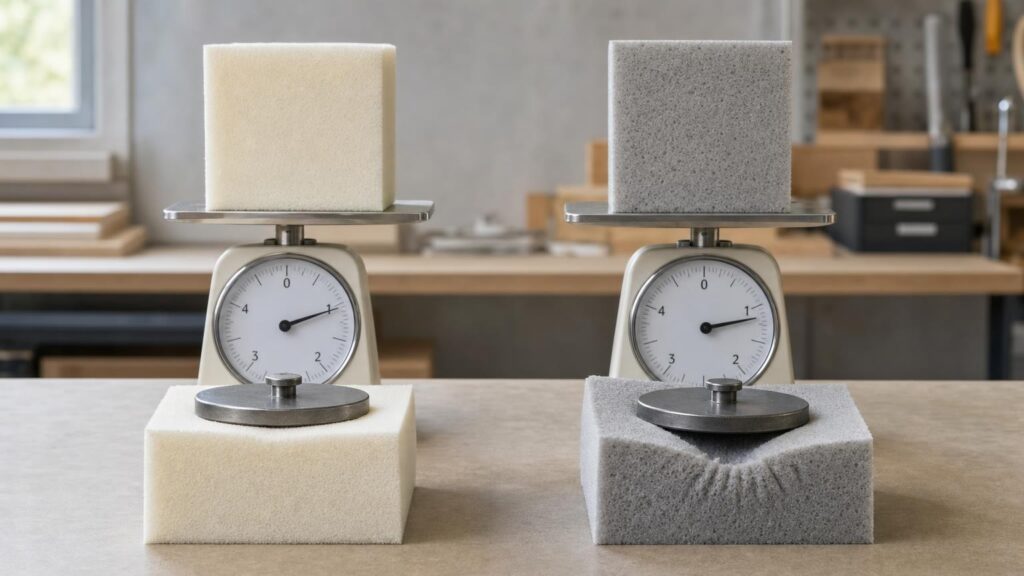
Mattress descriptions often place firmness and foam density side by side, which can make them sound like two ways of reporting the same property. They are not. Firmness concerns how strongly a material or complete mattress resists compression, while density describes how much material is contained within a given volume of foam.
Understanding the distinction helps explain why a dense foam can feel soft, why a lower-density foam can initially feel firm, and why neither figure can describe an entire mattress on its own. Shoppers need to consider these specifications alongside foam type, layer thickness and the rest of the mattress construction.
Firmness and density answer different questions
Firmness describes resistance to compression. In everyday terms, it relates to how soft or hard a foam or mattress feels when weight is applied. A firmer material resists indentation more strongly, while a softer one allows more immediate compression.
Density describes mass per unit volume. It is normally found by dividing the mass of a piece of foam by its volume and may be expressed in kilograms per cubic metre or pounds per cubic foot. Density does not directly state how difficult the foam is to compress.
Manufacturers can formulate foams with different combinations of these characteristics. A relatively dense memory foam may be designed to contour deeply and feel soft. A less dense polyurethane support foam may be made to feel noticeably firm when new. Density and firmness can sometimes influence related aspects of performance, but one cannot be reliably calculated from the other.
This distinction matters because the specifications answer different shopping questions. Firmness information may help describe initial feel, while density can provide context about the foam’s material content and likely ability to retain its properties. Both still need to be interpreted within the mattress design.
How foam firmness is measured – and why the number is not the whole feel
Foam firmness is commonly assessed using an indentation force measurement, which may be described as indentation force deflection or indentation load deflection. In simplified terms, testing equipment presses into a foam sample and records the force required to compress it by a defined proportion of its original thickness.
A higher force reading generally indicates greater resistance under those particular test conditions. However, a number without its testing context can be misleading. Results can be affected by:
- The dimensions and thickness of the sample
- How far the foam is compressed
- The size and shape of the testing surface
- The foam type and its response speed
- Temperature, conditioning and test procedure
- Whether the figure describes one layer or a finished mattress
Two ratings are meaningfully comparable only when they refer to compatible methods and conditions. A figure for a small foam sample should not automatically be treated as a direct prediction of how a multilayer mattress will feel.
Foam also has a response curve rather than one fixed level of resistance. Some materials compress easily at first but become much more resistant as they are pressed further. Others have a more even response. A single indentation figure records one point under defined conditions, not every stage of the experience as a sleeper settles into the bed.
What foam density can reveal about a mattress
Density indicates how much a foam sample weighs in relation to its size. Within the same broad foam family, a higher density generally means that more polymer material is present in a given volume and less of that volume consists of air. This can be relevant to resilience, structural stability and resistance to lasting impressions.
Density is therefore often more useful as a clue about expected long-term behaviour than as a guide to immediate softness. Even then, it should not be treated as an absolute quality score. Foam chemistry, cell structure, additives, manufacturing consistency and the demands placed on the layer all matter.
Comparisons are most useful between foams of a similar type and function. Conventional polyurethane foam, memory foam and latex have different structures and typical density profiles. A density that appears high for one category may be ordinary or unsuitable as a benchmark for another. Latex, for example, is inherently different from many polyurethane foams, so comparing the figures directly would reveal little about relative comfort or durability.
Layer location matters too. A soft surface layer experiences repeated compression and may require different performance characteristics from a deep support layer. A lower-density foam in a lightly loaded quilting panel does not carry the same role as foam used through a thick comfort section.
Why layer thickness changes how firmness is experienced
The thickness of a foam layer determines how much room it has to compress before the layer beneath begins to dominate the feel. This is why the same foam can perform differently in two mattress designs.
A thick, soft comfort layer allows more sinkage and contouring. A sleeper can move further into it before reaching the transition or support materials below. If that same foam is used as a thin layer, it will compress sooner and the firmer underlying structure will become noticeable more quickly.
Thickness also changes how a sleeper experiences a firm material. A thin firm transition layer may subtly limit sinkage, while a thick block of the same material can have a much stronger influence on the entire mattress. The effect is not simply additive because layers interact under load.
When reviewing specifications, shoppers should therefore look for both firmness and thickness. A description such as “soft memory foam” is incomplete without knowing whether it is a light quilted component or a substantial part of the comfort system.
The whole mattress matters more than a single foam specification
A mattress is a system of interacting components. Its surface feel and deeper support can be shaped by the cover, quilting, comfort layers, transition layers, support foam or springs, zoning and edge construction.
A taut cover can slightly restrict how readily the surface materials deform. Thick quilting may create an initially plush sensation even when firmer layers sit beneath it. Transition foam can moderate the change between a soft comfort layer and a rigid support core. Springs can respond differently according to their arrangement and how force is distributed across them.
Zoned construction may also provide different resistance in different areas, while reinforced edges can make the perimeter feel unlike the centre. These design choices affect pressure distribution, ease of movement, sinkage and the overall sense of stability.
Consequently, the density or indentation rating of one foam layer cannot predict the completed mattress. Even knowing the specifications of every layer will not perfectly recreate the experience, but it gives shoppers a more useful picture than one headline number.
Support, pressure relief and firmness are not synonyms
Firmness is primarily a description of resistance or perceived hardness. Support concerns how the mattress limits excessive sinkage and responds to the sleeper’s load. Pressure relief relates to how the surface accommodates areas where weight is concentrated. These qualities interact, but they are not interchangeable.
A very firm surface is not automatically more supportive for every person. It may resist compression strongly while offering limited contouring. Conversely, a mattress can have a soft initial surface but use firmer transition and support layers to limit deeper sinkage.
Perceived firmness also changes with the sleeper. A heavier person generally applies more force and may engage deeper layers that a lighter person barely reaches. Sleeping position changes where weight is concentrated: side sleeping places more localised load around the shoulder and hip, while other positions distribute it differently. Body shape and weight distribution add further variation.
This is why the same mattress can be described as firm by one person and comparatively soft by another. Firmness labels are useful as broad orientation, but they cannot guarantee an identical experience for every sleeper.
Why firmness labels are difficult to compare across brands
Terms such as soft, medium and firm do not have one universal marketplace definition. Brands may develop their own scales based on internal testing, design targets or subjective assessments. A “medium” mattress from one range may therefore feel closer to “medium-firm” or “soft” in another.
Numbered firmness scales can appear more precise, but the numbers are not necessarily standardised either. Unless two sellers define their scales in the same way and use compatible assessment methods, matching numbers do not establish matching feel.
Construction makes cross-brand comparisons harder. Two mattresses carrying the same label may use different cover tension, comfort-layer thicknesses, transition materials and support systems. They may feel similar under light pressure but behave very differently once the sleeper settles further into them.
Treat firmness labels as useful for comparing options within a clearly defined product range. For comparison across unrelated brands, examine construction details and any explained test method rather than relying on the label alone.
How to assess specifications without being misled
A structured reading of the product information can reveal what is known and where uncertainty remains.
- Identify the material. Establish whether each relevant layer is conventional polyurethane foam, memory foam, latex or another material. Density figures should be interpreted within the correct material family.
- Check layer thickness. Note how much of the mattress is devoted to soft comfort material, transition layers and the support core. Total mattress depth alone does not provide this information.
- Separate layer data from whole-mattress claims. A firmness or density specification for one foam should not be assumed to describe the completed bed.
- Look for defined units and methods. Density should use a recognised mass-per-volume unit. An indentation rating is more useful when the test conditions and compression depth are stated.
- Consider each layer’s role. Surface foam, transition material and the core face different stresses and serve different purposes. One preferred density is not appropriate for every position.
- Recognise vague wording. Phrases such as “high density”, “premium foam” or “orthopaedic firmness” provide little basis for comparison unless they are supported by meaningful construction details.
Missing information does not prove that a mattress will perform poorly. It simply limits how confidently shoppers can compare it with a more fully specified option.
Balance first-night comfort with long-term ownership
Initial feel is important, but a brief trial does not establish how well a mattress will retain that feel. Foams can change during early use as materials settle, covers relax and the sleeper becomes accustomed to the construction. Over a longer period, repeated loading can gradually soften foam and contribute to impressions.
Density may offer a resilience clue within a comparable foam category, but it cannot supply a guaranteed lifespan. Layer thickness, sleeper load, frequency of use, ventilation, care and the supporting bed base can all affect long-term performance.
Before buying, consider whether the manufacturer explains the construction clearly and states any bed-base requirements. Review applicable trial, return, rotation and care terms rather than assuming they are the same across sellers. Packaging and unboxing guidance may also indicate when the mattress is expected to reach its intended shape and feel.
A sensible decision balances immediate comfort preferences with construction transparency and ownership conditions. Choosing solely because a mattress carries a familiar firmness label overlooks much of what determines its performance.
Choose by construction, not by one headline number
Start with the overall feel and degree of contouring you prefer, taking account of sleeping position, body weight and how deeply you are likely to engage the mattress. Next, examine the arrangement, type and thickness of its layers and the nature of the support core.
Use density mainly as contextual information about material content and possible resilience within the same foam family. Use indentation ratings to compare resistance only when their definitions and test conditions are compatible. Treat broad firmness labels as orientation rather than universal measurements.
No single specification can capture a complete mattress. The most informative comparison combines intended feel, layer design, material details and ownership terms, while recognising where the available information does not support a precise conclusion.
Continue exploring on Frowse
Discover More Frowse Insights
- Why Battery Voltage Does Not Tell You How a Cordless Lawn Mower Will Cut
- What a Sleeping Mat’s R-Value Reveals – and What It Leaves Out
- The Roof-Rack Fit Problem: Rails, Fixing Points and Clamp Systems Explained
- Why Paper Weight Alone Cannot Tell You How Printer Paper Will Perform
- Digital Piano Actions Explained: Weighted Keys, Hammers and Sensors