





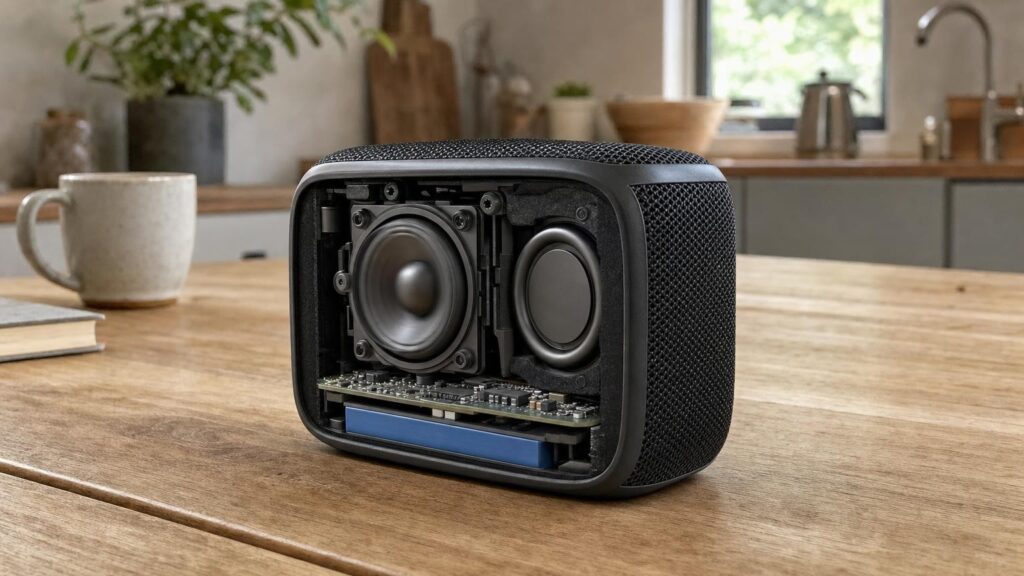
A compact Bluetooth speaker can sound surprisingly full, especially when it first starts playing in a kitchen, bedroom or outdoor seating area. That effect is not evidence that acoustic limits have disappeared. Instead, designers combine specialised drivers, carefully tuned enclosures, passive radiators and digital processing to make the best use of a very small amount of moving air.
It helps to separate three qualities that are often grouped together as “good bass”. Bass impact is the sense of punch from drums and bass lines. Bass extension describes how far a speaker reaches into lower frequencies. Sustained output is its ability to maintain that performance as volume rises. A small speaker may deliver impressive punch at moderate volume while having limited deep-bass extension or reducing bass when pushed harder.
Bass starts with moving air
A loudspeaker driver creates sound by moving its cone or diaphragm backwards and forwards. This movement produces changes in air pressure that reach the listener as sound waves. Low-frequency waves require the speaker to displace substantially more air than higher-frequency sounds at a comparable listening level.
Two factors are especially important: the effective area of the driver and how far it can travel, known as excursion. A large woofer can move plenty of air with relatively modest cone movement. A small driver has less surface area, so it generally needs greater excursion to produce strong bass at the same level.
This presents several challenges in a portable speaker. There is limited room for a wide driver, a large magnet assembly and suspension components capable of controlled movement. The small enclosure also contains a restricted volume of air, which acts like a spring behind the driver. As the cone moves further, mechanical strain, electrical demand and the risk of distortion increase.
Designers can use long-excursion drivers that move farther than their dimensions might suggest. A capable suspension and motor system help keep that movement controlled. Even so, excursion is finite. If a driver is asked to move beyond its useful range, it may distort, lose definition or risk damage. Protective electronics therefore become an important part of compact-speaker design.
What passive radiators add to a compact enclosure
Many small Bluetooth speakers use one or more passive radiators to increase bass output around a chosen range. A passive radiator can resemble a speaker driver, but it has no powered voice coil. Pressure changes inside the enclosure, created by the active driver, make the passive diaphragm move.
The radiator’s mass, suspension and relationship with the enclosure volume determine its tuning. Around that tuned frequency, it can contribute useful output while reducing how hard the active driver has to move. This can create convincing warmth or upper-bass punch from a cabinet that would otherwise sound thin.
A passive radiator performs a similar acoustic role to a bass-reflex port, which uses air moving through a tube or opening. Ports can work well, but fitting an effective port into a tiny cabinet is difficult. A short or narrow port may create audible turbulence when air moves quickly through it. A passive radiator avoids that form of port noise and can be easier to package in a compact, sealed-looking design.
Neither method provides unlimited low bass. Below the enclosure’s tuned region, output can fall steeply and the active driver may receive less acoustic support. A speaker can therefore have a powerful beat in one bass range while reproducing the lowest notes much more quietly. Passive radiators may also move visibly during playback, but dramatic movement alone does not establish that the speaker reaches particularly deep.
Enclosure design matters as much as driver count
A speaker enclosure is part of the acoustic system, not merely a case for electronics. Its internal volume affects the air pressure behind the active driver and the behaviour of any passive radiator. Airtight construction is particularly important in a passive-radiator design because uncontrolled leaks reduce the pressure needed to drive the radiator properly.
Cabinet stiffness matters too. Energy intended to move the driver can instead make thin enclosure panels vibrate. Some vibration may add an initially impressive sense of warmth, but uncontrolled resonance can produce one-note bass, buzzing or blurred detail. Bracing, material choice and structural shaping can help control these effects, although they consume space and add weight.
Driver and radiator placement also influence performance. Opposed radiators or drivers can help balance mechanical forces, while a poorly supported design may move across a hard surface or transmit strong vibration into furniture. The proportions of the enclosure, internal damping and available space around components all contribute to the final tuning.
This is why visible driver count is an unreliable shortcut. Two small drivers may improve coverage, stereo separation or maximum output without reaching lower than one well-engineered driver. Likewise, a large passive radiator is not an additional powered woofer. The whole acoustic system determines the result.
How digital signal processing reshapes the sound
Digital signal processing, usually called DSP, is central to the sound of many portable speakers. It allows designers to adjust different frequency ranges, filter out signals the driver cannot reproduce safely and alter the tuning according to playback level.
Equalisation can raise selected bass frequencies so that the speaker sounds fuller. Dynamic bass processing may vary that boost depending on the music and available headroom. Filtering can remove very low frequencies that would consume excursion and amplifier power without producing much audible output. The saved capacity can then be used more effectively elsewhere.
DSP can also monitor or estimate stress on the driver, amplifier and battery. At low and moderate volume, there may be enough excursion and power available for generous bass enhancement. As volume rises, the system may progressively reduce low-frequency output to protect the hardware and preserve clarity. Consequently, the speaker’s tonal balance can change with the volume setting.
This does not mean that processing creates bass from nothing. It redistributes limited resources. Boosting one frequency range requires amplifier power and additional cone movement, leaving less capacity for other demands. Well-judged processing makes these compromises unobtrusive; aggressive processing may sound exciting on some tracks but artificial or inconsistent on others.
The unavoidable trade-offs: depth, loudness, distortion and battery life
Compact speakers operate within limits set by driver size, excursion, enclosure volume, amplifier capacity and stored battery energy. Improving one aspect often places pressure on another.
- Deeper bass: Reproducing lower notes at meaningful levels demands greater air displacement. In a small driver, that usually means more excursion.
- Higher volume: Playing loudly requires more amplifier power and leaves less headroom for boosted bass peaks.
- Lower distortion: Keeping the driver within a controlled operating range may require limiting deep bass or maximum output.
- Longer battery life: Strong bass and high volume increase electrical demand, while more powerful amplification can also generate additional heat.
Protective limiting is therefore not necessarily a design flaw. It may prevent harsh distortion or mechanical damage. However, it explains why a speaker that sounds rich at conversational listening levels can become leaner at a party volume. Some models may compress the whole signal, while others preserve vocals and treble by pulling back the bass.
Heat adds another constraint. Portable enclosures offer limited room for cooling, and the battery, amplifier and driver share the same compact structure. Sensible power management helps maintain dependable operation, but it further limits the possibility of combining maximum loudness, deepest bass and longest runtime in one very small product.
Bass quality is not the same as bass quantity
Shoppers can judge bass more accurately by listening for several distinct characteristics rather than asking only whether there is “a lot” of it.
- Extension describes how far the speaker reaches towards lower notes before output fades significantly.
- Punch is the immediate impact of kick drums and rhythmic bass, often concentrated higher in the bass range.
- Definition means individual notes and textures remain distinguishable rather than merging together.
- Boom is an excessive emphasis over a narrow range, which can make different recordings sound similar.
- Resonance occurs when the enclosure, radiator or nearby surface reinforces particular notes.
- Compression is the loss of increasing output or musical dynamics as the speaker approaches its limits.
A strong mid-bass boost can make a compact model sound impressive during a quick demonstration. It may give pop and dance tracks satisfying weight, but it should not be confused with genuine low-bass reach. Excessive warmth can also mask vocals, soften percussion detail or make acoustic instruments sound unnaturally thick.
Placement changes the result as well. A speaker near a wall or in a corner may gain bass reinforcement, while one placed in open space can sound leaner. A hollow shelf or lightweight table may add vibration and boom. Comparisons are most useful when speakers occupy similar positions and play at matched perceived volume.
How to assess bass claims and specifications before buying
Single specifications rarely describe compact-speaker bass adequately. Amplifier wattage indicates neither how efficiently that power becomes sound nor how much of it is available continuously. Driver count says little about tuning, excursion or low-frequency extension. Labels such as “bass boost” or “enhanced bass” describe an intended effect rather than a standard level of performance.
Frequency-response information can be useful when it includes measurement conditions and a meaningful tolerance range. A quoted low-frequency number without those details does not reveal how quiet that frequency is relative to the rest of the sound. Room conditions, measurement distance and listening level can also affect results.
Independent measurements and careful listening tests can provide better context. Look for evidence of how the speaker behaves at several volume levels, not only at a comfortable setting. Reports of bass becoming thinner, rougher or compressed at high output may matter greatly for outdoor or social use but very little for quiet personal listening.
Before buying, consider the conditions that matter most:
- Usual listening level: If you normally listen at moderate volume, balanced tuning and definition may matter more than maximum output.
- Music and spoken content: Rhythmic music may benefit from punch, while podcasts and acoustic recordings can suffer if bass emphasis clouds the midrange.
- Room and placement: Indoor walls and surfaces can reinforce bass. Open outdoor spaces provide less acoustic support.
- Portability: A slightly larger or heavier enclosure may allow greater displacement and battery capacity, but it may be less convenient to carry.
- Runtime priorities: Published battery figures, where available, should be considered alongside the test conditions because playback level and bass demand can affect energy use.
Match the engineering compromise to how you listen
Convincing bass from a small Bluetooth speaker is the product of coordinated engineering. The active driver moves the air, the enclosure controls pressure, passive components reinforce a tuned region, and DSP manages equalisation and protection. None of these techniques removes the underlying physical limits of a compact cabinet.
The most suitable compromise depends on use. Some listeners will prefer rich, balanced bass at ordinary indoor volume. Others need sustained output outdoors, even if the deepest notes are reduced. Travellers may prioritise size and battery endurance over maximum impact. Evaluating those priorities is more useful than expecting one miniature design to deliver the deepest bass, highest volume, lowest distortion and longest runtime simultaneously.
Continue exploring on Frowse
Discover More Frowse Insights
- The Roof-Rack Fit Problem: Rails, Fixing Points and Clamp Systems Explained
- What a Surge Protector’s Joule Rating Means and Why Protection Wears Out
- Why Mechanical Keyboard Switch Colours Are Not a Universal Standard
- Single-Coil, Humbucker and Active Pickups: How the Hardware Shapes the Signal
- Why Some Induction Pans Heat Evenly – and Others Only Pass the Magnet Test