





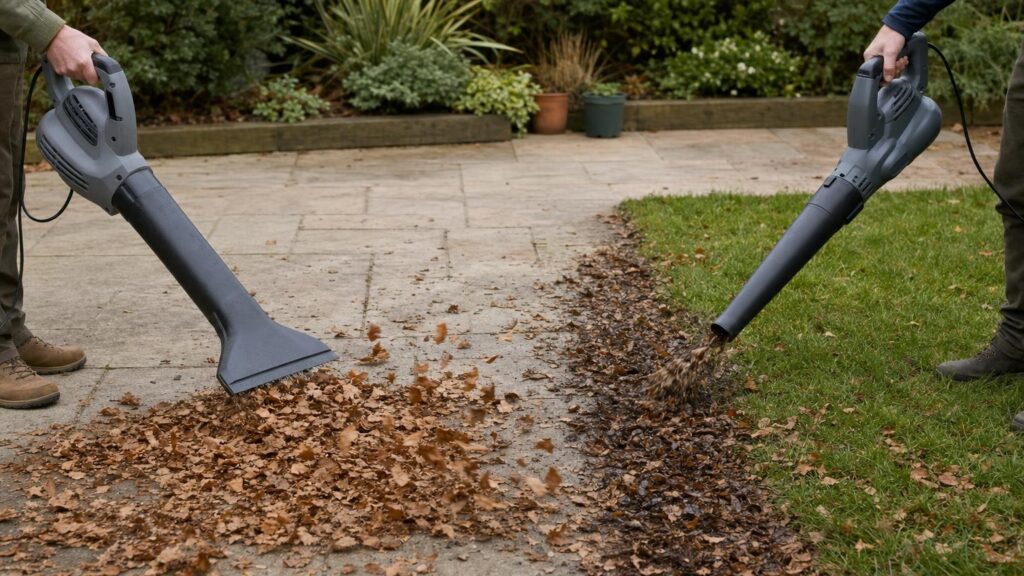
Leaf blower specifications often encourage a simple comparison: find the model with the largest number and assume it will clear debris most effectively. The problem is that airflow and airspeed describe different aspects of performance. Nozzle shape then changes how that air reaches the ground, while power delivery, battery behaviour and handling determine how useful the output is over an entire job.
A blower that produces a fast, narrow jet may be effective at disturbing material caught in a corner but slower when sweeping a wide area. Another may move a larger volume of air across a broad path yet feel less forceful against damp or compacted debris. To compare electric leaf blowers properly, shoppers need to read the air system as a whole rather than treating one headline figure as a performance score.
Airflow and Airspeed Measure Different Things
Airflow describes the volume of air moved over a given period. It may be stated in cubic feet per minute (CFM) or cubic metres per minute (m³/min). A higher volume can help a blower influence more material at once, particularly when the air stream remains broad enough to cover a useful area.
Airspeed describes how quickly the air is travelling. Common units include miles per hour (MPH) and kilometres per hour (km/h). It says something about the velocity of the air leaving the tube or nozzle, but not how much air is being moved at that speed.
These measurements are not interchangeable. A CFM figure cannot be compared directly with an MPH figure, and figures expressed in different units should first be converted to the same unit. Even after conversion, comparisons are most meaningful when manufacturers have measured performance in similar ways. A value measured at a narrow nozzle outlet may not describe the same operating arrangement as one measured elsewhere in the air path.
Neither measurement alone represents total clearing ability. Very high velocity through a small outlet can produce a focused jet without moving a particularly large volume of air. High airflow at a lower velocity may provide excellent coverage but less concentrated disturbance. Practical performance comes from the relationship between both.
Coverage Versus Concentrated Force
Airflow is especially relevant when the task involves sweeping a broad layer of loose material. Dry leaves, light clippings and dust on a hard surface may not require an exceptionally fast jet. Moving a generous volume of air over a wide path can gather them efficiently while reducing the need to trace every small patch with the nozzle.
Airspeed becomes more important when debris needs to be disturbed before it can be moved. Leaves pressed into grass, material collected along an edge or slightly damp debris may respond better to a concentrated, faster stream. Even then, velocity is only part of the answer: once the material has been loosened, sufficient airflow helps carry it towards the intended pile or boundary.
Most gardens and outdoor spaces contain a mixture of these jobs. This is why a balanced specification can be more useful than the maximum possible result in either column. Adjustable output is also valuable. It allows a user to apply a gentler stream around gravel, mulch or delicate planting, then increase output where debris is harder to shift.
How Nozzle Shape Changes the Air You Can Use
The nozzle is not merely an accessory. It shapes the stream and affects how the blower feels in use. Different outlets trade width for concentration:
- Round nozzles generally create a defined stream that can be directed accurately. They suit general clearing and reaching into corners, although the exact result depends on the outlet diameter and taper.
- Tapered nozzles narrow towards the outlet, concentrating the air into a smaller area. This can raise outlet velocity and make the stream feel more forceful, but it may reduce the width covered in each pass.
- Flat nozzles spread the air into a thin, controlled band. They can be useful for sweeping along hard surfaces or working beneath low obstacles.
- Wide outlets favour coverage, helping move loose debris across a larger path. Their broader stream may feel less concentrated against stubborn material.
Nozzle choice can therefore alter the apparent performance of the same blower. A narrow attachment may produce an impressive airspeed figure because it accelerates air through a restricted opening. That does not mean the blower’s motor and fan are generating more underlying airflow. The attachment is changing the delivery of the available air.
When comparing specifications, check whether the quoted values apply to a particular nozzle. Also consider whether useful attachments are supplied, available separately or easy to change. A blower with multiple practical nozzle options may adapt to more tasks than one optimised around a single extreme measurement.
Motor Output, Fan Design and Efficiency
Electric blowers create airflow through a system consisting of a motor, fan or impeller, intake, internal air path, tube and outlet. Each part affects the final result. The motor must drive the fan under load, while the fan geometry and housing influence how effectively that rotation moves air. Restrictions, bends and turbulence in the air path can also affect what reaches the nozzle.
This is why motor type, electrical input or headline wattage cannot establish nozzle performance on its own. Input power describes energy supplied to the system, not the amount of useful air delivered at the outlet. Two tools with similar electrical ratings may convert and direct that power differently. Likewise, a more powerful motor does not automatically guarantee better practical performance if the air path or fan design is poorly matched.
Electronic control matters too. It governs speed settings, response and protection against excessive electrical or thermal loads. The most informative comparison combines stated airflow and airspeed with nozzle configuration, operating mode and independent indications of handling, rather than using motor terminology as a shortcut.
Peak Figures Versus Sustained Performance
Maximum output is often achieved in a boost or turbo mode. This can be useful for briefly releasing a stubborn patch, but it may not represent the setting a user will want to maintain throughout a larger task. High output increases energy demand and can also generate more noise, reaction force and fatigue.
Look for clarity about the mode used for published specifications. If a maximum figure applies only during boost operation, it should not be treated as the blower’s normal continuous output. Consider whether boost must be held manually, whether it is time-limited and how easily the tool moves between settings.
Variable control can be more valuable than an unnecessarily high maximum. Lower output may be sufficient for dry leaves on paving, and it gives the operator better control around loose stones or prepared piles. Stepped modes offer predictable settings, while a variable trigger can provide finer adjustment. Cruise control or a trigger lock may reduce the effort of maintaining a suitable setting over time.
Sustained performance also depends on heat management and the power source. A tool may reduce output or stop if operating conditions exceed its protective limits. Without comparable test conditions, shoppers should be cautious about assuming that two peak specifications describe equal performance across a full task.
Battery Performance in Real Use
For cordless blowers, voltage and battery capacity are relevant but should not be read as complete performance measures. Voltage relates to the electrical system, while capacity indicates stored charge. Runtime then depends on the battery, the tool’s power demand, the selected setting, operating conditions and battery condition.
A larger-capacity battery can support longer use, but it normally adds size and weight. That added mass may sit near the handle or at the rear of the tool, changing its balance. A smaller battery can make the blower easier to direct but may require more frequent charging or battery changes. The right compromise depends on task length and whether uninterrupted operation matters.
Battery comparison should include practical ownership questions:
- Is the quoted weight for the bare tool or for a ready-to-use blower with battery and nozzle?
- Are the battery and charger included, or is the product sold as a bare tool?
- Which battery capacities are approved for the tool, and how do they affect weight and balance?
- Is the battery compatible with other tools the shopper already owns?
- How long does charging take with the included or intended charger?
- Would one larger battery or two smaller batteries better suit the planned work pattern?
A shared battery system can reduce duplicated purchases for someone already committed to a compatible tool family. However, platform compatibility should be confirmed precisely rather than assumed from brand name alone. Battery voltage families, connectors and tool requirements can differ.
Balance, Controls and the Effort of Directing Air
Weight on a specification sheet does not reveal how heavy a blower will feel after repeated sweeping movements. Centre of gravity is equally important. A well-balanced tool keeps mass close to the hand and reduces the leverage created by a long, front-heavy tube. A lighter but poorly balanced blower can be more tiring than a slightly heavier model that sits naturally in the working position.
Handle angle, grip size and control placement affect comfort and precision. A trigger that requires constant pressure can contribute to fatigue, especially when high output must be maintained. Cruise control can help, provided it is easy to release and does not make adjustment awkward.
Tube length also deserves attention. The outlet should reach an effective working height without forcing the user to bend or hold the tool at an uncomfortable angle. A tube that is too long may feel cumbersome in tight areas, while one that is too short can make it difficult to keep the air stream close to the ground. Adjustable or interchangeable tubes can help accommodate different tasks and users.
There is also a physical reaction when a strong air stream leaves the nozzle. Directing maximum output can demand more wrist and arm effort than the static weight suggests. For this reason, handling at realistic operating power is more informative than lifting an unpowered display model.
Match the Specification Mix to the Work
Begin with the surfaces and debris you expect to encounter, then look for the combination of characteristics that serves them:
- Dry leaves on patios and paths: broad, controllable airflow and a lower setting can matter more than extreme velocity. A flat or wider nozzle may make sweeping passes efficient.
- Larger lawn areas: useful air volume, comfortable balance and sustainable battery operation become important. Consider how many passes and battery changes the area may require.
- Corners, borders and confined spaces: a defined stream, manageable tube and good low-speed control help direct debris without scattering nearby material.
- Leaves caught in grass or heavier debris: stronger velocity and a tapered nozzle can help disturb the material, while sufficient airflow remains necessary to move it once released.
- Mixed or occasionally damp material: prioritise balanced airflow and airspeed, accessible boost control and a realistic plan for battery consumption. A blower will not necessarily handle saturated or heavily compacted debris simply because one maximum number is high.
When comparing models, record airflow and airspeed separately and note the units, nozzle and operating mode associated with each figure. Then add ready-to-use weight, control type, tube design, included equipment and battery arrangements. This creates a practical comparison rather than a ranking based on whichever number happens to look largest.
Conclusion: Read the Air System, Not Just the Box
A leaf blower’s useful capability comes from the interaction of air volume, velocity, nozzle geometry, fan design, power delivery and ergonomics. Airflow helps describe coverage, airspeed helps describe concentration, and the nozzle determines how those qualities are presented at the work surface. None is a complete performance score on its own.
Before choosing, check whether published figures use comparable units and operating modes. Identify the nozzle used, distinguish peak boost output from sustainable operation, and assess battery weight, charging arrangements and compatibility. Finally, consider balance, controls and tube length, because output only helps when it can be directed comfortably and consistently. Reading the entire air system provides a much clearer guide than chasing the biggest number on the box.
Continue exploring on Frowse
Discover More Frowse Insights
- Why Mechanical Pencil Leads of the Same Diameter Perform Differently
- End Grain, Edge Grain and Face Grain Cutting Boards Explained
- Why Identical-Looking Concealed Cabinet Hinges May Not Be Interchangeable
- Drive Size, Socket Size and Point Count: Understanding Socket Compatibility
- Fixed-Speed vs Inverter Air Conditioners: What Compressor Modulation Really Changes