




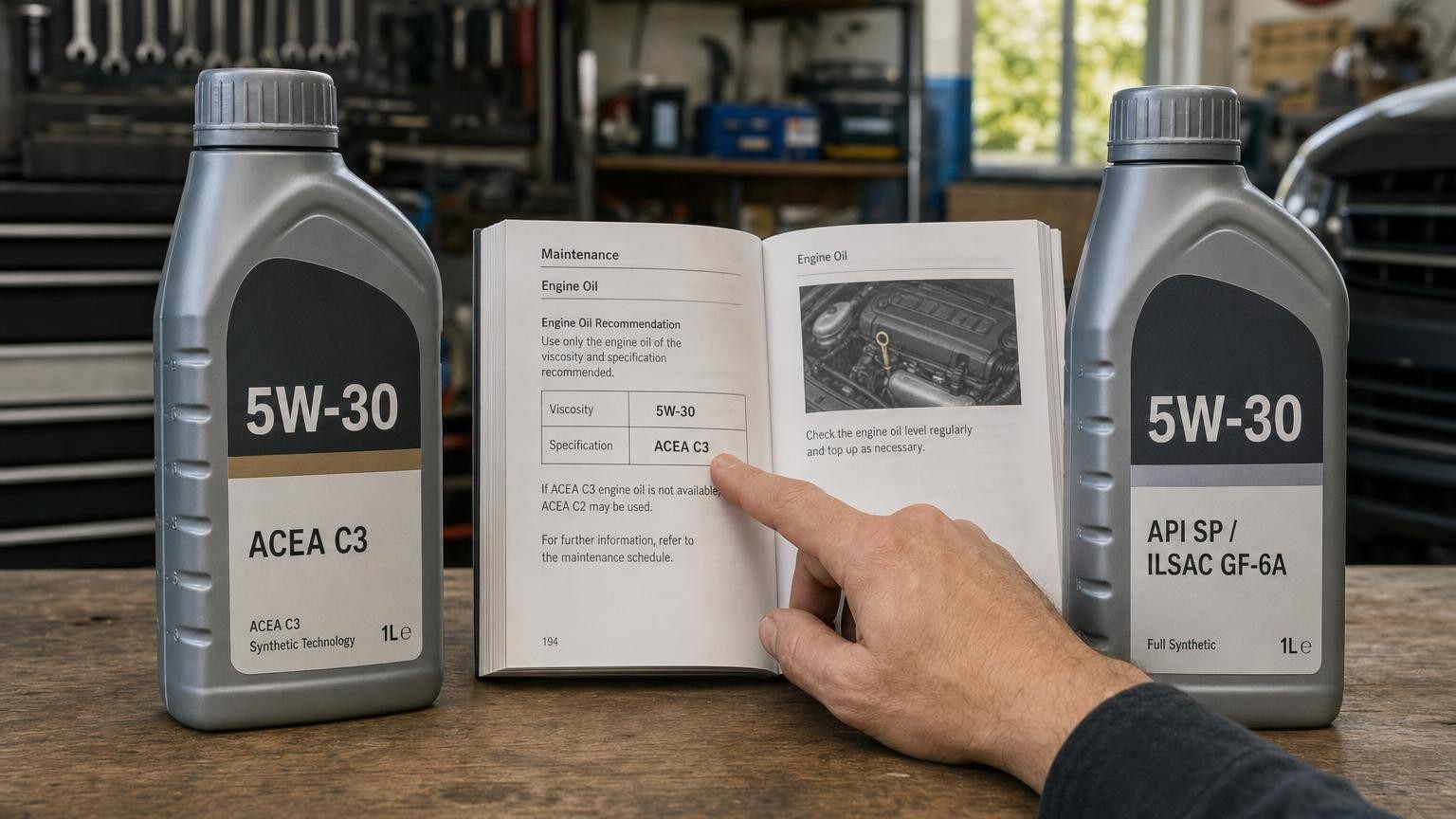
Engine-oil labels make viscosity prominent, so it is easy to assume that any two bottles marked 5W-30 will do the same job. They may have broadly similar viscosity behaviour under standard tests, but that does not make them interchangeable.
Behind the large 5W-30 print are performance classifications, manufacturer specifications and different additive systems. These affect how an oil handles deposits, wear, oxidation, fuel-economy requirements and emissions-control equipment. The correct choice therefore comes from matching the complete requirement in the vehicle handbook, not simply finding the same viscosity grade.
What 5W-30 actually tells you
5W-30 is an SAE viscosity grade. The number before the W describes the oil’s low-temperature performance within defined laboratory limits. A 5W oil is intended to remain pumpable and allow suitable engine cranking at lower temperatures than oils carrying some higher winter grades. The W refers to winter, not weight.
The second number describes viscosity behaviour at normal high test temperatures. A 30-grade oil must fall within the relevant viscosity range for that grade. This helps indicate how thick the oil remains once the engine is warm.
These ratings matter because oil must circulate promptly during a cold start while maintaining an adequate lubricating film when hot. However, an SAE grade does not tell you:
- Which detergents, dispersants or anti-wear additives are used
- How the oil performs in a particular engine test
- Whether it meets a fuel-economy specification
- Whether it is suitable for a particulate filter or catalyst system
- Whether a vehicle manufacturer has approved it
- Whether it supports a particular service interval
Two 5W-30 oils can therefore occupy the same viscosity category while being formulated for substantially different engines and operating requirements.
The specifications that sit alongside viscosity
Industry classifications provide information that viscosity alone cannot. API, ILSAC and ACEA are separate performance frameworks, each with its own categories and test requirements. A shopper should read the letters and numbers following these names, rather than treating the organisations’ logos as general signs of quality.
API categories
API classifications are widely associated with North American requirements. Categories beginning with S generally relate to petrol engines, while C categories generally relate to diesel engines. The exact category matters because each generation has its own performance criteria.
A later category may often cover earlier requirements within a defined sequence, but it is unwise to assume that every newer API-labelled product is suitable for every older engine. The handbook may specify another framework, a manufacturer approval or a formulation characteristic that the API mark alone does not establish.
ILSAC specifications
ILSAC standards are primarily aimed at petrol-engine oils and place emphasis on areas including fuel economy, emissions-system compatibility and engine protection. They are commonly encountered on oils for vehicles designed around North American and Asian-market requirements.
An oil carrying an ILSAC specification is not automatically a substitute for every European 5W-30. The European vehicle may require an ACEA category or a manufacturer approval involving a different balance of viscosity and additive performance.
ACEA oil sequences
ACEA classifications are prominent in European vehicle requirements. The A/B families cover certain petrol and light-duty diesel applications, while C categories address engines requiring compatibility with particular exhaust after-treatment systems. Categories within a family are not simply ranked from worst to best. They represent different performance profiles.
This is why shoppers should compare the complete notation on the bottle or technical data sheet. “API approved”, “meets an ACEA category” and “suitable for an ILSAC requirement” do not all mean the same thing, even when the products share a viscosity grade.
Why manufacturer approvals can be decisive
Vehicle manufacturers often publish their own oil specifications. These may supplement an industry category or define additional requirements based on particular engine designs, service intervals and emissions systems.
If the handbook names a manufacturer specification, look for that exact identifier. A label stating that the oil formally holds the required approval provides a different level of assurance from phrases such as “recommended for”, “suitable for use where” or “meets the performance requirements of”. Such wording may reflect a formulation claim by the oil supplier rather than a current approval granted by the vehicle maker.
This distinction does not automatically make an unapproved oil poor quality. It means the shopper should not confuse general suitability wording with documented approval when the handbook expressly requires an approved lubricant. If the bottle is unclear, consult the producer’s current technical documentation rather than relying on a marketplace title or an image of old packaging.
How additive packages change an oil’s job
Base oil provides the foundation, but a finished engine oil also contains a carefully balanced additive package. Its ingredients may perform several different jobs:
- Detergents help control deposits and neutralise acidic by-products.
- Dispersants help keep contaminants suspended so they are less likely to collect as sludge.
- Anti-wear agents support protection where lubricating films are heavily loaded.
- Antioxidants slow degradation caused by heat and oxygen.
- Friction modifiers can help an oil meet particular efficiency or friction requirements.
- Viscosity-index improvers help a multigrade oil maintain the required viscosity behaviour across a broad temperature range.
Formulators choose combinations and concentrations to pass specific tests. More of an additive is not necessarily better. One ingredient may help satisfy a wear requirement but need to be limited for compatibility with an emissions system. Different additives can also interact, so a finished formulation should be judged against the required specification rather than by the length of its marketing claims.
Emissions systems and low-SAPS formulations
SAPS refers to sulphated ash, phosphorus and sulphur. These characteristics matter because lubricant-derived material can affect exhaust after-treatment equipment over time. Certain diesel particulate filters, petrol particulate filters and catalytic systems are designed to operate with oils meeting specified chemical limits.
ACEA C-category oils are associated with after-treatment compatibility, but the individual C categories are not identical. They can differ in viscosity-related and chemical requirements. Choosing any bottle carrying a C designation is therefore not enough; the precise category and any manufacturer approval still need to match the handbook.
Likewise, an oil described as premium, high-performance or fully synthetic may be unsuitable if its formulation does not meet the engine’s required emissions-system specification. Conversely, it is not sensible to choose a low-SAPS oil merely because it sounds cleaner. An engine should receive the formulation type for which it was designed and approved.
Synthetic, semi-synthetic and fully synthetic are incomplete labels
Synthetic terminology can provide a broad indication of how an oil is positioned and of the base stocks used in its formulation. Synthetic base oils may offer useful properties for areas such as low-temperature flow, volatility and resistance to oxidation. The finished oil’s performance, however, depends on both its base oils and its additive system.
Terms such as synthetic blend, semi-synthetic and fully synthetic can also be defined or used differently across markets. They do not, by themselves, establish compatibility with a vehicle. A fully synthetic 5W-30 intended for one family of petrol engines may be less appropriate for a particular diesel engine than another product carrying the exact approval that diesel requires.
Treat synthetic wording as supporting information, not the primary selection rule. It cannot override the handbook’s viscosity, performance category or manufacturer specification.
A handbook-first method for comparing two 5W-30 oils
A systematic comparison prevents the prominent claims on the front label from obscuring the details that matter.
- Identify the exact vehicle and engine. Model names can cover multiple petrol, diesel and hybrid powertrains. Requirements may also vary by model year or sales market.
- Find the oil section in the handbook. Record the required SAE grade, industry classification and manufacturer specification. Check whether the handbook says an approval is required or merely offers it as one option.
- Read any conditions attached to alternatives. A manufacturer may permit other viscosity grades for particular ambient temperatures or operating conditions. Do not assume that an alternative shown for one engine applies to another.
- Check the product’s back label. Look for the full API, ILSAC or ACEA category and the exact manufacturer specification, not just “5W-30” and “synthetic”.
- Verify ambiguous wording. Use the oil producer’s current technical data sheet or approval information when the packaging does not clearly distinguish formal approvals from suitability claims.
- Match every mandatory element. If one oil matches the viscosity but not the required specification, it is not an equivalent choice simply because its brand, price or marketing appears more impressive.
For vehicles without an accessible handbook, manufacturer service information or a qualified service provider is a better source than a generic online compatibility claim. Registration-based selectors can be useful starting points, but the engine variant and stated specification should still be verified.
Common substitution mistakes to avoid
Choosing by viscosity alone
This is the central error. Matching 5W-30 establishes only a viscosity category. It does not demonstrate equivalent wear protection, deposit control, fuel-economy performance or emissions compatibility.
Assuming a newer specification always replaces an older one
Some standards include defined backward compatibility, but this should not be extended to unrelated specifications or manufacturer approvals. Check what the handbook permits and what the newer oil explicitly claims.
Treating petrol and diesel requirements as identical
Some oils cover both types of engine, while others are designed around more specific needs. Fuel type alone is not enough either – two diesel engines may require different oils because of their design or after-treatment systems.
Confusing recommendation with approval
“Recommended for” can look reassuring on a label, but it may not mean the vehicle manufacturer has tested and approved that product. Where a formal approval is required, look for explicit evidence of it.
Mixing oils without checking the guidance
Commercial engine oils are commonly designed to be miscible, but miscibility does not make two products equivalent or guarantee that the mixture retains every claimed approval. For routine servicing, use the specified oil. If a top-up is necessary, follow the handbook’s instructions on permitted grades and specifications, then seek appropriate servicing advice if the correct product was unavailable.
Match the full requirement, not just the large print
5W-30 tells you something important about an oil’s viscosity, but it does not describe the complete lubricant. API, ILSAC and ACEA categories, manufacturer approvals, additive chemistry and emissions-system requirements all help determine where a product belongs.
The most reliable shopping method is therefore straightforward: identify the exact engine, read its handbook, note every required specification and verify those details against current product documentation. Branding, price and synthetic claims can help distinguish products only after compatibility has been established. When two 5W-30 oils carry different specifications, the difference is not merely label decoration – it may determine whether the oil is suitable for the engine at all.
Continue exploring on Frowse
Best Sellers · Top Rated · Fresh Finds · Under £50
Explore products on Amazon
Looking for products related to this guide? to enter your own search term.
Discover More Frowse Insights
- Lumens, Candela and Beam Distance: How to Read Flashlight Specifications
- Fan-Assisted, Convection and True Convection Ovens Explained
- What Makes a Spirit Level Accurate?
- Why a Replacement Door Handle Must Match More Than the Existing Screw Holes
- How Waterproof Mattress Protectors Balance Liquid Blocking, Breathability and Noise