




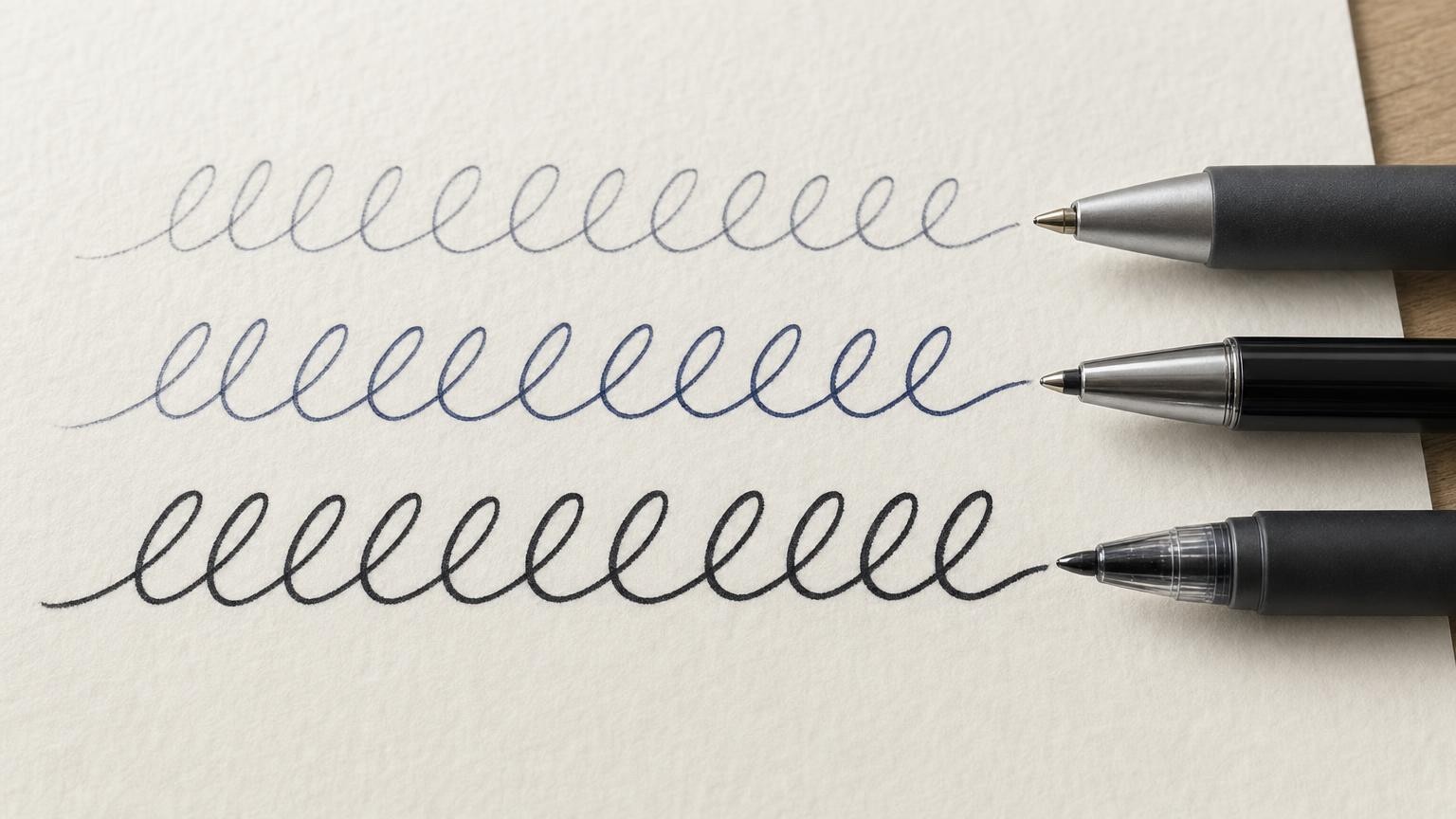
Ballpoint, rollerball and gel pens belong to the same broad family: each normally uses a small rotating ball to carry ink from a reservoir onto the page. Yet they can feel remarkably different. One may require firm pressure and produce a restrained line, while another glides with a light touch or lays down dense, vivid colour.
The main reason is not the ball alone. Ink viscosity, the amount of ink delivered, socket design and the way the pen is sealed all influence smoothness, control, drying and reliability. Understanding those differences is more useful than assuming one category is always better.
What happens inside a ball-and-socket tip
At the writing end of each pen is a tiny ball held in a socket. Part of the ball faces the ink supply and part touches the paper. As the pen moves, the ball rotates, picks up ink from inside the tip and transfers it to the writing surface. The socket retains the ball while controlling the space through which ink can pass.
This simple mechanism has to balance several competing requirements. The ball must rotate freely enough to write smoothly, but the fit must also restrict excessive ink flow and leakage. Ink needs to reach the ball consistently without flooding the page. The tip must also cope with changes in direction, writing speed and angle.
Several design details affect the result:
- Ball size: A larger ball generally has the potential to create a broader line, although the ink and paper also affect the line that appears.
- Socket fit: The clearance around the ball helps regulate flow. A very controlled supply may feel less fluid, while generous flow can increase drying time and pooling.
- Ink viscosity: Thick ink resists movement more than fluid ink, changing both writing pressure and delivery.
- Writing angle: A pen may skip if held at an angle that prevents the ball from making effective contact or rotating as intended.
- Paper surface: Rough fibres can interrupt a fine tip, while absorbent paper can pull more fluid ink away from the ball.
Skipping does not always mean a pen is empty. Dried ink at the tip, an unsuitable angle, an uneven paper surface or a momentary interruption in the ink supply can all produce gaps. Conversely, a pen that releases more ink than the paper can absorb may leave dark spots or small pools when the tip pauses.
Ink is the main distinction
The familiar category names largely describe different approaches to ink formulation and delivery, although formulations vary between manufacturers and individual product lines.
Ballpoint ink
Traditional ballpoints typically use a relatively thick, oil-based ink paste. Its higher viscosity helps the tip deliver a controlled amount and reduces the tendency of ink to run freely when the pen is not being used. This contributes to the category’s reputation for practical, long-lasting everyday writing.
The trade-off is resistance. The ball must move the thicker ink through the tip, so some ballpoints need more hand pressure than more fluid systems. Modern low-viscosity ballpoint formulations can feel smoother than conventional paste inks, which means the category label alone does not predict exactly how a pen will write.
Rollerball ink
Rollerballs usually use a more fluid, water-based ink. It reaches the paper readily and can create a smooth line with relatively little pressure. The result often feels closer to a liquid-ink writing instrument than to a traditional ballpoint.
That easy flow also creates practical considerations. More ink may reach the page, increasing the importance of drying time and paper quality. Because water can evaporate from the formulation, effective cap or tip sealing is particularly important.
Gel ink
Gel pens generally use a water-based gel that carries colourants, often including suspended pigments. The gel behaves differently under movement and pressure, allowing ink to flow through the tip during writing while remaining comparatively stable in the reservoir.
Gel can produce dense, opaque lines and supports a wide variety of colours and visual effects. Flow, drying and smoothness still vary substantially. A fine gel pen may feel precise, while a broad, ink-rich version may need more time to dry.
Writing pressure, smoothness and control
For long writing sessions, required pressure can matter as much as line appearance. A conventional ballpoint’s thicker ink may encourage a firmer grip or greater downward force. Some writers appreciate the resulting feedback because it makes the pen feel controlled, particularly on forms, labels or quick working notes. Others find that pressure tiring over extended use.
A rollerball normally needs a lighter touch because its fluid ink reaches the ball readily. This can make continuous handwriting feel effortless, but generous flow may feel less controlled to someone who writes slowly, presses heavily or forms very small letters. Excess pressure is rarely useful with a fluid pen and may simply put more ink onto the page.
Gel pens often occupy a middle ground. They can write with low pressure while producing a defined, saturated line. However, very fine gel tips may feel less forgiving on rough paper, and some formulations can hesitate if the pen is moved extremely quickly.
Smoothness is not always the same as suitability. A highly fluid pen may glide beautifully but be inconvenient on absorbent paper. A controlled ballpoint may provide more tactile feedback and cleaner handling even if it does not feel as effortless. Grip shape, pen weight and balance also affect comfort independently of the ink system.
Line consistency, colour and tip size
Fine, medium and broad labels are useful within a pen range, but they are not perfectly interchangeable across categories or manufacturers. A nominal tip measurement describes part of the mechanism, not necessarily the exact width of the dried line.
A ballpoint with controlled paste ink may put down a line that looks narrower than the line from a similarly labelled rollerball. Fluid ink can spread into paper fibres, making the rollerball line appear broader. Gel ink may stay relatively defined while looking visually bold because of its opacity and colour density.
Writing speed also changes the result. A slowly moving fluid tip has more opportunity to deposit ink, while rapid strokes may look lighter. Absorbent paper can widen lines and soften their edges; smoother, less absorbent paper can preserve sharper detail but may extend drying time.
For compact handwriting, planners and annotated documents, a fine, controlled line may matter most. For signatures, headings or highly visible notes, a broader and more saturated line may be preferable. Shoppers should therefore consider line samples on representative paper where possible rather than relying only on a tip-size label.
Drying, smudging and bleed-through
Drying behaviour depends on how much ink is deposited, how quickly liquid evaporates or absorbs, and how the paper is coated or sized. No pen category is universally smudge-proof or bleed-proof.
Traditional ballpoint paste usually transfers in a relatively restrained quantity and often presents fewer immediate smearing concerns. It can still leave small ink deposits around the tip, which may create occasional blobs or marks.
Rollerball ink tends to wet the paper more heavily. On suitable paper this produces a fluid, attractive line, but on porous sheets it may feather along fibres, show through strongly or bleed to the reverse. Gel ink can remain on the surface for a period before setting, particularly with broad tips, dense colours or slow handwriting.
These differences matter in several situations:
- Fast note-taking: A quick-drying, controlled line reduces the chance of one page marking another when a notebook is closed.
- Left-handed writing: Writers whose hand passes over fresh text may prefer faster-drying formulations or finer tips, although writing posture also affects smearing.
- Double-sided pages: Lower-flow pens and more substantial paper can reduce distracting show-through and bleed.
- Highlighting: Applying a highlighter before underlying ink has set may smear or redistribute it. Compatibility varies with both ink formulations.
- Low-quality paper: Fluid inks are more likely to expose feathering and absorption problems, so a conventional ballpoint may be the more predictable option.
Capped, retractable and tip-seal designs
A cap does more than protect a pen in a pocket. On rollerballs and many gel pens, it forms part of the ink-management system by limiting air exposure around the tip. A well-sealed cap helps reduce evaporation and dry starts after storage.
Retractable pens offer quick, one-handed access and remove the risk of losing a separate cap. Their mechanisms must protect the tip when retracted, however. Some use internal seals or shutters, while others rely on an ink formulation that tolerates limited exposure. A retractable design should not automatically be assumed to seal as tightly as a capped one.
Ballpoints often tolerate retractable construction well because their thicker ink is less prone to evaporation. Even so, retracting the tip helps prevent marks inside bags and pockets. Capped pens can provide robust tip protection, but only if the cap is replaced firmly.
The choice is therefore partly behavioural. A retractable pen suits frequent, short bursts of writing. A capped design may be preferable when tip sealing is a priority and the user reliably replaces the cap.
Storage and everyday ownership
Simple habits can improve reliability. Replace caps fully, retract exposed tips and avoid leaving pens in sustained heat or direct sunlight. Heat can change ink behaviour and increase the chance of leakage, while an uncapped fluid-ink pen may dry around the ball and socket.
There is no single correct storage orientation for every pen. Some fluid systems may benefit from being stored horizontally, while certain designs have specific manufacturer instructions. Tip-down storage can help ink remain near the writing point but may encourage pooling in some pens; tip-up storage can reduce leakage risk but may contribute to a temporary dry start. Follow the guidance supplied for the particular pen or refill where available.
Air travel, pressure changes and temperature changes can also challenge liquid-ink systems. Keeping pens capped or retracted and protected inside a case is more sensible than leaving exposed tips against clothing or documents.
Refills: shape matters as much as ink type
A refill labelled ballpoint, rollerball or gel is not automatically compatible with every pen body in that category. The refill is a physical component of the mechanism, so length, diameter and tip geometry all matter. Spring stops, shoulders, rear plugs and retractable actuation points must align correctly.
Even refills that look similar can differ enough to sit too deeply, protrude too far or fail to retract. In capped pens, an alternative tip shape may also interact differently with the inner cap seal. Shoppers should check the exact refill specification or the pen manufacturer’s compatibility information rather than relying on a broad ink label.
Where a pen officially accepts multiple refill types, changing the refill can alter more than colour. A different ink system may change writing pressure, line width, drying time and paper performance. This flexibility can be valuable, but it should be treated as a change to the writing experience rather than a simple replacement.
Refill availability is worth considering before choosing a pen intended for long-term use. A comfortable body is less useful if the correct refill format, preferred colour or suitable tip width is difficult to obtain.
Choosing by writing situation, not category reputation
Start with the surface and task rather than asking which pen type is best in the abstract. A traditional ballpoint is often a practical choice for controlled flow, mixed paper quality and low-maintenance everyday use. A rollerball suits writers who value fluid movement, strong lines and low-pressure writing, provided the paper and drying conditions are appropriate. A gel pen is attractive when opacity, precise colour or visual expression matters.
Then consider how quickly you write, whether your hand crosses fresh ink, whether pages will be used on both sides and how often the pen may sit unused. Decide whether capped reliability or retractable convenience matters more, and confirm the exact refill format before buying a refillable body.
The category name provides a useful starting point, but the final experience comes from the entire system: ball, socket, ink, seal, refill and paper. Matching those elements to the way you actually write is the most reliable route to a pen that feels good and behaves well in everyday use.
Continue exploring on Frowse
Discover More Frowse Insights
- Where a Vacuum Flask Actually Loses Heat
- Why Identical-Looking USB-C Cables Can Perform Completely Different Jobs
- Clumping Clay, Silica and Plant Fibre: How Cat-Litter Materials Behave Differently
- The Roof-Rack Fit Problem: Rails, Fixing Points and Clamp Systems Explained
- Why More Ceiling-Fan Blades Do Not Automatically Mean More Airflow