




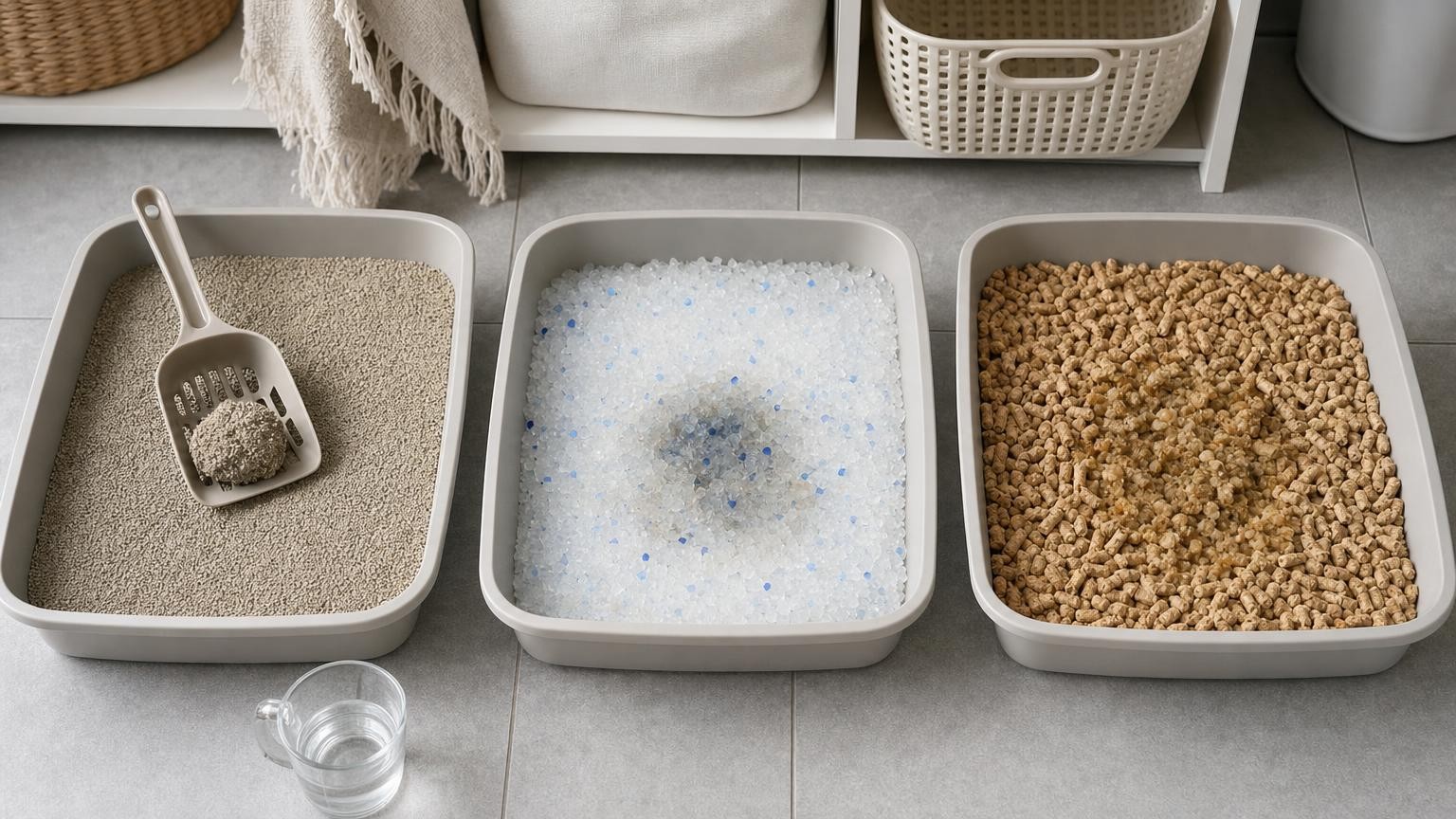
Cat-litter materials do not all manage liquid and odour in the same way. Clumping clay binds wet particles into a removable mass, silica stores moisture within porous granules, while plant-based litter may absorb, clump or break down depending on its fibres and formulation. These differences affect how often the tray needs attention, how much clean litter is discarded and how much material travels beyond the tray.
No single material is automatically best. The more useful question is which behaviour suits your cat, tray, scoop and cleaning routine. Looking beyond broad labels such as “clay”, “crystal” or “natural” helps reveal the practical trade-offs.
Why litter material changes everyday performance
A litter tray has several jobs. It must receive liquid, limit wet residue, retain odour compounds and allow waste to be removed without emptying large amounts of usable litter. The base material influences all of these tasks, but so do granule size, added binders, tray depth and maintenance.
Clumping clay usually prioritises precise removal: wet material binds together so it can be lifted out. Silica litter generally takes a storage approach, retaining moisture within porous particles until the litter becomes saturated. Plant fibre is more varied. Some products form scoopable clumps, while others absorb liquid and soften, crumble or turn to sawdust-like material.
That means a shopper comparing litter needs to consider the expected routine, not merely the material name. A product that works well when stirred may seem ineffective if treated like clumping clay. A strong-clumping formula may still stick to the tray if the layer is too shallow.
Absorption, adsorption and clumping: the mechanisms that matter
Three related processes are often grouped together, but they lead to different results.
- Absorption occurs when liquid enters a material, much as water enters a sponge. Porous fibres and granules can hold moisture internally.
- Adsorption occurs when molecules adhere to a material’s surface. A highly porous material has extensive internal and external surface area, which can help retain some moisture and odour compounds.
- Clumping occurs when wetted particles bind into a mass that can be removed with a scoop. Absorption may contribute, but the defining feature is the formation of a coherent clump.
These mechanisms determine what remains after cleaning. A firm clump can remove much of the wetted litter in one piece. Non-clumping absorbent litter retains moisture throughout individual particles, so routine maintenance may involve mixing the litter and replacing it when its capacity is used. A weakly clumping fibre litter may remove the wettest section but leave small fragments behind.
Odour performance is linked to moisture handling but is not identical to it. Removing a clump takes the source out of the tray. A non-clumping material instead needs to retain moisture and odour until replacement. Added fragrance may change what a person smells, but it is separate from capturing or removing the source.
Clumping clay: fast binding and firm removal
Clumping clay contains moisture-responsive mineral particles that swell and adhere when wet. The surrounding grains join into a clump, allowing the affected portion to be separated from dry litter. This can make daily spot cleaning precise and helps preserve unaffected material.
Clump quality depends on more than the word “clumping”. Fine particles can pack closely and create a cohesive mass, while coarser blends may leave more gaps. Formulas can also differ in how rapidly they set and how well they remain intact when lifted. Scooping too soon may break a soft clump, whereas leaving it against the tray base can make removal more difficult.
Fill depth matters because liquid needs enough litter beneath it to bind before reaching the tray. In a shallow layer, a clump may spread across or adhere to the base. Maintaining a suitable depth can improve removal, although it also makes the filled tray heavier.
Weight is a notable practical trade-off. Mineral litter can be substantial both in its unopened bag and inside the tray. Fine grains may also lodge between paws and travel onto nearby floors. Dust varies by processing, particle size and handling, so the base material alone does not predict how much will appear when pouring or scooping.
Silica litter: porous granules and moisture management
Silica litter is commonly sold as translucent or opaque granules, sometimes described as crystals. Its porous structure takes up and retains moisture rather than forming conventional clay-like clumps. Solid waste is removed, while urine moisture is distributed through and held by the litter.
This creates a different routine. Many non-clumping silica formats benefit from regular stirring so that moisture is not concentrated in one area. Stirring exposes less-used granules and can reduce the chance of a persistently damp patch. The specific packaging directions matter because not every silica formulation is maintained identically, and some products use silica within a clumping blend.
As the material approaches saturation, its ability to manage additional liquid and odour declines. Changes in texture, dampness or appearance can indicate that replacement is due, but these signs differ by formulation. Waiting until performance has noticeably deteriorated may leave moisture concentrated at the tray base.
Silica granules can feel and behave very differently from fine clay. Larger pieces may be less likely to spread as fine grit, but individual granules can still be kicked from the tray or carried away. Coarse particles also require a scoop whose slots retain solid waste while allowing usable litter to fall through.
Plant fibre: absorbent structures with varied formulations
Plant-fibre litter is a broad category that can include wood, paper, cereal-derived material and other botanical fibres. These should not be treated as interchangeable. Their source material, processing and physical format can produce very different results.
Fibres naturally take up liquid within their structure. In non-clumping pellets, wet material may swell and break down into smaller particles. Some systems are designed around separating this broken-down material from intact pellets. Paper-based products may remain as softened pellets or absorbent pieces rather than creating a firm scoopable mass.
Clumping plant litters usually rely on the behaviour of milled fibres, starches or other binders to make wetted particles adhere. Their clumps can range from firm and compact to soft and crumbly. A label describing a litter as plant-based therefore says little about its scoopability unless the format and clumping method are also clear.
Plant-fibre litter is often lighter to lift than dense mineral litter, but low weight can have another consequence: loose, small particles may be more easily kicked or carried from the tray. Pellets may reduce fine-grain scatter, yet pieces that break down can create their own surrounding debris. Storage needs also vary because a light product may occupy a relatively bulky bag.
Particle size and shape: the hidden performance variables
Granule format can matter as much as the headline ingredient. Fine grains, coarse crystals and compressed pellets interact differently with paws, scoops and liquids.
Fine grains
Fine particles provide extensive surface contact and can pack closely, which may support quick, cohesive clumping. They also pass readily through scoop slots, helping dry litter return to the tray. The trade-off is that small particles can cling to paws, settle into floor edges and produce visible dust when disturbed.
Coarse granules
Coarser particles may be less likely to behave like sand outside the tray. However, they can still scatter when a cat digs, and their texture is noticeably different underfoot. Larger spaces between granules may affect how liquid spreads before being taken up.
Pellets
Pellets are usually easier to see and collect when they leave the tray. Their size may reduce the amount lodged between paws, although light pellets can still be kicked out. Intact pellets require a scoop or sifting system with appropriately sized openings. If they disintegrate when wet, the routine may involve removing fine spent material rather than lifting a clump.
Comparing scoopability, tracking, dust and odour control
A practical comparison should focus on behaviour rather than rank the materials universally.
- Scoopability: Clumping clay generally aims for firm, precise removal. Clumping plant formulas can offer a similar routine, but cohesion varies. Conventional silica and non-clumping plant pellets require a different method, with solids removed and absorbent material stirred, sifted or replaced.
- Tracking: Fine clay and fine plant particles can travel easily on paws. Larger silica granules and pellets may reduce fine-grit tracking but can still scatter. Tray entry design and the surrounding mat also affect what reaches the floor.
- Dust: Small particles and broken material tend to create more visible dust than intact, larger pieces. Manufacturing and bag handling matter, so claims should be considered at formulation level rather than assumed from the ingredient alone.
- Odour handling: Clumping litter removes the wet source when the clump is scooped. Silica retains moisture and associated odour compounds until it nears saturation. Plant formats may remove, retain or separate wet material depending on whether they clump or break down.
Household conditions can change the outcome. More frequent tray use consumes capacity faster, while humid surroundings can affect how dry a tray seems. Weak clumps, saturated granules or spent fibres can all leave residue, so declining performance may indicate that maintenance or replacement is overdue rather than that the entire material family is unsuitable.
Tray setup and maintenance can change the result
The correct litter can perform poorly in mismatched equipment. Scoop slots that are too narrow for pellets will retain clean material, while slots that are too wide may let small clump fragments fall back. High-sided trays can contain kicked litter, but tray shape may also create corners where wet material collects.
With clumping products, maintain enough depth for liquid to bind before it reaches the base, top up after removing clumps and lift carefully to reduce breakage. For non-clumping silica, remove solids promptly and stir if the manufacturer directs it. Pellet systems may require sifting spent particles rather than using a conventional scoop.
The number of cats and trays affects how quickly any litter reaches its practical limit. A routine that works in a lightly used tray may not suit a heavily used one. Regular full changes and tray cleaning remain distinct from daily scooping, stirring or topping up, and should follow the product instructions and the condition of the tray.
Disposal, storage and total ownership trade-offs
Purchase price is only one ownership consideration. Dense clay may be compact to store but heavy to carry and discard. Lightweight fibre can be easier to lift yet take up more cupboard space. Silica may remain in the tray under a moisture-management routine, but the entire contents eventually require replacement.
Consumption depends on how much usable litter is lost during scooping, how often full changes are needed and how heavily the tray is used. A weak clump can increase waste because clean particles are removed with it. Conversely, leaving saturated non-clumping material too long can undermine moisture and odour handling.
Disposal terms require care. “Natural”, “plant-based” and “biodegradable” do not automatically mean a used litter is accepted in household compost, garden waste or wastewater systems. Flushability should never be inferred from the base material. Check the packaging directions and local waste rules, accounting for both the litter and the waste it contains.
Choosing by routine rather than by label
Start with the job you most want the litter to do. If firm clumps and precise daily removal are priorities, compare clump strength, grain size and recommended fill depth. If you prefer moisture to be retained within the tray between larger changes, examine silica formats and be prepared for stirring and saturation monitoring. If low bag weight or botanical material matters, establish whether a plant-fibre option clumps, remains as pellets or breaks down when wet.
Then consider the secondary trade-offs: particle tracking, visible dust, filled-tray weight, scoop compatibility, storage space and disposal requirements. A coarse pellet and a fine clumping botanical litter may have less in common with each other than two similarly sized products made from different base materials.
The most informative comparison therefore combines material, particle format and maintenance instructions. Choosing a litter whose physical behaviour fits your tray and routine is more reliable than expecting one broad material label to guarantee every aspect of performance.
Continue exploring on Frowse
Discover More Frowse Insights
- Why the Number on a Toaster Dial Usually Is Not Minutes
- What Changes Inside a Quartz Clock When the Second Hand Sweeps Instead of Ticks
- Why Bathroom Scales Give Different Readings on Different Floors
- How an Electric Kettle Knows When the Water Has Boiled
- Why Garden Hoses Lose Flow and Why Their Connectors Do Not Always Fit