





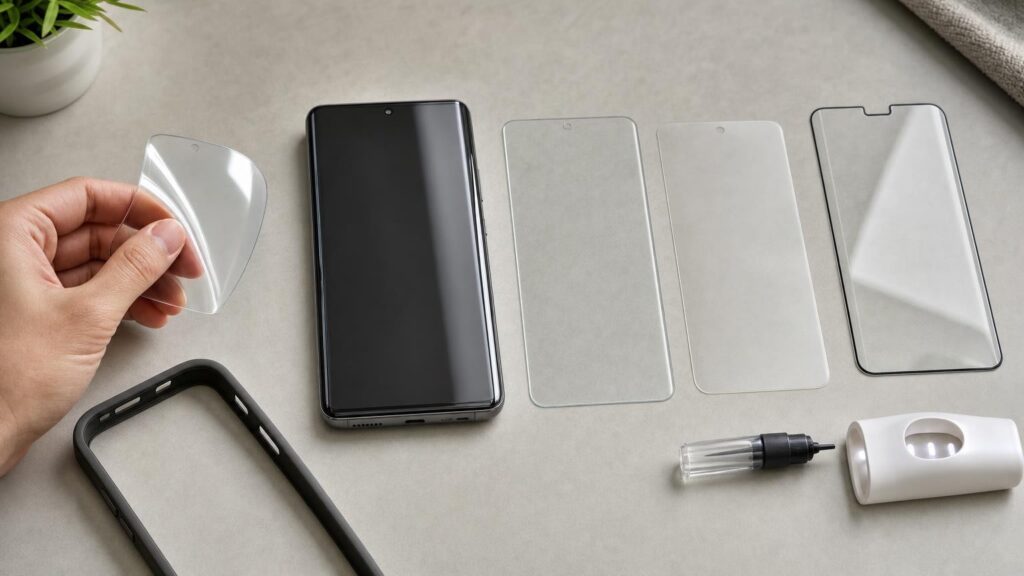
A screen protector is more than a scratch-resistant layer cut to the shape of a phone. Its material affects how it feels and bends, but adhesive placement, display curvature, case clearance and fingerprint-sensor design can matter just as much. Two protectors made from similar materials may therefore behave very differently once installed.
The most useful choice is not necessarily the protector with the boldest hardness claim or the widest advertised coverage. It is the one whose construction suits the phone and the way it will be used. Understanding the trade-offs can help you avoid lifting edges, unreliable fingerprint recognition, distracting optical effects and unnecessarily difficult installation.
Tempered glass, PET and TPU: What each construction changes
Tempered glass
Tempered glass protectors are rigid sheets made to sit over the display. Their smooth surface usually feels closer to the phone’s original glass than plastic film does, and their rigidity can make alignment easier on a flat screen. Glass also tends to resist everyday surface scratching better than softer films.
Rigidity has disadvantages. Glass cannot readily follow pronounced curves unless it has been formed for a particular display. Its edges can chip, and the protector may crack when stressed or struck. A cracked protector does not prove that it either saved or failed to save the display – the result depends on the force, angle, surface and phone construction.
Glass is normally thicker than basic film. That added thickness may make the protector’s edge more noticeable and can affect recessed buttons, raised case lips or under-display sensors. Rounded or bevelled protector edges can make swiping more comfortable, but they do not solve an underlying mismatch with a curved screen.
PET film
PET is a relatively thin, firm plastic film. It adds little bulk and is often suitable when maintaining a slim profile matters. Because it is thinner than glass, the edge can be less obvious, although the surface generally feels more like plastic and may show scratches or wear sooner.
PET film has some flexibility but does not stretch easily around complex curves. It is commonly better suited to flat display areas or designs that intentionally stop before a rounded perimeter. Installation can be less forgiving than expected because a thin sheet may attract dust, trap bubbles or become difficult to reposition without creasing or contaminating its adhesive.
TPU film
TPU is a softer and more flexible film. It can conform more readily to curved or rounded display areas, making it useful where rigid glass struggles to remain bonded. Its flexibility also means it is unlikely to crack like glass.
The trade-off is a different surface feel. TPU may have more drag under a finger, can show indentations or marks, and may not reproduce the hard, slick feel of the original display. Some films are designed so that light surface marks become less visible over time, but this should not be interpreted as protection against all scratches or damage.
No material makes a phone impact-proof. A protector mainly covers the exposed face of the display; it cannot control how impact travels through the frame, corners or internal structure.
What hardness labels do – and do not – tell you
Hardness figures are among the most prominent screen-protector claims, but they are easy to overvalue. A label such as 9H may refer to a pencil-hardness test rather than the mineral hardness scale shoppers sometimes assume. Without a clearly stated test method, the number offers limited help when comparing unrelated products.
Surface hardness concerns resistance to being marked by certain materials under particular conditions. It is not the same as toughness, flexibility or impact resistance. A hard sheet can still be brittle, while a softer film can flex without cracking but collect surface marks more readily.
Thickness and edge design matter too. A protector may resist central scratches yet remain vulnerable to chipping at an exposed edge. Similarly, a thicker protector is not automatically stronger in every situation. It may provide a more substantial barrier, but it can also sit higher above the screen and encounter more interference from a case.
Treat hardness as one specification, not a complete performance grade. Construction, adhesive quality, coverage and fit are usually more informative when judging suitability for a particular phone.
Adhesive systems: Full coverage, edge-only and liquid-applied designs
Full-adhesive protectors have adhesive across most or all of the viewing area. A well-fitted example can maintain consistent contact, reduce air gaps and support predictable touch response. Dust, uneven pressure or incorrect alignment can still create bubbles or patches that look different from the rest of the screen.
Edge-only adhesive is sometimes used on rigid protectors shaped for curved displays. The central area may sit over the screen without being fully bonded. This can simplify installation, but an air gap may affect appearance, produce a hollow tapping sound or reduce touch and sensor reliability. Visible dots or patterns may be incorporated to help the protector interact with the screen, and these can become noticeable under certain lighting.
Liquid-applied adhesive systems use a separate liquid between the display and protector rather than relying only on a factory-applied layer. Some systems require a curing stage. They can help a rigid protector bond across a shaped display, but they demand careful preparation, controlled adhesive distribution and exact alignment.
Liquid adhesive should not be confused with liquid products marketed as coatings. A coating does not create the same replaceable physical sheet as glass or film. For any liquid-applied system, follow the supplied instructions and protect openings such as speakers and buttons as directed. Excess adhesive, incomplete curing or difficult removal can turn installation into a more involved task than applying an ordinary self-adhesive protector.
Flat, curved and edge-to-edge coverage
A protector described as screen-area or case-friendly usually leaves a visible margin around the display. A full-cover design may extend over more of the front face, sometimes using a coloured border to blend with the phone. Edge-to-edge suggests extensive coverage, but the exact boundary varies by design. These terms are not reliable measurements on their own.
On a flat display, broad coverage is comparatively straightforward if the protector is cut accurately. Phones with rounded glass edges or displays that curve towards the frame create a harder problem. A flat protector may bridge the curve and leave an unbonded border. A shaped glass protector may fit better but require specialised adhesive. Flexible film can follow the contour more easily, though it changes the feel and offers less resistance to surface marking.
Maximum coverage is not always the most dependable choice. A slightly smaller protector can maintain better adhesion because it remains within the genuinely flat area. It may also leave necessary clearance for a case. Compare the protector’s actual outline, camera and speaker cut-outs, and stated coverage style rather than relying on an edge-to-edge label.
Cases, bezels and the risk of lifted edges
A phone case often has a raised lip that extends slightly over the front perimeter. If that lip presses against the protector, it can lift the adhesive at a corner or edge. Once a gap forms, dust may enter and the lifted area may gradually spread.
A case and protector can both be listed for the same phone yet still interfere with one another. Their combined tolerances matter: one protector may extend farther out than another, while one case may grip the front edge more tightly. Curved displays make this interaction especially sensitive.
If you intend to keep a particular case, a protector with a small, even perimeter gap may be more reliable than one promising the broadest possible coverage. Fit the protector centrally and check that the case does not push it sideways or compress its edges. Installing the protector before attaching the case can also make alignment easier.
Clarity, reflections and the feel of the screen
Clear protectors aim to preserve the display’s original appearance, but every additional layer can alter light transmission and reflection to some degree. Glass often looks crisp when fully bonded and clean. Film may introduce mild texture or haze, while poor contact can produce rainbow-like areas or uneven reflections. These effects depend on finish, adhesive design and installation quality as well as material.
Glossy surfaces usually retain a familiar screen appearance but show fingerprints and reflections readily. Matte or anti-glare finishes diffuse reflections and can make finger movement feel different, but diffusion may also soften fine detail or create a grainy appearance on bright backgrounds. Privacy filters intentionally restrict off-angle viewing and will affect brightness or viewing clarity as part of that function.
An oleophobic surface treatment can make oils easier to wipe away and improve glide, but such treatments wear with use. Marketing language alone does not indicate how long a particular finish will retain its feel. If smooth swiping is a priority, base material and surface finish deserve as much attention as scratch claims.
Fingerprint readers, touch sensitivity and other screen features
Under-display fingerprint readers are particularly sensitive to protector design. Optical readers use light to capture a fingerprint image through the display, while ultrasonic readers use sound-based sensing. Thickness, air gaps, opacity, adhesive coverage and surface contact can affect the two types differently.
A protector that works with one phone or sensor design is not automatically suitable for another. Edge-only adhesive and poorly bonded areas can be especially problematic because the sensing path is less consistent. Very thick or optically disruptive layers may also interfere, depending on the device.
Check the phone manufacturer’s guidance and any device-specific fitting instructions. After installation, it may help to register fingerprints again if the phone’s instructions recommend doing so. A touch-sensitivity setting can assist on some devices, but it cannot correct a protector that is fundamentally incompatible or badly fitted.
Also consider front cameras, proximity sensors, earpieces and stylus use. Cut-outs must align correctly, and a textured film may change how a stylus tip moves across the surface. Avoid assuming that general model compatibility guarantees ideal operation with every screen feature.
Installation quality can outweigh headline specifications
Even a suitable protector can perform poorly if dust, oil or trapped air prevents proper contact. Work in a clean, well-lit area and follow the supplied sequence. Clean and dry the screen thoroughly, use dust-removal tools if provided, and inspect from several angles before exposing the adhesive.
- Check alignment first: Use the phone’s edges, speaker opening and camera position as references.
- Avoid repeated lifting: Repositioning can introduce dust or weaken the adhesive, particularly with thin film.
- Do not force persistent bubbles: A bubble caused by dust will not behave like one containing only air.
- Allow for curing: Where a film or liquid adhesive requires settling or curing, follow the stated time and handling instructions.
- Inspect the perimeter: Confirm that every edge is bonded before fitting the case.
Removal and replacement also deserve consideration. Glass is often straightforward to lift when intact but requires care if cracked. Flexible film may stretch or leave residue. Liquid-applied systems can involve a more deliberate removal process. If you expect frequent replacement, a simpler self-adhesive design may be preferable to a system that prioritises extensive curved-screen coverage.
Match the protector to the phone and your priorities
There is no universally best screen-protector material. Tempered glass is a strong choice for shoppers who value a glass-like feel and surface scratch resistance, particularly on flat displays. PET keeps bulk low and provides basic film coverage, while TPU is better able to follow curves and flex without cracking.
Before buying, consider the complete setup: display shape, actual coverage, adhesive pattern, case clearance, fingerprint-reader type, desired surface finish and installation complexity. Decide whether you value maximum perimeter coverage or a smaller protector that is less likely to lift. Finally, consider your willingness to perform a precise liquid-adhesive installation or replace a marked film.
A modestly labelled protector that fits correctly will often be a more practical choice than one built around a dramatic hardness number. Fit, adhesion and compatibility determine how well the protector works in everyday use.
Continue exploring on Frowse
Discover More Frowse Insights
- Why a Turntable Cannot Always Plug Straight Into Speakers
- Inside a Stand Mixer: How Gearing, Planetary Action and Bowl Geometry Work Together
- How Small Bluetooth Speakers Produce More Bass Than Their Size Suggests
- Pressure, Flow and Nozzles: What Really Determines How a Pressure Washer Cleans
- Why Mattress Firmness and Foam Density Are Not the Same Thing