





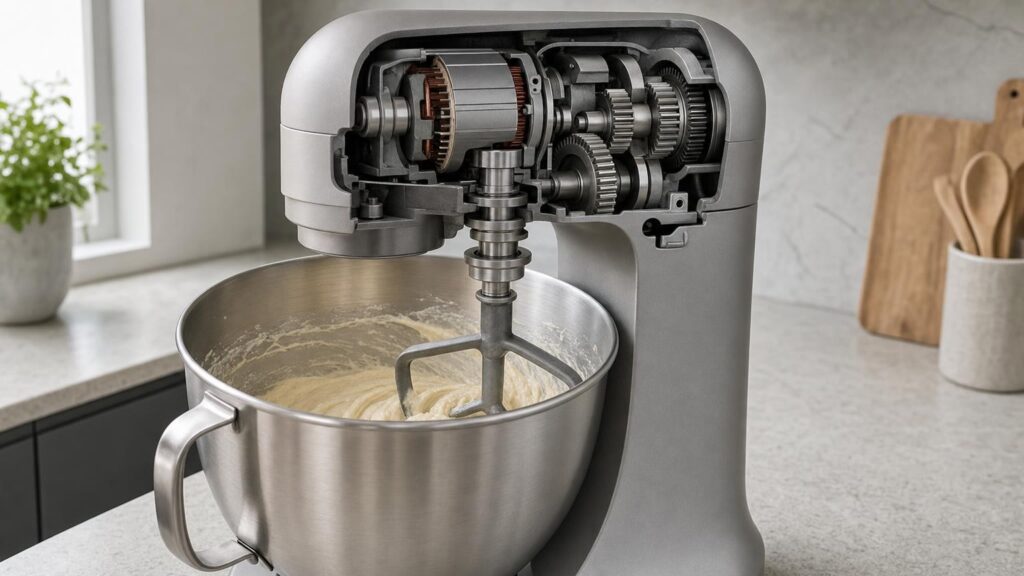
What Actually Happens Inside a Stand Mixer
A stand mixer does more than spin a tool in a bowl. Its motor, gears, shafts, attachment interface, mixing action, bowl and tool must work as one system. The quality of that relationship determines whether ingredients are incorporated evenly, whether a whisk can reach a small quantity and whether the machine can keep moving through resistant dough.
This is why motor wattage is a poor shortcut for judging capability. A wattage rating describes electrical input under defined conditions, not the exact turning force delivered to the tool. It does not reveal how efficiently power travels through the drivetrain, how the mixer manages sustained resistance or how well the tool covers the bowl.
For shoppers, the more useful question is not simply “How powerful is it?” but “How effectively does the complete design turn motor power into the mixing action my recipes need?”
From Motor to Mixing Tool: Following the Power Path
The motor begins the process by producing rapid rotation. That motion passes through a drivetrain containing gears and shafts before reaching the output where the beater, whisk or dough hook is fitted. Some mixers also provide a separate powered hub for accessories, although its arrangement and intended uses vary by design.
The motor may be positioned horizontally or vertically, and different mixers use different combinations of gears, belts and shafts. These decisions influence the shape and weight distribution of the machine as well as how power changes direction on its way to the tool.
Drivetrain layout can also affect:
- Mechanical efficiency: Every transfer of motion introduces some friction and energy loss.
- Noise character: Motors, gears, belts and housings produce and transmit sound differently.
- Heat management: The motor and transmission generate heat, particularly during long or resistant mixing tasks.
- Packaging and balance: Component placement affects head size, centre of gravity and the space available around the bowl.
- Service complexity: Access to belts, gears and other internal components depends on the construction.
No single arrangement is automatically best. A compact drivetrain can be well engineered, while a physically larger one is not necessarily more efficient or durable. The important issue is whether the components are designed for the loads, speeds and duty cycles the manufacturer permits.
Gear Reduction: Trading Speed for Turning Force
An electric motor generally turns much faster than a mixing tool should. Gearing reduces that speed to a useful range. In broad terms, reducing rotational speed allows the drivetrain to provide greater turning force at the output. It is similar to selecting a lower gear when a vehicle needs to move slowly against greater resistance.
This matters because ingredients do not all behave alike. Cream may move readily around a bowl, while stiff dough pushes back strongly against a hook. The mixer needs sufficient torque at the tool to continue rotating under the intended load without excessive slowing, overheating or triggering protection systems.
Input wattage does not directly state that available torque. Two mixers with similar motor ratings can use different gear ratios, motor types, control systems and transmission designs. Conversely, two machines with different ratings may deliver surprisingly similar performance in a particular task. Efficiency also matters because some input energy becomes heat, sound and friction rather than useful motion.
Speed control is part of the same system. A well-matched low speed should move resistant ingredients steadily rather than merely delivering a brief surge. At higher settings, the drivetrain must provide the speed appropriate for whipping or aerating without making the machine difficult to control.
Shoppers should therefore treat wattage as one specification, not a performance verdict. Information about recommended batch limits, permitted kneading times and rest periods often says more about intended workload than the largest number printed on the box.
Planetary Mixing and the Area the Tool Reaches
In a planetary mixer, the tool spins around its own axis while its mounting point travels around the bowl. The motion resembles a planet rotating while orbiting. This creates a broader path than a tool that only spins in one fixed position.
The practical aim is to pass the tool through a large proportion of the mixture. Effective coverage can pull ingredients from different parts of the bowl, reduce persistent pockets and encourage more consistent incorporation. It may also reduce manual scraping, although many recipes still benefit from stopping the mixer and scraping the bowl.
The phrase “planetary action” does not, by itself, reveal how thoroughly a mixer covers its bowl. Coverage depends on the size of the orbit, tool dimensions, bowl contours and the clearance between them. A tool can follow a planetary path yet still miss material at the very bottom or leave a band on the side if the geometry is poorly matched to the batch.
Coverage also changes with consistency. A pourable batter can flow back into the tool’s path, whereas butter stuck to a bowl wall may remain outside it. Dough can gather around a hook and move as a single mass. The same motion can therefore produce different results with different ingredients.
Bowl Geometry, Tool Shape and Clearance
Bowl volume attracts attention, but bowl shape is just as important. A wide bowl provides room for ingredients to spread and may make access easier. A deeper, narrower bowl can help contain splashes and bring ingredients into a more concentrated zone. Curved sides encourage material to move towards the tool, while the form of the base influences whether small quantities collect within reach.
Tool shape must complement this geometry. A flat beater needs to move through the main ingredient zone without striking the bowl. A whisk needs enough clearance for its wires while still reaching shallow liquids. A hook needs room to collect, stretch and turn dough rather than simply pushing it around the perimeter.
There must normally be intentional space between a rigid tool and the bowl. Direct contact could cause wear or damage. Too much clearance, however, may leave flour, butter or egg at the bottom and sides, especially in small batches. Some designs allow tool height adjustment, but shoppers should follow the maker’s instructions rather than treating any gap as an assembly fault.
Mismatched bowls and tools create a separate problem. Components that appear physically similar are not necessarily interchangeable. Their dimensions, locking systems and safe clearances may differ, so compatibility should be confirmed for the exact mixer model.
Why Different Tools Behave Differently Under Load
Wire whisks
A wire whisk repeatedly passes fine wires through a mixture, creating movement and helping incorporate air. It is suited to tasks such as whipping cream or egg whites, where speed and aeration matter. Thick mixtures can place inappropriate stress on slender wires and may not circulate effectively through them.
Flat and flex-edge beaters
A flat beater pushes, folds and smears ingredients. It is a general-purpose choice for many batters, cake mixtures and creaming tasks. A flex-edge version adds a flexible section intended to pass close to part of the bowl wall. This may reduce scraping in suitable mixtures, but it does not eliminate the need to check for unmixed ingredients. Its effectiveness depends on bowl shape, mixture consistency and correct fit.
Dough hooks
A dough hook gathers and stretches dough as it moves. Dough resistance varies greatly with hydration, flour characteristics, batch size and stage of development. A heavy dough can impose a substantial sustained load even when it occupies only a modest part of the bowl.
These tools should not be compared as if one were more powerful than another. They perform different mechanical jobs. The correct speed matters too: a speed useful for aerating cream may be unsuitable for kneading. Manufacturer guidance on tool choice, speed, quantity and operating time should take priority over assumptions based on the motor rating.
Capacity Is More Than the Bowl’s Stated Volume
Nominal bowl volume is the amount of space inside the bowl, not a promise that every recipe can safely use all of it. Practical capacity depends on what the ingredients do during mixing.
Cream, egg whites and some batters expand as air is incorporated. Liquids can splash or climb the bowl at higher speeds. Flour can form a cloud if accelerated too quickly. Dough may wrap around a hook, rise with it or move as a heavy mass that places considerable force on the drivetrain.
Minimum useful capacity matters as well. A large bowl may be convenient for big batches yet place one egg white or a small quantity of cream below the whisk’s effective path. Good tool reach can improve small-batch performance, but stated bowl size alone cannot confirm it.
When comparing capacity, look for recipe-specific guidance rather than one universal figure. Useful information may include maximum flour quantity, total dough weight, egg or cream guidance and limits for particular tools. Also consider headroom: ingredients need space to circulate and expand without escaping the bowl.
Tilt-Head and Bowl-Lift Designs: Mechanical Trade-offs
A tilt-head mixer allows the motor head to pivot upwards for bowl and tool access. This can make changing attachments and scraping the bowl straightforward. However, the raised head requires vertical clearance, which may be awkward beneath low wall cupboards. The hinge and locking mechanism are also part of the load-bearing structure and should be properly engaged during use.
In a bowl-lift design, the head generally remains fixed while the bowl moves vertically on supporting arms or guides. This changes how the bowl is installed and how ingredients are added. A fixed head can suit a design intended to control movement under demanding loads, but construction quality and the complete support system matter more than the format label alone.
Bowl-lift machines may require more room around the supports, while tilt-head models need room above. Bowl weight, handle design and attachment access can be as important as mechanical layout, particularly for anyone who expects to move full bowls frequently.
Neither format is universally stronger, more stable or easier to use. The better choice depends on batch habits, available worktop space, overhead clearance and how often tools or bowls will be changed.
Reading Specifications Without Being Misled by Wattage
A disciplined comparison looks across several pieces of information:
- Motor rating: Useful context for electrical input, but not a direct measure of delivered torque or mixing quality.
- Speed settings: Check whether the available range suits gentle starts, kneading, general mixing and whipping. The number of labelled positions alone does not establish control quality.
- Capacity guidance: Prefer limits tied to ingredients and tools over bowl volume in isolation.
- Duty guidance: Note restrictions on operating time, heavy mixtures and required cooling periods.
- Tools supplied: Examine which tasks they are designed for and whether optional tools are confirmed as compatible.
- Bowl and head arrangement: Consider access, locking, support, worktop depth and overhead space.
- Adjustment and care: Check whether tool clearance is adjustable and what maintenance or cleaning the manufacturer specifies.
Specifications cannot fully establish durability, noise, vibration, smoothness under load or real-world bowl coverage. Nor can a metal exterior alone prove that all load-bearing internal parts share the same material or construction. Product weight may contribute to stability, but feet, balance, bowl locking and worktop condition also influence movement.
Think in terms of intended recipes. A shopper mainly making cakes and whipped mixtures has different requirements from someone regularly kneading resistant dough. Occasional large batches create different demands from long, repeated sessions. Matching the machine to those patterns is more informative than choosing the highest wattage or largest bowl available.
Judge the Mixer as a System
A stand mixer’s usable performance comes from the relationship between its motor, gear reduction, shafts, control system, planetary path, tools and bowl. Weakness or poor matching in one area cannot always be corrected by a larger motor rating elsewhere.
Before buying, consider the realistic minimum and maximum batches, the mixtures you prepare most often and the space available in your kitchen. Look for clear operating limits, compatible tools and bowl geometry suited to those jobs. Wattage belongs in the comparison, but it should never make the decision alone. The best-informed choice is the mixer whose complete mechanical system fits the work you actually plan to give it.
Continue exploring on Frowse
Discover More Frowse Insights
- What Feed Dogs, Presser Feet and Hooks Do in a Sewing Machine
- Why Mattress Firmness and Foam Density Are Not the Same Thing
- Foil vs Rotary Electric Shavers: How the Cutting Mechanism Changes the Shave
- Inside a Duvet: How Fill and Construction Determine Warmth
- Pressurised and Traditional Espresso Baskets Do Different Jobs