




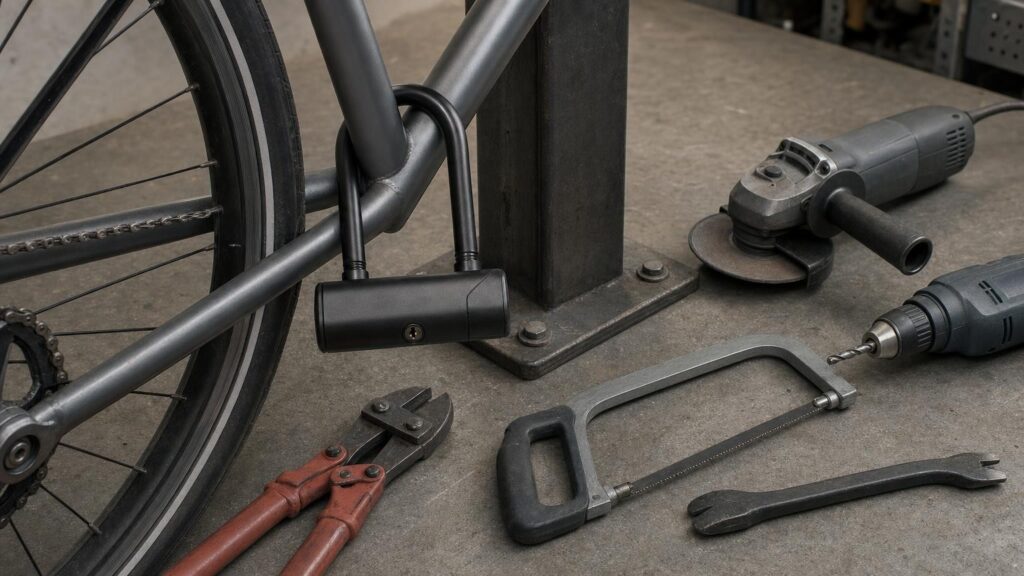
A thick bicycle lock can look reassuring, but thickness is only one part of its security. A lock must resist attacks on its shackle or links, locking mechanism, joints and key cylinder. Its shape and the way it is fitted around the bicycle also affect how much leverage or tool access a thief can obtain.
No portable bicycle lock is attack-proof. Given enough time and suitable tools, it may eventually be defeated. The useful shopping question is therefore not simply whether a lock is “strong”, but how its complete design responds to different methods of attack while remaining practical enough to carry and use correctly.
The attack methods a lock must contend with
Bolt cutters are only one possible threat. They use long handles to concentrate force at their jaws, making exposed parts that fit between those jaws potential targets. Hardened materials, awkward cross-sections and larger dimensions can make this kind of attack more difficult, but those features do not necessarily provide the same protection against other tools.
Manual saws attack a material through repeated abrasion. Powered angle grinders also remove material, but do so far more quickly and can attack components that are too hard or large for bolt cutters. Grinder resistance depends on several factors, including the amount and type of material that must be removed, whether one or two cuts are needed and how securely the lock can be held during the attack.
Leverage and twisting attacks work differently. Instead of cutting through the lock, they apply force to deform the shackle, separate its locking points or damage the body. Empty space inside a U-lock can allow a bar or other object to be inserted, while a loosely fitted chain may be easier to position for attack.
Drilling, picking and impact attacks target the locking mechanism or its surrounding structure. A lock that resists cutting well may still have an exposed cylinder, vulnerable joint or inadequately protected body. This is why resistance to one named tool should not be treated as a complete security assessment.
Shackle materials, hardening and cross-section
Steel composition and heat treatment matter as much as visible size. Hardening can improve resistance to cutting and sawing, while toughness helps a component withstand impact and deformation without cracking. These properties require balance: a very hard material can be less useful if it is brittle, while a tough but comparatively soft material may be easier to cut.
Some lock components use surface hardening, creating a harder outer layer around a tougher core. However, shoppers usually cannot verify metallurgical quality by looking at a product photograph. A description such as “hardened steel” provides more context than no material information at all, but it does not reveal the precise treatment, consistency or performance of the finished lock. Independent testing is more informative than material wording by itself.
Round, square and irregular sections
A round shackle presents a predictable surface to a cutting tool. Square or irregular cross-sections may make it harder to seat cutter jaws securely, reducing their purchase. They can also complicate attempts to grip and twist the component. This does not automatically make every non-round design stronger, because the result still depends on material, dimensions and construction.
Nominal diameter can also be misleading when comparing different formats. The outer measurement of a covered chain link may include a sleeve, while the apparent bulk of a folding lock includes several plates, pivots and fasteners. Look for the dimensions of the load-bearing metal rather than judging only by the lock’s overall appearance.
Tool access is equally important. A substantial shackle can still be attacked if it leaves ample room for large tools. Conversely, a close-fitting lock may make it difficult to position cutter jaws or brace the lock against a hard surface. Material strength and practical geometry should therefore be considered together.
Locking points, exposed joints and leverage
Many U-locks secure the shackle at both ends. With a genuinely double-locking arrangement, cutting one side may not release the bicycle immediately because the remaining side is still retained. A second cut or another form of attack may be required. In a single-locking design, one end is actively locked while the other may act as a hook or locating point, so the result of one cut can be different.
The number of apparent openings or bolts does not prove how the internal mechanism works. If double locking is important, look for an explicit construction description or evidence from independent testing rather than inferring it from the lock’s exterior.
Connections deserve particular attention. Hinges, rivets and pivots are fundamental to folding locks. Padlocks used with separate chains introduce a shackle and body connection. Cables rely on secure junctions between the cable and terminal fittings. Any of these areas can become a more attractive target than the main material if it is thinner, exposed or easier to hold still.
Installation changes the forces a lock must withstand. A large gap around the bicycle and anchor can provide room for a lever, twisting tool or jack. A lock resting on the ground may be easier to strike or brace. A close fit, with minimal unused space and the locking body positioned away from convenient support, generally reduces these opportunities.
The key cylinder can be the weakest component
The cylinder is sometimes overshadowed by attention to shackle thickness, yet it controls the lock’s release. Its resistance depends on the cylinder design, its protection inside the lock body and the accessibility of the keyway.
Protective features may include hardened components intended to resist drilling, restricted access around the cylinder, or a shutter that helps keep out dirt and moisture. Such features can be useful, but their presence does not establish the performance of the whole mechanism. A complex-looking key is not, by itself, proof of strong picking or drilling resistance.
It is also helpful to distinguish covert manipulation from destructive attack. Picking attempts to operate a cylinder without the proper key and with limited visible damage. Drilling, pulling or striking the cylinder is destructive and places different demands on the housing and internal components. A claim about pick resistance should not be read as evidence of resistance to these forceful methods.
Everyday reliability matters too. A keyway that becomes contaminated or difficult to access may discourage careful locking. Weather protection, sensible key access and suitable maintenance can help ensure the mechanism remains usable, although a keyway cover should not be confused with a high-security cylinder feature.
What independent security ratings can – and cannot – tell you
Independent ratings are useful because they assess a finished lock under defined conditions rather than relying only on material descriptions. When comparing rated locks, check which organisation issued the rating, the security tier, the intended use category and, where available, the relevant test version.
Do not assume that similarly named tiers from different schemes are equivalent. Each testing body can use its own tools, attack methods, time limits and scoring rules. A high tier in one system cannot be converted automatically into a tier from another. Comparisons are clearest within the same scheme and category.
A rating is also not a guarantee against theft. Testing takes place under controlled rules, while a real attack may involve different tools, more time or a vulnerable anchor. The rating does not necessarily account for how a particular bicycle is parked, whether components are left unsecured or whether the lock has been fitted with excessive open space.
Use a recognised rating as one strong piece of evidence, then examine the details that matter to your situation. Be cautious when a listing uses a medal, star or “security level” without identifying the issuing body. Some numerical levels are manufacturers’ own scales and may be useful only for comparing products within that manufacturer’s range.
Why lock format changes the trade-offs
U-locks
U-locks use a rigid shackle and compact locking body. Their rigidity can limit how they are positioned, but it can also reduce the number of joints in the load-bearing structure. A compact U-lock leaves less room for leverage, although it may not fit around broad posts, large frame tubes or multiple bicycle components. A larger version offers more locking options at the cost of extra space that should be managed carefully.
Chains
Chains can wrap around a wider variety of anchors and can make it easier to secure more than one part of a bicycle. Their moving links may be awkward to hold steady during an attack, but each link still needs suitable material and dimensions. The joining lock or integrated locking body must be considered alongside the chain itself. Heavy protective chains can also be burdensome to carry.
Folding locks
Folding locks combine rigid plates with the ability to fold into a compact package. They often provide useful reach and straightforward frame mounting. Their structural trade-off is the presence of multiple pivots and fasteners, which must resist cutting, leverage and twisting as part of the complete system. Plate width alone does not reveal the strength of those joints.
Supplementary cables
Cables are flexible, light and convenient for passing through wheels or accessories, but flexibility should not be mistaken for equivalent protection to a substantial primary lock. A cable can be useful as a supplementary restraint for components when paired with a stronger lock. Whether it is appropriate as the main lock depends on the security demands of the parking situation and credible independent evidence.
Portability, mounting and everyday use are part of security
More protective material often means more weight and bulk, but the heaviest lock is not automatically the best choice. A lock left at home provides no protection, and an awkward design may encourage a rider to lock only a wheel or choose a weak anchor.
Before buying, consider how the lock will be carried on the journeys for which it is intended. A frame mount should fit the bicycle without obstructing bottles, cables, pedalling or wheel clearance. It should hold the lock securely enough to control movement and rattling. Riders who use a bag need to consider weight distribution, available space and whether the lock could damage other contents.
Usability at the parking location matters as well. Check that the internal dimensions or chain length can pass around a structurally meaningful part of the frame and the anchors you commonly encounter. Leave enough room for practical use, but avoid unnecessary open space. Consider whether the keyway remains accessible when the lock is fitted tightly and whether the locking body can be kept away from the ground.
Outdoor exposure can affect moving parts and key access over time. Protective sleeves can reduce paint damage, while keyway covers may limit contamination. These practical details are secondary to the load-bearing construction, but they can influence whether the lock continues to be used properly.
A better way to compare bicycle locks
Start with the parking environment. Short stops in visible locations, long periods in public areas and overnight storage present different exposure to tools and uninterrupted attack time. Also consider the value and replaceability of the bicycle and its components without assuming that any portable lock eliminates risk.
- Verify the rating: identify the independent testing body, tier, use category and applicable version rather than relying on an unexplained security score.
- Inspect the main structure: consider the load-bearing shackle, links or plates, their cross-section and the quality evidence available for their materials.
- Check locking points and joints: look for double locking where relevant and examine hinges, rivets, cable ends, chain closures and other exposed connections.
- Assess the cylinder: consider how deeply it is protected, its exposure to drilling or impact and whether the keyway remains practical to use.
- Test the usable space: make sure the lock fits the bicycle and realistic anchors without leaving excessive room for leverage.
- Plan transport: choose a weight, mount and carrying method that you can use consistently.
The strongest choice is not defined by thickness, weight or format alone. It is a lock whose materials, geometry, mechanism and joints offer credible resistance to several attack methods, supported where possible by independent testing. That construction must then suit the bicycle, anchor and rider well enough to be carried regularly and fitted closely. Bicycle security works as a system – and the way the lock is used is one of its most important components.
Continue exploring on Frowse
Best Sellers · Top Rated · Under £50 · Fresh Finds
Explore products on Amazon
Looking for products related to this guide? to enter your own search term.
Discover More Frowse Insights
- What Makes a Suction Cup Stay Attached – and Why It Eventually Lets Go
- Behind a Kitchen Knife’s Edge: Geometry, Hardness and Sharpenability
- What a Surge Protector’s Joule Rating Means and Why Protection Wears Out
- What Determines How Long a Cool Box Stays Cold?
- What Makes a Backpack Water-Resistant – and Why the Protection Wears Out