




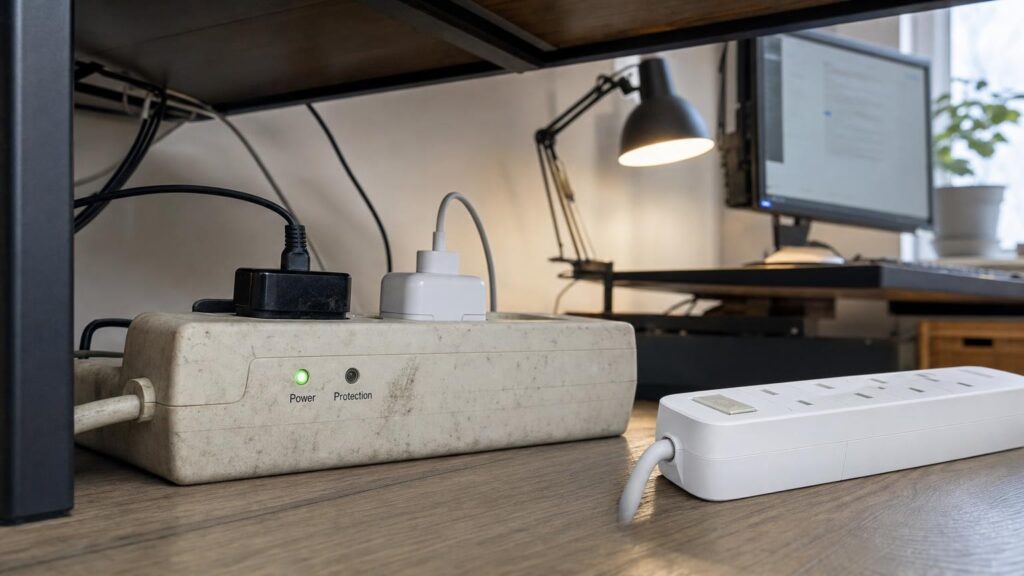
A surge protector may look much like an ordinary multi-socket power strip, but the components inside determine whether it merely distributes electricity or also helps limit brief voltage spikes. Even genuine surge protection is not permanent: the components that handle surge energy can deteriorate with use.
Understanding joule ratings, clamping performance and status indicators makes it easier to compare products without treating any single specification as a guarantee. It also helps owners recognise when a protector may need to be replaced.
Why a surge protector is more than a multi-socket power strip
A basic power strip expands one wall socket into several outlets. It may also include a switch, an overcurrent breaker or USB charging ports, but none of those features automatically provides surge protection.
A surge-protected strip contains components designed to respond to short-lived increases in voltage. The physical resemblance between the two product types can be misleading, so appearance, socket count and words such as “protected” near a power switch are not enough. Shoppers should look for an explicit surge-protection specification, appropriate certification information and an explanation of the product’s protection-status indicator.
An overload breaker and surge suppression also perform different jobs. A breaker responds when connected devices draw too much current for the strip’s rating. Surge components respond to transient voltage events that may last only a tiny fraction of a second. A product may include both, but one does not substitute for the other.
How metal-oxide varistors respond to a voltage surge
Many surge protectors use metal-oxide varistors, commonly called MOVs. Under normal supply conditions, an MOV has high electrical resistance and conducts very little current. When voltage rises sharply beyond its designed threshold, its resistance falls. This allows it to conduct surge current and helps limit the voltage passed onwards to connected equipment.
The unwanted energy must go somewhere. Some is dissipated as heat within the protective components, while some surge current may be diverted through available conductor paths. Depending on the design, protection may be fitted between live and neutral, live and earth, and neutral and earth. The precise arrangement matters because disturbances can appear between different pairs of conductors.
A sound earth connection may be important to protection modes that rely on it. However, the presence of an earth pin or an illuminated grounding light does not establish that every aspect of the building wiring is correct.
Brief surges are not the same as sustained overvoltage
Typical plug-in surge protectors are intended primarily for brief transients, such as disturbances created by switching electrical loads or by events elsewhere on the power network. They are not a general remedy for a supply that remains at an excessive voltage.
Nor should a plug-in protector be regarded as proof against a direct lightning strike. Lightning can involve energy and current far beyond what a small outlet-level device is intended to manage. Building-level protection, correct earthing and plug-in protection can form different parts of a wider approach, but no joule figure makes connected equipment invulnerable.
What the joule rating actually tells you
A joule is a unit of energy. On a surge protector, the joule rating describes an energy-handling capability established under specified test conditions. In broad terms, a higher figure can indicate that the protection system has more capacity to absorb or divert surge energy than a lower-rated design tested on a comparable basis.
However, the rating does not tell shoppers how many years the protector will last. It also cannot be converted into a reliable number of surges. One protector might encounter many low-energy transients, while another experiences a single much larger event. Those histories place very different stresses on the components.
The joule number is not a promise that attached equipment will survive every incident. The result depends on factors including the surge’s size, duration and path, the protector’s response, the electrical installation and the equipment being protected. Published values may also reflect different test arrangements, so seemingly precise comparisons are most useful when products have been assessed under compatible standards.
A larger joule rating can therefore be a useful comparison point, but it is not a complete measure of quality. It says little by itself about the voltage that reaches connected devices, the protected conductor modes, thermal safeguards, construction or certification.
Joule rating and clamping voltage answer different questions
Joule rating concerns energy-handling capacity. Clamping performance concerns the voltage level at which the protective circuit starts conducting significantly and the voltage that may appear while it is responding. These specifications describe related but different aspects of protection.
A lower clamping or voltage-protection figure can suggest tighter voltage limiting when figures are measured in the same way. Yet published figures depend on the test waveform, current and terminology used. A number from one test method may not be directly comparable with a differently derived number from another product.
There is also an engineering balance involved. A protective component must stay out of the way during acceptable mains variations but respond when a genuine transient occurs. Components that conduct more readily can be exposed to more events and stress. Consequently, neither the lowest-looking clamping figure nor the largest joule number should be treated as an automatic winner.
Look for clearly presented specifications tied to an applicable standard rather than relying on an unexplained headline. If a listing uses terms such as clamping voltage, let-through voltage or voltage-protection level, check how the manufacturer defines them before comparing the figures.
Why surge protection wears out
An MOV changes physically when it handles surge energy. Small events can cause incremental degradation, while a severe event may cause substantial damage at once. Over time, its electrical characteristics can shift until it no longer provides the intended level of protection.
This makes service life dependent heavily on exposure. Two identical protectors bought on the same day can age differently if they are used in locations with different electrical conditions. Calendar age alone cannot reveal the remaining energy capacity, and there is no universal replacement interval that suits every product and environment.
Well-designed products commonly include thermal protection intended to disconnect an MOV if it begins to overheat. This is important because a degraded MOV can conduct abnormally and generate heat. The exact failure response varies by design: some units may continue supplying power after surge protection has been disconnected, while others may stop supplying some or all outlets.
This distinction is why an old strip can still power a computer or television even though its surge-suppression function is no longer available. Continued power delivery is not evidence of continued protection.
What protection and power indicator lights can and cannot confirm
Indicator labels are not standardised across every design. A power light may show only that the strip is receiving electricity. A protection-status light may indicate that a particular protective circuit remains connected. A grounding light may report a limited condition relating to the earth connection.
Shoppers should check the instructions rather than infer the meaning from a green or red lamp. In particular, an illuminated protection light usually does not provide a live measurement of remaining joule capacity. It cannot say that the protector is “80% healthy”, confirm that every protective component is unchanged or guarantee protection from the next event.
A grounding indicator is not a comprehensive wiring tester either. It may fail to identify some installation faults, and the exact conditions it detects depend on the circuit used. Suspected wiring problems require appropriate professional assessment rather than interpretation of a strip’s lamp alone.
If a protection indicator goes out, changes colour or triggers an alarm, follow the manufacturer’s instructions. Replacement is commonly the appropriate response when the product reports that surge protection has been lost. Do not assume that switching the strip off and on restores components that have worn out.
Surge protectors, ordinary power strips and UPS units compared
These three product categories overlap in appearance and sometimes in features, but they address different needs:
- Ordinary power strip: primarily adds outlets. It may include switching and overload protection without suppressing voltage transients.
- Surge-protected power strip: adds outlets and includes components intended to limit specified transient overvoltages.
- Uninterruptible power supply: uses a battery to provide temporary power when the mains fails. Some UPS units also offer surge suppression, filtering or voltage regulation, but those capabilities must be checked individually.
Battery runtime does not describe surge performance, and a surge joule rating does not indicate backup runtime. Voltage regulation is another separate function. A UPS may be valuable where equipment needs time to remain operating or shut down safely, but the letters “UPS” do not by themselves establish every aspect of its surge protection.
How to compare surge protectors beyond the headline joule figure
A balanced comparison should consider several specifications and practical details:
- Recognised certification: look for evidence that the complete product has been assessed to an applicable electrical and surge-protection standard for the market in which it will be used.
- Clamping performance: compare voltage-protection figures only when the terminology and test basis are compatible.
- Protected modes: check which conductor pairs are covered rather than assuming every design protects every path.
- Electrical load rating: confirm that the strip’s voltage, current and total load limits suit the intended devices. Surge capacity does not increase its continuous load capacity.
- Grounding requirements: understand whether proper protective earthing is required for the stated performance.
- Status indication: find out whether power, grounding and active protection have separate indicators and what happens if protection fails.
- Socket layout: allow enough room for bulky plugs and power adaptors without forcing connections or blocking neighbouring outlets.
- Cord and enclosure: consider suitable cord length, plug type, strain relief and construction for the intended indoor environment.
- Replaceability: decide whether the whole strip must be replaced after protection is lost and whether its indicators make that condition clear.
Connected-equipment policies, where offered, should not replace technical comparison. Their terms, exclusions, registration requirements and evidence requirements may vary. Treat such policies as contractual details rather than proof that no damage can occur.
Plan for protection as a consumable capability
Surge protection is best treated as a capability that can be used up, not as a permanent property of a bank of sockets. Keep the instructions so the indicator scheme remains understandable, and note any manufacturer-specific replacement guidance. Do not exceed the strip’s electrical rating or connect high-load equipment unless the strip is explicitly suitable for that use.
After a known major electrical disturbance, inspect the unit and reassess it according to its instructions, even if connected devices still turn on. Replace a protector when it reports that protection has been lost, when it shows damage or when the manufacturer directs replacement after an event.
The most useful purchasing approach is therefore not simply to choose the largest joule number. Compare energy capacity, clamping performance, certification, protected modes, load limits and status reporting together. A properly selected surge protector can reduce risk from certain transient events, but its protection is finite and never an absolute guarantee.
Continue exploring on Frowse
Discover More Frowse Insights
- End Grain, Edge Grain and Face Grain Cutting Boards Explained
- Drive Size, Socket Size and Point Count: Understanding Socket Compatibility
- Machine-Woven, Tufted and Hand-Knotted Rugs: What Construction Changes
- Cemented, Blake-Stitched and Welted Shoes: What Sole Construction Really Changes
- What “Solid Top” Really Means on an Acoustic Guitar