




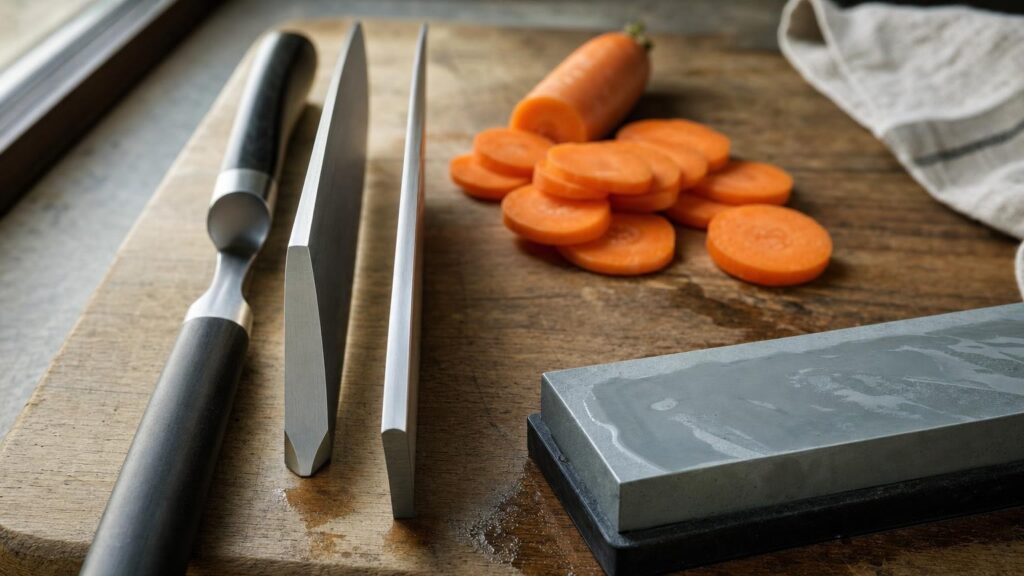
A kitchen knife is often described by its steel, but the name stamped on the blade reveals only part of how it will perform. Cutting feel, edge life and resistance to damage depend on an interacting system: blade geometry, edge angle, heat treatment, hardness, toughness and maintenance.
This is why two knives made from nominally the same steel can feel and behave very differently. One may pass easily through firm vegetables but require careful handling, while another may feel less effortless yet tolerate rougher work. The useful question is not simply which steel is best. It is which combination of properties suits your food preparation, technique and willingness to sharpen.
Blade geometry: What determines cutting resistance
A knife does more than separate food at its very edge. As the blade advances, the food must move around the material above the edge. The shape and thickness of that material therefore have a major effect on cutting resistance.
Thickness behind the edge is especially important. A knife can have a comparatively thick spine while becoming very thin near the cutting edge, allowing it to cut efficiently. Conversely, a blade that looks slim at the spine may still feel wedge-like if it remains thick immediately behind the edge. A stated blade thickness is consequently difficult to interpret unless the point of measurement is known.
Other geometric features also matter:
- Spine thickness contributes to overall stiffness and strength but does not by itself determine cutting ability.
- Distal taper describes how a blade becomes thinner towards its tip. A pronounced taper can make the forward section feel more precise while leaving greater substance near the handle.
- Blade height affects knuckle clearance and the distance over which the blade can narrow from spine to edge.
- Thickness distribution influences both cutting resistance and how readily food separates around the blade.
Thin geometry generally reduces resistance, particularly in dense foods. However, removing material also leaves less support behind the edge and can reduce resistance to bending or damage. Geometry should therefore be judged in relation to the knife’s intended work rather than treated as a race towards the thinnest possible blade.
Grinds and edge profiles: How the blade narrows
The grind describes how the faces of a blade narrow towards the edge. It affects cutting feel, food release, durability and future maintenance.
Flat, convex and hollow grinds
A flat grind narrows along relatively straight planes. It can offer a predictable balance between cutting ability and support, although its performance still depends on how high the grind begins and how thin it becomes near the edge.
A convex grind curves outwards slightly as it approaches the edge. This can retain more supporting material while creating a smooth transition through food. Accurately reproducing the curve during maintenance may require more control than following a simple flat bevel.
A hollow grind curves inwards, producing a thin section near the edge while leaving more material higher on the blade. It can cut keenly when new, but repeated sharpening may eventually reach thicker material. Hollow geometry also varies considerably, so the label alone does not predict performance.
Single-bevel and double-bevel edges
Most general-purpose kitchen knives use a double-bevel edge, with both sides narrowing towards the apex. The bevels may be symmetrical or deliberately unequal.
A single-bevel construction is ground primarily on one side, with the opposite face shaped differently. It can support specialised cutting techniques and precise slices, but handedness, steering and sharpening method become more important. It should not be assumed to be a straightforward upgrade over a double-bevel design.
Grind also affects wedging, where thick blade geometry forces dense food apart, and steering, where asymmetric geometry encourages the blade to move away from a straight path. Food release depends on the shape and surface of the blade as well as the food itself, so dimples, finishes or grind labels should not be treated as guarantees.
Edge angle: Sharpness, durability and intended use
Edge-angle specifications can be confusing because some describe the angle on one side while others give the inclusive angle across both sides. A double-bevel edge sharpened to the same angle per side has an inclusive angle approximately twice that figure. Comparisons are unreliable unless the measurement convention is clear.
A lower edge angle generally creates a finer wedge at the apex, which can reduce cutting resistance and improve the sensation of sharpness. The trade-off is that less material supports the very edge. Depending on the steel, hardness, geometry and use, a very acute edge may roll, chip or lose its crispness sooner.
A wider angle adds support and may be more appropriate where the knife encounters harder ingredients, imperfect technique or occasional lateral loading. It may not move through food as effortlessly, particularly if the blade is also thick behind the edge.
Angle should match the task. Fine slicing can reward a more acute, carefully used edge. General preparation calls for a balance of cutting ability and stability. Work involving hard shells, joints, frozen food or twisting demands a suitable tool and more robust geometry rather than expecting a fine slicing knife to absorb every task.
Hardness, toughness and heat treatment
Hardness is resistance to indentation or deformation. Kitchen knife listings may report a value from a Rockwell hardness scale, but this number is not a complete quality score. It indicates one aspect of the blade after heat treatment, not how thinly it is ground, how tough it is or how well the treatment was controlled.
Toughness is the ability to resist fracture and absorb stress before breaking. Hardness and toughness are related but not interchangeable. Increasing hardness can improve stability and wear behaviour in some steels, yet it can also reduce tolerance for impacts or sideways forces if the complete design is not well balanced.
Heat treatment determines much of how a particular steel expresses its potential. Heating, quenching and tempering influence hardness, carbide condition, internal stresses and toughness. A steel name identifies a composition category, but it does not reveal all the processing choices made by the manufacturer.
Edge failure also takes several forms:
- Rolling occurs when the apex bends or folds rather than immediately fracturing.
- Blunting can result from gradual wear that rounds the apex.
- Microchipping involves very small fractures that may feel like roughness or reduced cutting quality.
- Larger chips indicate more substantial fracture, often requiring removal of considerably more metal during repair.
A tougher, more deformable edge may be easier to restore after rolling, while a harder edge may resist deformation but be less forgiving of misuse. Neither behaviour is automatically preferable in every kitchen.
Edge retention is more than wear resistance
Edge retention is commonly discussed as though it were a single material property. In practice, a knife stops cutting well through a mixture of abrasive wear, deformation and fracture.
Steel composition and carbide structure can influence resistance to wear. Hardness can help the apex resist deformation. Toughness can limit fracture. Yet edge geometry determines how much material supports the apex, while the cutting surface and user technique determine the stresses applied to it.
A hard board surface, contact with bones, scraping sideways or twisting the blade can degrade an edge differently from controlled slicing on a more edge-friendly board. Even highly wear-resistant steel will not deliver useful retention if an unsuitable geometry repeatedly chips. Similarly, a tough blade may lose crispness by rolling or abrasion while remaining free of visible damage.
This explains why steel-name comparisons can be misleading. Two blades using the same named steel may have different hardness, heat treatment, carbide condition, thickness behind the edge and sharpening angles. Their edge retention may therefore differ even before variations in technique and maintenance are considered.
Sharpenability: What maintenance will actually involve
Sharpenability is not simply whether a knife can become sharp. It includes the time, abrasives, skill and metal removal needed to restore the desired edge.
- Honing works at or near the apex and may realign or refine an edge, depending on the tool used. It does not replace sharpening when the edge is substantially worn or damaged.
- Stropping can refine an apex and remove small burr remnants. Excessive or poorly controlled stropping may round the edge.
- Sharpening removes material to create a fresh bevel and apex.
- Thinning removes material behind the edge to restore efficient geometry as repeated sharpening moves the bevel into a thicker part of the blade.
A wear-resistant steel can retain an edge well under suitable conditions but may take longer to sharpen or work best with appropriate abrasives. A steel that abrades readily may be quicker to refresh, though it may need attention more often. The practical balance depends on whether you sharpen at home, use a professional service or prefer simple maintenance tools.
Damage raises the workload. Removing chips requires grinding until the new edge reaches undamaged steel. Asymmetric and single-bevel grinds require the original geometry to be understood and preserved. Over years of use, even a well-sharpened knife can become thick behind the edge unless it is periodically thinned.
Reading specifications without overinterpreting them
Specifications are useful when their limits are understood. Consider them as pieces of a system rather than as a ranking table.
- Steel name: Use it to understand the broad material family, not to predict performance on its own.
- Hardness: Check whether a value or range is given, but remember that accuracy, heat treatment and toughness are not captured by one number.
- Edge angle: Determine whether it is measured per side or inclusively and whether it applies to the factory edge only.
- Blade thickness: Look for the measurement location. Spine thickness near the handle says little about thickness immediately behind the edge.
- Grind: Consider symmetry, blade-face geometry and maintenance implications rather than relying on the grind name.
- Intended use: A clear description of suitable tasks may be more helpful than an isolated technical figure.
Be cautious when a listing gives a highly specific angle or hardness without explaining measurement conventions or tolerances. Also note what is omitted. Few product descriptions fully communicate distal taper, behind-edge thickness or heat treatment, so apparently precise comparisons may still rest on incomplete information.
Choosing the right balance for your kitchen
Start with the foods and techniques that dominate your preparation. A cook who mostly slices vegetables, herbs and boneless proteins may value thin geometry and a fine edge. Someone who prioritises resilience, shares knives with less careful users or undertakes varied work may prefer a more supportive edge and tougher construction.
Then consider your maintenance tolerance. Hard, wear-resistant blades can appeal to shoppers who want longer intervals between sharpening, but they may demand suitable equipment or professional attention when sharpening is finally required. More readily sharpened blades can be convenient for frequent touch-ups and simpler repair.
Your cutting surface and habits matter as well. Controlled cuts on a suitable board place different demands on an edge from chopping onto hard surfaces, twisting through food or using the edge to scrape ingredients sideways. No combination of steel and hardness makes a thin precision edge immune to inappropriate loading.
A useful decision framework is:
- Identify the knife’s main tasks and avoid asking one edge geometry to handle incompatible work.
- Decide whether effortless cutting or tolerance of rough handling matters more.
- Assess how carefully the knife will be used and stored.
- Consider how often you are willing to sharpen and which tools or services are available.
- Read angle, hardness, thickness and steel specifications together rather than choosing by the largest or smallest number.
Conclusion: Judge the edge as a system
A kitchen knife’s performance cannot be inferred from its steel label alone. Geometry governs how readily the blade moves through food. Edge angle balances cutting feel with support. Hardness, toughness and heat treatment influence wear, deformation and fracture. Sharpenability determines how practical it will be to restore that performance over time.
Before buying, ask whether the blade is thin where it matters, whether the grind and edge suit your technique, how much careful handling the construction expects and whether its maintenance needs fit your routine. The best balance is not the most extreme specification. It is the combination of cutting ability, durability and upkeep that makes sense in your kitchen.
Continue exploring on Frowse
Discover More Frowse Insights
- Why Lower Microwave Power Usually Means Switching Full Power On and Off
- Lumens, Candela and Beam Distance: How to Read Flashlight Specifications
- Why Air-Fryer Capacity Does Not Reveal Its Usable Cooking Space
- Why Stainless-Steel Cutlery Can Still Rust, Stain and Bend
- Why Staples That Look the Same Do Not Fit Every Stapler