




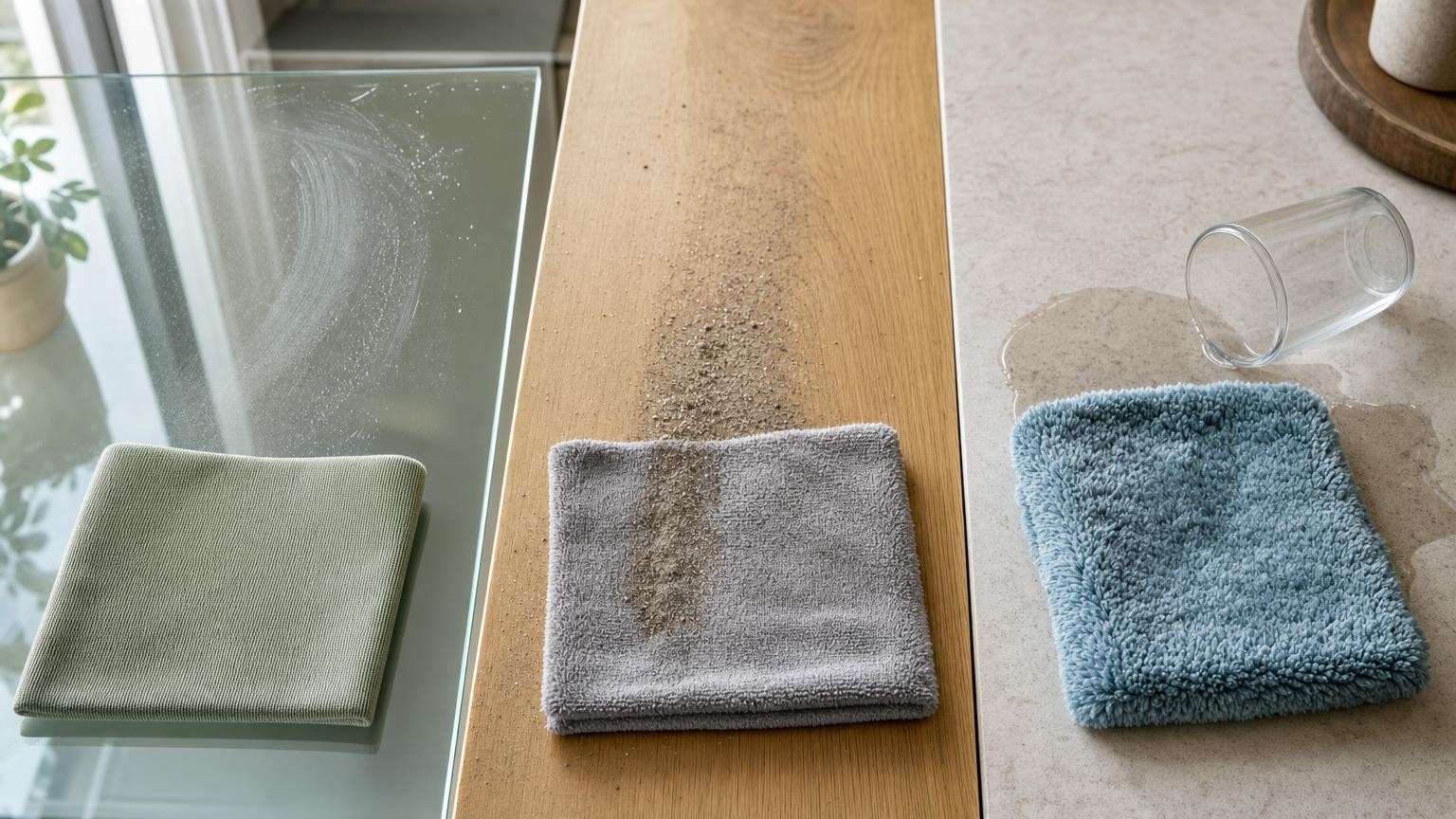
“Microfiber” describes a class of very fine synthetic fibres, not a single cloth design or level of performance. Two cloths carrying the same label can differ noticeably in how they pick up dust, absorb spills, move across glass, release dirt in the wash and withstand repeated use.
The differences come from the whole construction: filament size, whether the fibres are split, material blend, knit, pile, density, edge finish and even the label. Understanding those features makes it easier to choose a cloth for glass, dusting, drying or everyday cleaning instead of treating grams per square metre as a universal quality score.
Why two “microfiber” cloths can behave very differently
A cleaning cloth has to make contact with a surface, loosen or collect unwanted material, and hold that material until it is rinsed or washed away. Its construction affects every step.
A smooth cloth may maintain even contact on glass and leave little visible lint, yet offer less space for holding crumbs or heavier dust. A plush cloth can surround loose particles and carry more liquid, but may feel cumbersome on a small polished area. A dense cloth may feel substantial without necessarily being the easiest to wring out or manoeuvre.
This is why “best” only makes sense in relation to a task. Glass cleaning rewards different characteristics from dusting shelves, wiping a kitchen worktop or drying a wet surface.
The fibre basics: filament size, splitting and material blend
Microfibers are finer than many conventional textile fibres. Fine filaments provide numerous points of contact with a surface, helping a cloth interact with small particles and thin films of moisture or residue.
Some fibres are split during manufacturing. Splitting creates multiple fine sections, increasing the number of edges and spaces within the yarn. Those spaces can help collect particles and draw in liquid. An unsplit fibre can still be used in a cleaning textile, but it may behave more like a smooth filament and provide a different balance of wiping, absorption and release.
This mechanism is not identical to simple absorbency. A cloth can remove a thin film effectively because its fibres make close contact with the surface, while another can hold a larger total volume of liquid because it has more material and internal space. Pickup, capillary action and overall liquid capacity are related, but they are not interchangeable measures.
Many microfiber cloths use polyester and polyamide. Broadly, polyester contributes strength and cleaning contact, while polyamide can assist with moisture handling. However, a blend percentage does not reveal the filament size, quality of splitting, yarn arrangement, pile or finishing. Two cloths listing the same materials can therefore perform differently. Where construction details are limited, the blend should be treated as one clue rather than proof of a particular result.
Knit structure and pile shape the cleaning action
The way yarns are knitted or woven determines how the cloth bends, stretches and presents its fibres to the surface. It can also influence drag – the resistance felt while moving the cloth – and how readily debris becomes lodged in the fabric.
Smooth, low-pile constructions keep much of the cloth close to a flat surface. This can make them useful for glass, mirrors, screens where permitted by the device maker, polished fittings and final buffing. A close structure may be less likely to leave obvious fibres behind, although “low lint” should not be interpreted as an absolute guarantee.
Longer or looped pile provides more depth. The fibres can reach around loose particles and offer spaces in which dust is held away from the surface. This is valuable for general dusting and textured areas. Plush pile can also increase liquid capacity, but it may create more drag when damp and may be less precise around corners or narrow fittings.
Some cloths use different textures on each side. One face may offer a shorter pile for wiping while the other provides more depth for collecting moisture or buffing. This can be versatile, but it does not eliminate the need to keep track of which side has contacted dirt. Turning a cloth over only helps if the second face is still clean.
Density and GSM: useful clues, not a performance score
GSM means grams per square metre. It measures the mass of fabric over a given area, not cleaning efficiency, fibre fineness or absorbency by itself. A higher-GSM cloth generally contains more material per unit of area, but that material can be arranged in very different ways.
Equal-GSM cloths might use different yarns, pile heights, knit structures or edge finishes. One may be compact and firm; another may be thick and plush. They can consequently differ in drag, drying time, linting and particle retention even though the listed number is identical.
Lighter constructions can be easy to fold, wring out and guide over glass or into tight spaces. They may dry relatively quickly, which is useful when cloths are washed or rinsed frequently. Their lower bulk can, however, limit how much liquid or debris they hold before another clean section is needed.
Heavier cloths can offer greater cushioning and liquid capacity, depending on their construction. They may suit drying, larger spills or broad general wiping. The trade-offs can include more resistance when wet, slower drying and extra effort when rinsing or wringing. A thick cloth is not automatically more effective for streak-free finishing, just as a light cloth is not automatically flimsy.
Use GSM to compare broadly similar constructions, not unrelated cloths intended for different jobs.
Edges, seams and labels matter in use
Edge finishing prevents fraying and helps determine how the cloth behaves over repeated washes. An overlocked edge uses thread around the perimeter and can be durable, although the seam may feel firmer than the cloth body. Bound edges add a separate strip of material and can provide structure, but they also create a raised border.
Ultrasonic-cut or other edgeless designs avoid a sewn perimeter and can keep more of the cloth uniformly flat. Their long-term resistance to edge wear depends on the fabric and quality of finishing, so “edgeless” should not automatically be read as more durable or universally safer.
For delicate finishes, a prominent seam, trapped particle or stiff label may matter. Sewn-in labels can catch during wiping or interrupt contact, particularly on small areas. If a label is designed to be removed, follow the maker’s instructions rather than tearing it out in a way that damages the seam.
No edge style guarantees scratch-free cleaning. The cleanliness of the cloth, the nature of the surface and the pressure used are at least as important. Even a soft, edgeless cloth can move abrasive grit across a finish.
Match the cloth to the job
Glass and polished surfaces
Look for a smooth, close construction with low visible lint and manageable drag. A low-pile cloth is often easier to keep flat, helping it remove thin residue rather than pushing it around. Using too much cleaning product can still cause streaks, so cloth choice and technique need to work together.
Dusting and loose particles
A cloth with some pile can surround dust, hair and crumbs rather than merely moving them along the surface. Enough depth to hold particles is helpful, especially on textured furniture or fittings. Inspect and refold the cloth regularly so a loaded section does not redeposit debris.
Everyday wiping
For worktops, tables and routine household cleaning, a medium-pile cloth with moderate absorbency is often a practical compromise. It should be easy to fold into several working faces, rinse and wring without becoming unwieldy. A highly specialised glass cloth may hold too little debris, while a very plush drying cloth can feel excessive for quick wiping.
Drying, scrubbing and applying products
Drying benefits from liquid capacity and sufficient surface area. Light scrubbing may call for a more textured face, although the cloth and pressure must still be suitable for the surface. Applying polish or another treatment may favour a controlled, even spread rather than maximum absorption. Using separate cloths for application and final buffing helps prevent the first cloth’s product load from being transferred back during finishing.
Lint, streaks, drag and scratches: what the cloth can – and cannot – explain
A cloth’s construction contributes to the cleaning experience, but it is not the only cause of a poor result.
- Lint may come from loose fibres, worn edges or laundering with towels and other lint-producing fabrics.
- Streaks can be caused by excess cleaning product, grease already in the cloth, hard-to-remove surface residue or insufficient clean working faces.
- High drag may reflect a dense pile, too little moisture, excessive pressure or a cleaning product that has started to dry.
- Scratches are often associated with hard particles trapped between the cloth and surface rather than softness alone.
Fold a cloth into sections and switch to a clean face as it becomes loaded. Shake or rinse away loose grit where appropriate before wiping, and avoid pressing harder simply because residue remains. A second pass with a clean cloth is often more controlled than repeatedly rubbing with a contaminated one.
Always consider the surface maker’s cleaning guidance. A cloth suitable for ordinary glass or a durable worktop is not automatically suitable for every coated screen, high-gloss finish or delicate material.
Care and durability are part of the buying decision
Microfiber performance can change with laundering. Fabric softener may leave a coating that interferes with contact and moisture handling. Excessive heat can damage synthetic fibres, while unsuitable bleach or harsh treatments may affect the fabric or its colour. The product’s own care instructions should take priority because fibres, dyes, seams and finishes vary.
Wash heavily soiled cloths separately from clothing and lint-producing textiles where practical. Residual grease, cleaning compounds or fibres from mixed loads can undermine the next cleaning task. Rinse thoroughly and let cloths dry fully before storage.
Colour-coding can help separate uses, such as keeping bathroom cloths apart from kitchen or glass cloths. This is an organisational aid rather than a substitute for washing. Rotating several cloths also allows saturated ones to be removed from use instead of being pushed beyond their useful capacity.
Inspect cloths for embedded grit, stiff residue, damaged edges and persistent contamination. A durable seam is valuable if it survives frequent washing, but durability must be balanced against bulk and drying time. A cloth that lasts physically but no longer rinses clean may not remain suitable for delicate work.
A practical specification checklist
When comparing listings or packaging, assess the features as a combination:
- Intended task: Decide whether the priority is glass finishing, dust pickup, everyday wiping, scrubbing or drying.
- Fibre construction: Look for information about split fibres or filament structure where disclosed, but do not rely on material percentages alone.
- Knit and pile: Choose a smooth, low-pile face for close contact or more pile where debris and liquid capacity matter.
- GSM and density: Use the figure to understand weight and bulk in context, not as a universal performance ranking.
- Edge finish: Consider seam stiffness, durability and whether the perimeter could interfere with the intended surface.
- Size: A cloth should be large enough to fold into clean sections but manageable when wet.
- Care instructions: Check washing and drying requirements before buying, especially if the cloth will see frequent use.
The word “microfiber” is only the starting point. The most suitable cloth is the one whose fibre, structure, pile, weight and finish fit the cleaning task. Judging that complete construction is more useful than choosing by softness, thickness or GSM alone.
Continue exploring on Frowse
Best Sellers · Top Rated · Fresh Finds · Under £50
Explore products on Amazon
Looking for products related to this guide? to enter your own search term.
Discover More Frowse Insights
- Ballpoint, Rollerball and Gel Pens: How Tip and Ink Design Change the Writing Experience
- Why the Hook on a Tape Measure Is Supposed to Move
- Why a Dehumidifier’s Extraction Rating Changes With the Room
- The Roof-Rack Fit Problem: Rails, Fixing Points and Clamp Systems Explained
- How Steam Irons Produce, Control and Lose Steam