




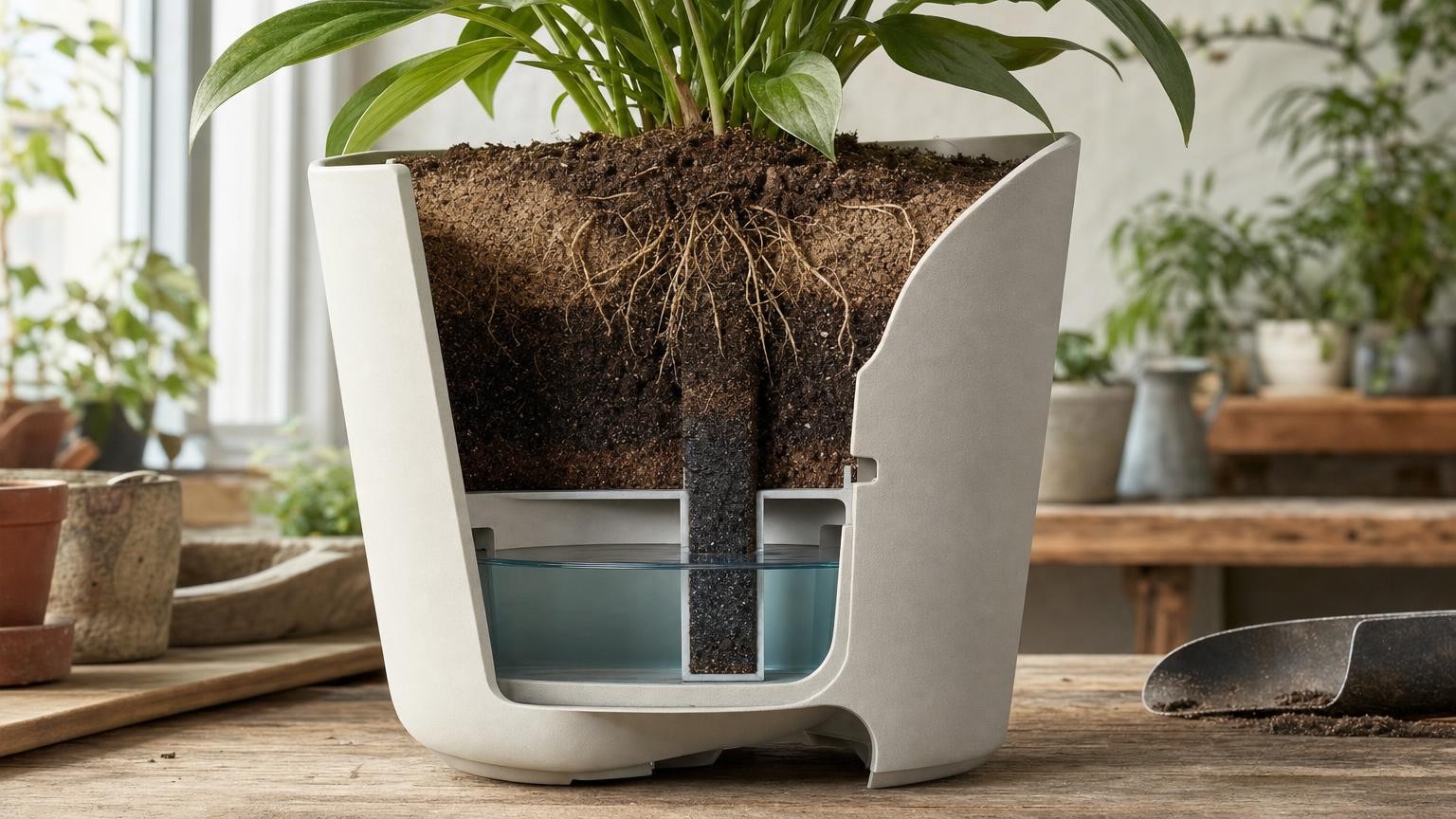
A self-watering planter does not actively pump water into its soil. Instead, it stores water below or beside the growing area and relies on a capillary connection to move moisture towards the roots. That connection may be a cord wick, an absorbent column of potting mix or part of the planter itself.
This distinction matters when comparing planters. A large reservoir can hold more water, but it cannot compensate for a poorly positioned wick, unsuitable potting mix, inadequate aeration or an overflow outlet that does not work correctly. Reliable performance comes from the entire water path, not the capacity figure alone.
The basic water path: reservoir, capillary bridge, mix and roots
Most self-watering planters use four connected elements: a reservoir, a capillary bridge, the potting mix and the plant’s root zone. Water begins in the reservoir and enters the bridge, which stays in contact with both the stored water and the growing medium. From there, it spreads through fine pores in the mix.
This movement is driven by capillary action and differences in moisture. As the upper mix becomes drier, water tends to move from wetter areas towards those drier areas. Plant roots remove moisture from the mix, while evaporation can also contribute to drying near the surface. These processes help maintain the moisture gradient that draws more water from below.
The result is better understood as a moisture zone than as automatic watering on demand. Water does not necessarily spread evenly to every part of a large container, and it does not bypass the physical properties of the mix. The distance it must travel, the amount of contact with the reservoir and the structure of the growing medium all affect distribution.
Roots still play an active role. As a plant establishes, roots may grow towards reliably moist areas. A newly planted specimen with roots confined near the top, however, may not immediately benefit from moisture stored much lower down. This is one reason initial top watering is often important.
Wicks, absorbent columns and false bottoms compared
Self-watering planters use several reservoir-to-soil arrangements. Understanding which one is present makes it easier to assess assembly, upkeep and likely moisture distribution.
Separate textile or cord wicks
A wick is a strip or cord made from material that absorbs water. Part of it sits in the reservoir while another part touches or extends into the potting mix. Wicks are simple and can provide a controlled capillary bridge without allowing the whole base of the mix to sit in water.
Their effectiveness depends heavily on installation. A wick that does not reach the water at lower reservoir levels, has poor contact with the mix or becomes displaced during planting may stop supplying moisture reliably. A narrow wick also has less contact area than a broad absorbent section. Over time, roots, sediment or mineral deposits may affect it, and some materials can deteriorate. Shoppers may therefore want to know whether the wick is accessible and replaceable.
Potting-mix-filled columns
Some planters have one or more openings or baskets that extend from the growing chamber into the reservoir. These are packed with potting mix, creating absorbent columns. Water rises through the pores in the column and then moves into the wider body of mix above.
Columns provide a larger soil-to-water contact area than a thin cord and contain no separate wick to position. They still require careful filling. Large voids, very loose packing or an unsuitable coarse medium can interrupt capillary contact. Excessive compaction can create the opposite problem by reducing aeration and keeping the lower mix persistently wet.
Raised or perforated false bottoms
A false-bottom design separates the growing area from the reservoir with a platform. Perforations, recessed sections or absorbent feet allow selected parts of the mix to contact reservoir water. The rest of the platform keeps most of the soil above the maximum water level.
This arrangement can distribute contact across several points, but the term covers many different layouts. A perforated base does not automatically mean that the whole growing chamber should be filled down into the reservoir. It is worth checking which sections are intended to hold mix and which must remain open for water or air.
Why potting mix controls water movement
Even a well-designed planter depends on the growing medium. Potting mix contains pores of different sizes. Smaller pores are generally more effective at holding and transmitting water by capillary action, while larger pores allow drainage and air movement. A useful medium balances moisture transfer with root-zone aeration.
Dense garden soil is usually a poor substitute for container potting mix. In a planter, it may compact, drain slowly and restrict oxygen around roots. Its behaviour in a confined container can be very different from its behaviour in the ground.
At the other extreme, a very coarse, open mix may contain gaps too large to maintain a continuous capillary path over the required height. Water might enter the bottom of the mix but fail to travel far enough upwards. Tall planters can make this limitation more noticeable because the water must rise further to reach much of the root zone.
Compaction also changes performance. Firm contact is useful within a wick pocket or absorbent column, but crushing the entire mix removes larger air spaces. Follow the planter and growing-medium instructions rather than assuming that tighter packing always improves wicking.
Severely dried potting mix can become difficult to re-wet. Water may run through isolated channels or fail to make good contact with particles. If the mix has dried completely, simply refilling the reservoir may not restore even moisture quickly. Careful top watering may be needed to reconnect the damp reservoir interface with the upper root zone.
Overflow holes, air gaps and refill points
These openings perform different jobs and should not be treated as interchangeable features.
The overflow outlet sets the maximum reservoir level. Once water reaches the height of the opening, excess should escape rather than continue rising into the growing chamber. This protects the intended air space and reduces the chance of the lower potting mix becoming fully submerged. Outdoors, it also provides an exit for rain entering the planter.
The position of the overflow matters. If it is too high for the internal layout, more mix may remain saturated than intended. If it is blocked by soil, roots, a wall or an outer decorative cover, the reservoir can overfill. Indoor use may require attention to where overflow water will go, particularly when filling through a tube.
An air gap separates most of the root zone from standing water. It is not unused space. Roots need oxygen as well as moisture, and the gap helps the planter provide a wet reservoir without turning the full soil chamber into a water-filled container. Some roots may eventually enter reservoir spaces, but that does not remove the need for ventilation and functioning overflow control.
A fill tube or refill opening provides reservoir access. Its diameter, position and visibility influence day-to-day convenience. A narrow or concealed opening may be harder to use without spilling. A removable tube or accessible reservoir can make cleaning easier. A level indicator may help, but shoppers should consider whether it shows the usable range clearly and whether it can be removed if deposits interfere with its movement.
Reservoir capacity is not the same as watering interval
Capacity tells you how much water a reservoir can hold, not exactly how long that water will last. Refill frequency is affected by the rate at which the plant and its surroundings remove moisture.
- Plant size and growth: A large, actively growing plant will generally use more water than a newly planted or slow-growing one.
- Foliage: More leaf area can mean greater water loss through transpiration.
- Temperature, light and airflow: Warm, bright or breezy conditions can increase water use and evaporation.
- Potting mix: Its water-holding capacity and capillary behaviour affect both delivery and storage within the root zone.
- Planter proportions: Soil depth, surface area and the distance from reservoir to roots influence moisture movement.
- Outdoor rainfall: Rain may reduce the need to refill, but it can also fill the reservoir rapidly if the planter is exposed.
- Season: Water demand can change as growth, light and temperature change.
The reservoir may also have less usable capacity than its overall internal volume suggests. Structural supports, absorbent columns and the need to preserve an air gap occupy space. For comparison, look for a clearly described usable water capacity, but treat any duration estimate as conditional rather than guaranteed.
Matching moisture delivery to the plant and setting
Self-watering systems are most intuitive for plants that tolerate or prefer relatively consistent moisture. They can reduce the sharp swing between freshly watered and very dry mix, provided that the reservoir, capillary bridge and medium are appropriately matched.
They may be less suitable for plants that benefit from a pronounced drying period or that are particularly sensitive to persistent moisture around their roots. The label self-watering does not establish universal plant compatibility. A planter can work mechanically while still creating the wrong moisture pattern for a particular plant.
Setting matters too. Indoors, conditions may be stable, but lower light or cooler temperatures can reduce water use. Continually topping up the reservoir without checking the soil may then maintain more moisture than expected. Outdoors, direct sun and wind can empty the same reservoir much faster. Rain can also enter the growing chamber, making an unobstructed overflow especially important.
Consider placement as part of the choice. A planter against a wall may have an inaccessible overflow or refill opening. A reservoir level window can be difficult to read in a dark corner. Large containers become heavier when both soil and water are added, so access for filling and seasonal relocation deserves attention before planting.
Set-up, first watering and routine ownership
Correct set-up establishes the continuous moisture path on which passive irrigation depends. Fit wicks through the intended openings and make sure they reach both the reservoir and potting mix. Fully fill absorbent columns, avoiding empty pockets while preserving the general structure of the mix. Keep air spaces and overflow channels clear.
After planting, water from above slowly and evenly. This settles mix around the roots, moistens the capillary bridge and gives a new plant access to water before its roots extend downwards. Depending on the design, the reservoir can then be filled through its designated opening. Check that excess water can leave through the overflow.
Monitor the planter during its early use rather than immediately relying on a fixed refill schedule. Feel the mix at more than one depth where practical, observe whether the plant is using water and note how quickly the level changes under current conditions. A permanently full indicator does not prove that moisture is reaching the root zone; equally, a dry-looking surface does not prove that the mix below is dry.
Routine care can include clearing the overflow, checking wick contact and removing sediment or mineral deposits from accessible reservoir parts. Roots may grow into openings or around indicators. Removable inserts and generous access can make this work easier, especially in planters intended for long-term use.
How to evaluate a self-watering planter before buying
- Identify the transfer mechanism: Is it a replaceable wick, a potting-mix column or an integrated false-bottom system?
- Check the capillary contact area: Consider whether the design provides enough contact for the planter’s width and soil depth.
- Find the overflow: Confirm that it is clearly positioned, likely to remain accessible and suitable for the intended indoor or outdoor location.
- Inspect the refill route: Look for an opening that can be reached after the planter is full-grown and placed in position.
- Consider water-level visibility: Decide whether you can see or measure the remaining water without dismantling the planter.
- Assess soil depth and air space: A large external planter may devote a substantial portion of its height to the reservoir or structural cavity.
- Think about cleaning: Removable liners, tubes, indicators or reservoir panels may simplify maintenance.
- Check replaceable parts: If the design depends on a textile wick, find out whether it can be accessed and whether a suitable replacement can be fitted.
- Match it to the plant: Judge the moisture pattern, root depth and aeration rather than relying on the self-watering label alone.
Choose the whole watering system
A reservoir is only one component of a self-watering planter. Water must pass through a dependable capillary bridge, spread through a suitable potting mix and reach roots without eliminating the air they need. Overflow height, refill access, planter proportions and maintenance all influence whether that process remains reliable.
For a useful comparison, look beyond the largest stated capacity. Identify how water moves, how excess escapes and how the system can be checked and cleaned. Then consider the plant, setting and seasonal demand. Choosing the whole watering system provides a sounder basis for purchase than treating every reservoir planter as equally self-sufficient.
Continue exploring on Frowse
Discover More Frowse Insights
- Why a Wireless Charger’s Wattage Is Not Its Charging Speed
- What Feed Dogs, Presser Feet and Hooks Do in a Sewing Machine
- Why Noise-Cancelling Headphones Work Better on Some Sounds Than Others
- Porcelain, Stoneware and Earthenware: What the Names Really Mean
- Inside a Duvet: How Fill and Construction Determine Warmth