




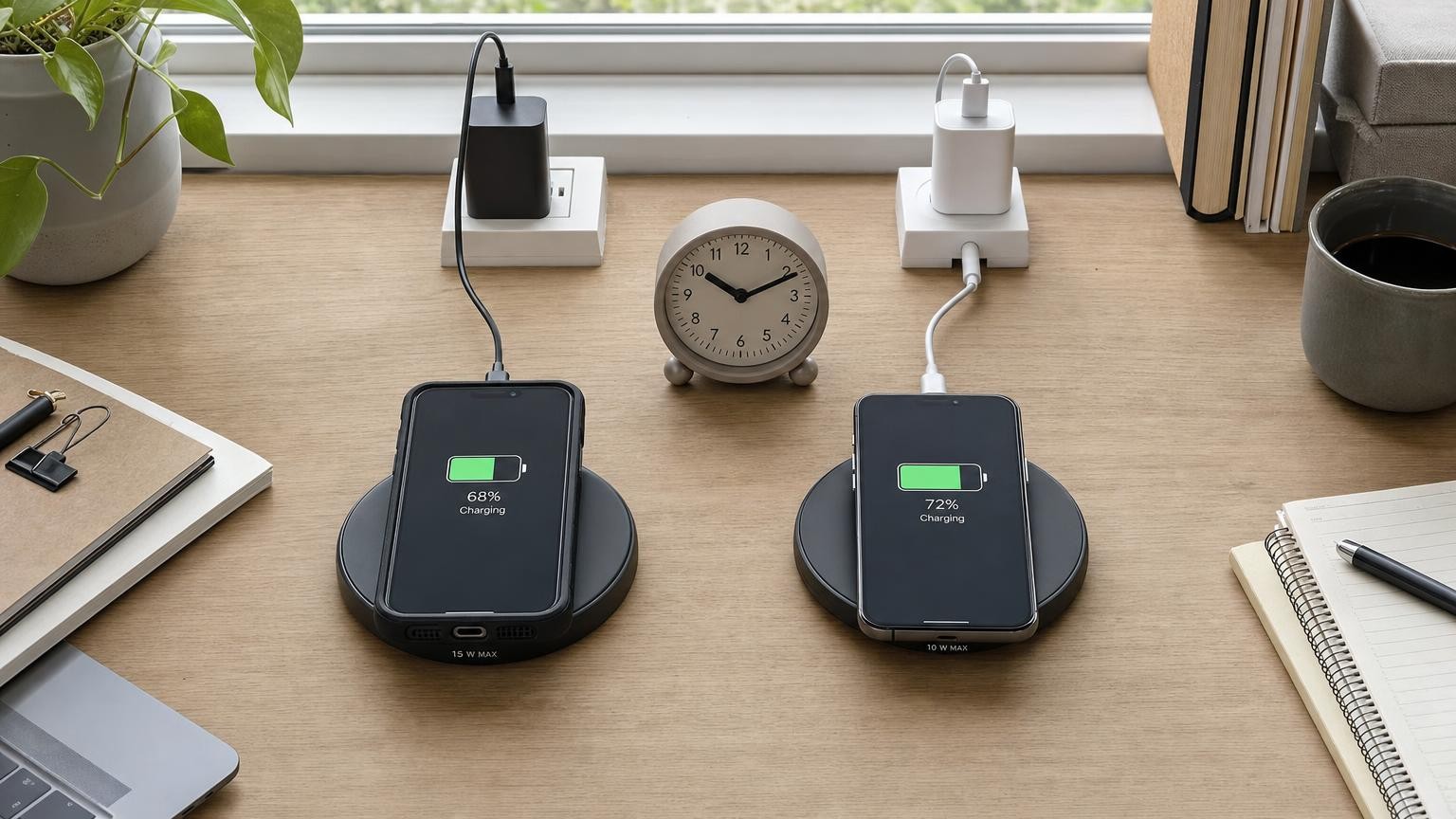
A wireless charger labelled 15 W may look faster than one labelled 10 W, but those figures do not tell you how quickly either will charge your phone. Wattage is a measure of power, not elapsed charging time, and the number on the box usually represents a maximum available output under compatible conditions.
The power that reaches a phone depends on the complete charging system: the wall adapter, cable, charger, coil alignment, phone, case and surrounding temperature. The phone also controls how much power it accepts at any moment. Advertised wattage is therefore best understood as a ceiling, not a stopwatch.
The power path from wall socket to battery
Wireless charging involves more stages than plugging a cable directly into a phone. Electricity travels from the wall socket through an adapter and cable to the charging pad or stand. A transmitting coil inside the charger creates an electromagnetic field, which transfers energy to a receiving coil in the phone. The phone then converts and manages that energy before it reaches the battery.
Power is lost as heat at several points in this process. The adapter and charging electronics are not perfectly efficient, while imperfect coil alignment can make wireless transfer less efficient. The phone’s battery-management system also adjusts power according to battery level, temperature and other operating conditions.
This makes it important to distinguish between three specifications:
- Input rating: the power the wireless charger may draw from the adapter.
- Wireless output: the maximum power the charger is designed to transmit in a supported charging mode.
- Power received by the phone: what the handset can accept after compatibility limits and transfer losses are considered.
These figures are not interchangeable. A charger that requires a particular input does not necessarily deliver all of that power wirelessly, and the power transmitted by the charger is not necessarily the same as the power ultimately used to charge the battery.
Charging time also depends on battery capacity and the phone’s charging curve. Phones commonly vary power during a session rather than maintaining one rate from empty to full. A charger may approach its peak under favourable conditions and then deliver less as the battery fills or the device becomes warmer.
Power negotiation sets the usable limit
A charger does not simply transmit its full rated power as soon as a phone is placed on it. The two devices communicate to establish a mutually supported charging mode. Higher power is available only when both sides support a compatible method and the required conditions are met.
In practice, the lower compatible limit usually governs performance. A high-wattage charger cannot force a phone to accept power beyond the level or mode the phone supports. Equally, a phone capable of faster wireless charging may fall back to a lower level when paired with a charger that does not support its preferred mode.
This is why comparing the largest printed wattage can be misleading. Two chargers with the same headline rating may not provide the same power to a particular handset. One might explicitly support the phone’s higher-power mode, while another reaches its advertised maximum only with different compatible devices.
Before buying, check whether the stated output applies to your phone or only to selected models or charging modes. General wireless compatibility may mean that charging works, but it does not guarantee the charger’s maximum advertised output.
Coil alignment can matter more than peak wattage
Wireless power transfer works best when the transmitting coil in the charger overlaps correctly with the receiving coil in the phone. If the phone sits too high, low or far to one side, less energy may transfer efficiently. Charging can become slower, generate more heat, stop intermittently or fail to start.
Placement sensitivity varies because phones and chargers use different shapes, coil positions and surface designs. A pad gives the user freedom to position a phone, but that freedom also makes an off-centre placement possible. A stand may guide the phone into a more repeatable position, although the height of its coil still needs to suit the phone’s geometry. Large camera housings can also prevent some phones from resting flat.
Some chargers use multiple transmitting coils to increase the area in which a phone can establish a useful connection. This can make positioning more forgiving, but it does not mean that all coils combine to multiply the charging power. Their practical benefit is usually placement flexibility rather than a simple increase in speed.
Magnetic positioning can help by pulling compatible devices or cases into a repeatable alignment. This reduces guesswork and can keep the phone from moving when it is touched. Magnets do not automatically make wireless charging faster, however. The charger and phone must still negotiate a supported power mode, and heat or input limitations can still reduce output.
Cases, accessories and distance interfere with transfer
Wireless charging can work through many phone cases, but every layer increases the distance between the two coils. A thick case, uneven back or raised camera surround may stop the phone from sitting in the charger’s intended position. Even when charging starts, the arrangement may be less efficient than direct contact.
Materials and attached accessories matter as well. Metal components can interfere with wireless transfer and should not sit between the phone and charger. Wallet attachments, cards, grips and stands may add distance, block alignment or prevent the device from lying flat. They may need to be removed before charging.
Magnetic accessories require particular attention. A case or ring described as compatible may improve alignment when its position matches the phone and charger, but a poorly positioned add-on can have the opposite effect. Compatibility is a property of the whole combination, not just one accessory viewed in isolation.
When assessing a charger, consider the case and accessories you actually use each day. A setup that works only after repeatedly removing a case may be inconvenient even if it delivers a higher theoretical peak. If you prefer a thick protective case or an attached grip, placement tolerance may matter more than maximum wattage.
Heat turns peak output into lower sustained power
Peak output describes a best-case maximum, not necessarily the power sustained throughout a charging session. Wireless transfer creates heat, especially when alignment is poor or the gap between coils is greater. The battery itself also warms while charging, and the phone’s processor, display and radios can add more heat when the device is in use.
Phones and chargers manage temperature by reducing power when necessary. This means a charger may initially operate at a higher level and then slow as the system warms. A product with a larger advertised output can therefore be less impressive in everyday use if it cannot maintain efficient transfer under your normal conditions.
Several practical factors can influence temperature:
- Charging in a warm room or direct sunlight gives the system less ability to shed heat.
- Streaming, navigation, gaming or video calls can warm the phone while it charges.
- A thick case may retain heat as well as increasing coil distance.
- Soft furnishings can obstruct airflow around a pad or adapter.
- Poor alignment wastes more energy as heat instead of useful charging power.
Some chargers use vents, larger surfaces or active cooling to manage heat. These features can support more consistent operation, but they introduce other trade-offs such as size, cost or fan noise. Design type alone does not settle the issue: both pads and stands can perform well when they hold the phone securely, align the coils and allow heat to escape.
For overnight or desk charging, dependable positioning and moderate sustained power may be more useful than a brief peak. If you regularly use the phone while it charges, thermal behaviour becomes an even more important consideration.
The wall adapter and cable complete the system
A wireless charger cannot provide more usable power than it receives from its power source. Some models include a suitable adapter, while others provide only the pad and perhaps a cable. When an adapter is not included, reaching the stated wireless output may depend on supplying the correct type of input.
The wattage printed on an adapter is not the only consideration. The adapter and charger need to support compatible power-delivery behaviour, including an appropriate voltage and current combination. An adapter with a high total rating may still fail to provide the mode the wireless charger requests. In that situation, the charger may operate at a lower level rather than reaching its advertised ceiling.
The cable is part of the same chain. It needs suitable connectors and sufficient capability for the required input. A damaged, poorly fitting or unsuitable cable can create another limitation. Long or low-quality cables may also be less effective at delivering power reliably.
Check the charger’s stated input requirements rather than assuming that any spare plug will do. If the product does not include an adapter, account for the cost and convenience of obtaining a compatible one. Also note whether the quoted performance assumes a particular adapter that is sold separately.
How to compare wireless chargers intelligently
Instead of ranking chargers by wattage alone, compare how well each option fits your phone and daily routine. A useful buying process is:
- Start with the phone. Identify the wireless charging modes and maximum levels the handset supports. A charger with a much higher ceiling will not override the phone’s limit.
- Check model-specific compatibility. Look for clear confirmation that the advertised output applies to your phone, not merely a general statement that it can charge wirelessly.
- Consider alignment. Decide whether you prefer a magnetic mount, a guided stand or an open pad. Think about the phone’s size, coil position and camera housing.
- Include your normal case. Check guidance on thickness, materials and magnetic accessories. Consider whether wallets, grips or stands must be removed.
- Review adapter requirements. Establish whether a compatible adapter and cable are included and what input mode is needed for maximum output.
- Think about sustained use. Ventilation and thermal design matter if you charge in warm spaces or use the phone heavily while it is on the charger.
- Match the form to the task. A stand can keep the screen visible at a desk, while a pad may suit a bedside table. Secure positioning can be more valuable than a small difference in theoretical power.
Also interpret charging claims carefully. A maximum output figure describes capability under stated conditions; it does not promise that every phone will receive that power or that it will be maintained from start to finish. Clear compatibility and input information is often more useful than a larger headline number without context.
Conclusion: judge the whole charging setup
A wireless charger’s wattage is one constraint in a longer power path. Actual charging speed depends on the adapter and cable supplying the right input, the charger and phone agreeing on a compatible mode, the coils remaining aligned, the case and accessories staying out of the way, and the system managing heat.
The best choice is therefore not automatically the charger with the highest printed wattage. Look for a setup that matches your phone, works with your everyday case, positions the device consistently and includes or clearly specifies the required power supply. Dependable sustained charging in real conditions is a more meaningful measure than a peak figure viewed on its own.
Continue exploring on Frowse
Discover More Frowse Insights
- Full-Grain, Top-Grain, Split and Bonded Leather Upholstery Explained
- The Roof-Rack Fit Problem: Rails, Fixing Points and Clamp Systems Explained
- Single-Coil, Humbucker and Active Pickups: How the Hardware Shapes the Signal
- Why Headphone Impedance Alone Does Not Tell You How Hard They Are to Drive
- What Determines How Long a Cool Box Stays Cold?