




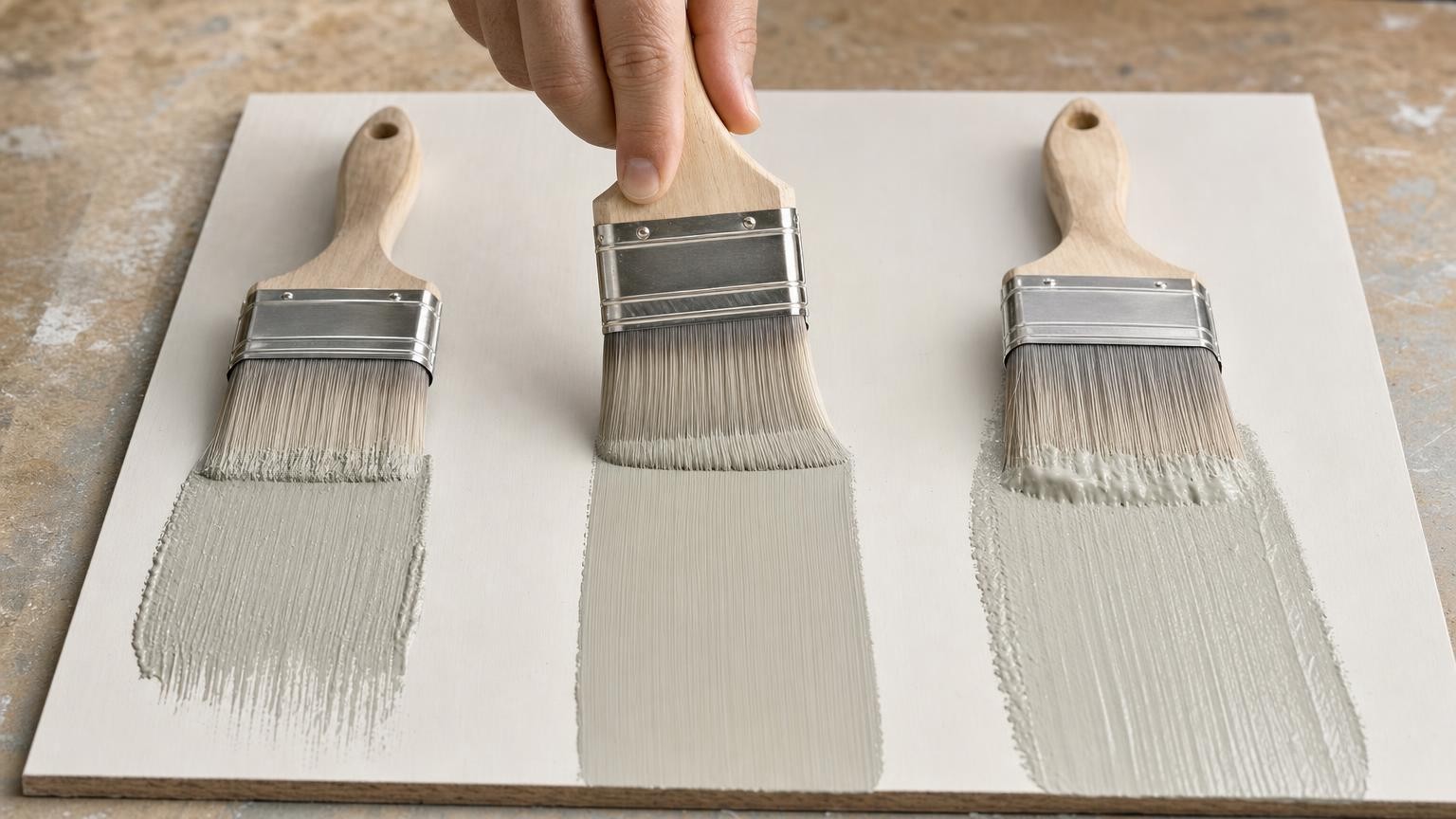
Two paintbrushes of the same width can behave very differently. One may carry a useful amount of paint, release it evenly and form a controlled edge. Another may feel empty after a short stroke, leave tramlines or spread apart under pressure. The difference is rarely explained by one feature alone.
Paint capacity, edge control and shape retention come from the interaction of filament material, taper, tip treatment, stiffness, pack density, brush profile and assembly. Understanding these elements makes it easier to assess whether a brush suits a particular coating and task rather than relying on colour, price or a broad quality label.
Why Similar-Looking Paintbrushes Perform Differently
A brush has to perform several jobs at once. It must pick up coating, hold it between the filaments, carry it to the surface and release it at a useful rate. It must also spread the coating without requiring excessive pressure. For cutting in, its working edge needs to remain predictable as the brush moves along a boundary.
These demands can conflict. More filament can increase capacity but also add drag. Softness can help a coating level smoothly but may reduce authority on a rough surface. A long filament pack can offer reach and fluid movement, yet feel less precise than a shorter one.
Shape retention is similarly complex. Stiff filaments are not necessarily resilient, and soft ones are not automatically weak. What matters is whether the filaments recover after bending, remain aligned and receive adequate support from the ferrule and setting compound.
Filament Material: Matching the Brush to the Coating
Paintbrush filaments fall broadly into natural bristle, synthetic filament and blended constructions. Each interacts differently with liquid coatings.
Natural bristle
Natural bristle has a surface structure that can help it pick up and release many solvent-based coatings effectively. It also tends to soften and conform during use, which may be helpful when laying off certain finishes.
Water can be absorbed by natural bristle, however, causing it to swell and lose some of its intended firmness or shape. For that reason, it is generally less practical with water-based paints. This is a broad material tendency rather than a universal compatibility rule, so the coating and brush manufacturers’ guidance should still be checked.
Synthetic filaments
Synthetic filaments such as nylon- or polyester-type materials are designed to resist water absorption and remain dimensionally stable. This usually makes synthetic brushes a practical choice for water-based paints. Different synthetic formulations can vary considerably in softness, stiffness, wear resistance and recovery, so the word synthetic alone says little about how a brush will feel.
Some synthetic brushes are engineered to imitate aspects of natural bristle, while others are deliberately firmer or smoother. Blended filament packs may combine materials or filament types to balance capacity, release, control and resilience. Compatibility should therefore be judged from the complete specification, not merely the broad material category.
Taper, Flagging and the Path Paint Takes Through the Brush
Filaments do not have to be uniform cylinders. In a well-designed pack, tapered filaments can be thicker near the ferrule and finer towards the working end. The resulting spaces within the body of the brush help receive paint, while the narrower tips create a more refined contact area.
This geometry helps explain why overall thickness is not the same as useful capacity. Paint needs pathways through the filament pack. If the arrangement is poorly balanced, the brush may hold paint deep inside but release it reluctantly, or shed too much near the beginning of a stroke.
Flagging refers to split or specially formed filament tips. Multiple fine ends create more contact points with the coating and surface. Depending on the wider construction, this can improve pick-up, moderate release and reduce prominent brush marks.
Flagged tips should not be confused with random damage. Purposeful tip treatment is generally distributed across the working end and contributes to a consistent profile. Conversely, visibly rough ends are not automatically proof of useful flagging. The relevant question is whether the tips form an even, functional edge and work coherently as a pack.
Stiffness, Flex and Recovery
Stiffness determines how readily a brush bends under pressure. A firmer brush can offer authority when pushing heavier coating, reaching into textured surfaces or guiding an edge. It may also provide clearer feedback through the handle because less movement is absorbed by the filament pack.
A softer brush can conform more readily and may help spread or lay off coatings with fewer pronounced marks. Too much softness for the task, however, can make the edge difficult to steer. The filaments may fan out when pressure is applied, especially if they are long or sparsely packed.
Flex describes the movement during a stroke, while recovery describes what happens afterwards. A useful brush bends progressively and then returns towards its original profile. Poor recovery can leave the pack splayed or twisted, making each subsequent stroke less predictable.
Ambient temperature, coating viscosity and surface texture can change how stiffness feels in practice. A brush that feels firm when dry may become more pliable once loaded. The aim is therefore not maximum stiffness, but enough support for the job without creating excessive drag or a harsh finish.
Pack Density and Paint Capacity
Capacity depends partly on how much filament is present, but also on how those filaments are arranged. Spaces between them act as small channels and reservoirs. An appropriate combination of density and spacing lets the brush load efficiently and release coating over a controlled distance.
A densely packed brush may carry more coating and hold its profile under pressure. Yet excessive density can make loading slower, increase resistance across the surface and trap paint near the ferrule. It can also make thorough cleaning more demanding.
Too little filament creates different problems. The brush may need frequent reloading, release paint unevenly or split into separate sections during a stroke. A sparse pack also provides less mutual support, which can weaken the working edge.
When assessing density, gently view the brush from the end and sides. Look for an even distribution rather than obvious gaps, clumps or an irregular silhouette. Density should be considered alongside filament length and stiffness: a full pack of very soft, long filaments may still behave less precisely than a smaller, firmer pack.
Brush Profile, Width and Edge Control
The external shape determines how much of the brush contacts the surface and how easily the painter can see and guide the working edge.
- Flat brushes provide a broad, straight contact area. They suit general coating work and can cut an edge when their filament pack is sufficiently controlled.
- Angled brushes place a narrower leading point at one side. This can improve visibility and manoeuvrability around frames, corners and other boundaries, although the angle does not compensate for weak recovery or a poorly formed tip.
- Oval or rounded brushes can provide greater body and capacity. Their shape may suit repeated loading and broader application, but the fuller profile can feel less direct in confined areas.
Width affects both efficiency and control. A broad brush covers more area per stroke but can be cumbersome near narrow trim or detailed boundaries. A narrow brush fits restricted spaces and offers local control, although it requires more strokes on large surfaces.
Filament length matters too. Longer filaments often hold more coating and produce a flowing stroke, while shorter filaments generally feel more immediate. For cutting in, a manageable width, visible working edge and reliable recovery are usually more important than capacity alone.
Ferrule and Handle Construction: The Support System
The ferrule is the sleeve joining the filament pack to the handle. Inside it, setting compound anchors the filaments, while plugs or spacers may help establish the required thickness and internal shape. Together, these components prevent the pack from shifting and provide support near its base.
A ferrule that moves relative to the handle makes control difficult. Poorly secured filaments may also work loose during painting or cleaning. Before use, practical signs of sound assembly include a firmly attached ferrule, an evenly shaped filament pack and no obvious movement at the handle joint. A few loose filaments can occur with a new brush, but repeated shedding suggests that the pack is not remaining securely anchored.
The handle should allow the intended grip without forcing the wrist into an awkward position. A short handle can be convenient in confined spaces, while a longer or fuller handle may suit broad, repeated strokes. Handle finish and shape affect comfort, but they cannot correct an unstable ferrule or poorly balanced filament pack.
Reading the Whole Brush Rather Than One Specification
No single visible characteristic reliably predicts performance. A practical assessment starts with the coating and task, then considers how the brush features work together.
- Check coating chemistry. Establish whether the paint or finish is water-based, solvent-based or requires a particular applicator type.
- Define the finish needed. Fine joinery and smooth surfaces may favour controlled release and refined tips, while textured areas may require more stiffness and reach.
- Match the profile to the area. Consider whether access, edge visibility, broad coverage or capacity is the main priority.
- Assess flex and recovery. The pack should bend without collapsing and return towards an even shape.
- Inspect assembly. Look for a secure ferrule, consistent shaping and minimal loose material.
Avoid choosing solely by softness, filament colour, overall thickness or price. Terms such as professional do not by themselves describe material, tip geometry or recovery. Useful specifications explain what the brush is made from and the types of coating or task for which it is intended.
Care, Cleaning and Shape Retention
Construction determines a brush’s starting performance, but care influences how long that performance is preserved. Avoid loading paint so deeply that it accumulates around the ferrule, where it is harder to remove and can force filaments apart.
Clean the brush with the method and cleaning medium appropriate to the coating. Work residue out from within the pack rather than only rinsing the surface. Avoid prolonged soaking, particularly where liquid can affect the setting compound, ferrule or handle connection.
After cleaning, remove excess moisture without sharply twisting the filaments. Reshape the pack while it is damp and allow it to dry without pressure on the working tips. Storage that bends the filaments can set the brush into an unwanted profile. A protective cover, where supplied, can help maintain the intended shape once the brush is clean.
Choosing for the Job, Not for Every Job
The most useful selection sequence is straightforward: identify the coating chemistry, decide how smooth or textured the target surface is, consider the size of the working area and determine how much edge control is required. Then compare material, taper, tip treatment, stiffness, density, profile and assembly as a complete system.
A high-capacity brush may not be the most precise. A very soft brush may not suit a coarse surface. A firm angled brush may guide an edge well but be unnecessarily tiring for laying off a large smooth area. These are deliberate trade-offs rather than simple signs of good or bad quality.
The right brush is therefore not one that claims to do everything. It is one whose filaments, shape and support structure are balanced for the coating and task at hand – and whose performance can be preserved through suitable cleaning and storage.