




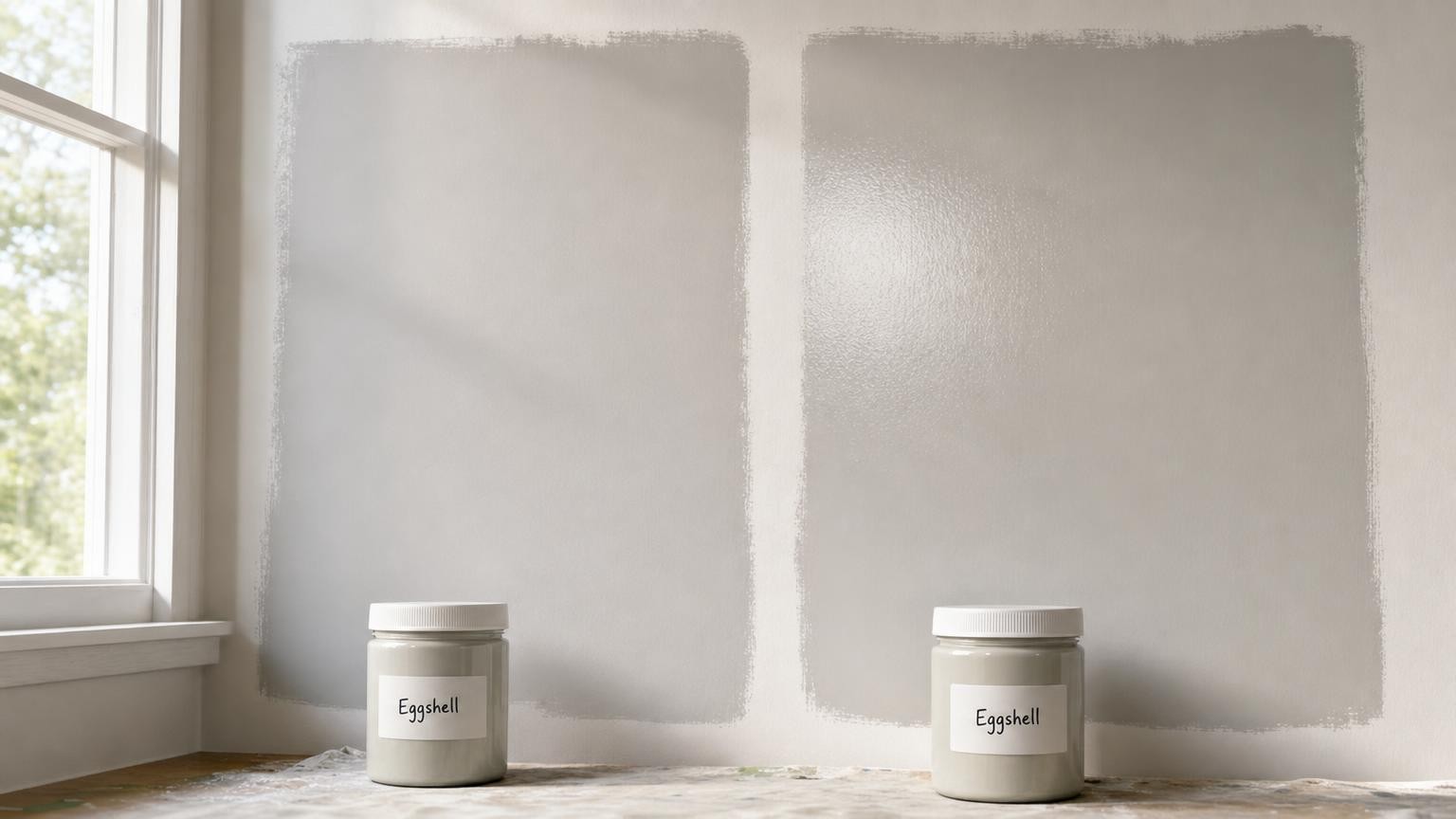
The same sheen name can mean a different finish
Matt, eggshell, satin and gloss sound like straightforward steps on a single scale. In practice, they are broad descriptive categories rather than universal specifications. One manufacturer’s matt may reflect noticeably more light than another’s, while a finish sold as eggshell in one range might resemble satin in another.
This matters because sheen affects more than appearance. It can influence how clearly you see wall defects, roller marks and repaired areas, as well as how easy the surface is to clean or touch up. However, the name on the tin cannot reliably predict all of those qualities. Paint formulation, colour, substrate, preparation, application and lighting contribute to the final result.
The best approach is to use the sheen label as a starting point, then compare technical information and test the paint under the conditions in which it will actually be seen.
How paint sheen is measured
Paint sheen is assessed by measuring specular reflectance: the amount of light reflected from a surface in a particular direction. A gloss meter directs light at the dried coating and measures the reflected light at a corresponding angle. The reading describes the behaviour of that tested film under defined conditions, not simply how bright the colour looks.
Measurement angle matters. A single angle is not equally useful for every finish. A steeper, grazing angle can distinguish between low-sheen surfaces that might produce very similar readings at another geometry. Higher-gloss coatings can be assessed at an angle better suited to separating strongly reflective finishes. A mid-angle measurement is also widely used for many general comparisons.
You may therefore see sheen or gloss values reported at angles such as 20, 60 or 85 degrees, depending on the finish and testing method. These readings should not be treated as interchangeable. Gloss units are also instrument readings, not a direct percentage of reflected light. Comparisons are most meaningful when the figures were obtained using the same test method, angle, substrate and preparation.
Where a manufacturer provides numerical sheen data, it usually gives a more precise basis for comparison than the descriptive name alone. Check whether the data refers to a particular colour, application method or curing period, as the tested result may not represent every possible use of the product.
Why matt, eggshell, satin and gloss overlap
There is no single naming sequence that every paint brand and market must follow. Matt normally indicates a low-reflectance appearance, while gloss indicates a clearly reflective surface, but the categories between them can overlap substantially.
Manufacturers may also use terms such as flat, ultra-matt, velvet, low sheen, soft sheen, silk, semi-gloss or high gloss. These names can describe useful differences within one product range, yet they do not establish an exact comparison with another range. For example, silk may occupy a satin-like position in one market or brand family, but that relationship should not be assumed universally.
Eggshell is particularly open to interpretation. It may indicate a restrained, softly reflective finish, but products bearing the name can differ noticeably in apparent sheen. Some are intended primarily for walls, while others are formulated for woodwork or other substrates. The shared label does not mean the paints have the same application characteristics or performance.
Even familiar terms can vary between countries. A shopper comparing imported paint with a locally familiar range should therefore prioritise measured sheen, intended use and sample appearance rather than trying to translate names directly.
What creates sheen inside the paint film
A dried paint film contains binder, pigments and, in many formulations, mineral extenders and other additives. The binder forms the continuous film that holds the solid particles together and attaches the coating to the surface. The balance of these ingredients, along with the way the film forms while drying, affects its microscopic texture.
A smoother film reflects more light in an organised direction, creating a glossier appearance. A microscopically rougher surface scatters light in many directions and appears flatter. Pigments and extenders can contribute to this scattering by interrupting the smoothness of the film.
It is common to hear that more resin or binder automatically means more gloss. This is a useful shorthand in some comparisons, but it is not a complete rule. Binder type, pigment loading, particle size, additives, drying behaviour and the way the coating levels all influence the final surface. Two paints with different formulations may reach a similar sheen while behaving differently during application or cleaning.
The film also develops over time. A finish viewed before it has dried and cured as directed may not show its settled appearance or performance. Product instructions are therefore important when deciding when to judge a sample.
Why colour and lighting change the perceived finish
Measured sheen and perceived sheen are related, but they are not identical. A dark or saturated colour can make bright reflections, roller bands and changes in surface texture more conspicuous. Strong contrast between a dark wall and a reflected window or lamp may make a moderate sheen feel more pronounced than it does in a pale colour.
Lighting direction matters just as much. Diffuse daylight can make a surface look relatively calm, while low-angle sunlight may reveal every ripple and lap mark. Directional lamps can create distinct highlights that are absent under broad ambient lighting. The same wall may look matt when viewed straight on and significantly more reflective when seen along its length.
Small colour chips are poor tools for judging this behaviour because they do not reproduce the room’s substrate, scale, lighting or viewing angles. A useful sample should be large enough to show a reflection and should be inspected from several positions. Look at it in daylight and after the room’s normal evening lights are switched on.
Surface preparation and application can alter the result
Paint can only form an even-looking finish over a reasonably consistent base. Porous filler, bare plaster, old glossy patches and previously painted areas may absorb the new coating differently. This can create flashing, where repaired or unevenly sealed areas appear as patches of changed sheen.
A suitable primer or sealer can help create a more uniform substrate, but preparation still matters. Sanding marks, dents, ridges and ripples become more obvious as reflectivity increases. Gloss and higher-sheen finishes tend to highlight defects because their directional reflections are disturbed by every change in the surface.
Application choices can also change the visible result:
- Roller pile: A roller’s texture can leave a more or less pronounced surface pattern.
- Brush and roller technique: Heavy brush marks, inconsistent pressure and repeatedly working partly dried paint can create uneven texture.
- Film thickness: Thin and heavy areas may level or dry differently, producing visible bands.
- Thinning: Unapproved dilution can affect coverage, flow and film formation. Follow the product instructions rather than applying a general rule.
- Drying conditions: Uneven airflow, temperature or absorbency can cause adjoining areas to set at different rates.
For a meaningful test, use the same primer, roller or brush, number of coats and application technique planned for the room.
Sheen, washability and durability are related – but not identical
Higher-sheen paints have traditionally been associated with smoother, denser films that resist marking and cleaning better than flatter finishes. That relationship can still be useful as a general orientation within a single, consistently formulated range. It is not a guarantee across all products.
Washability, stain resistance, moisture suitability and abrasion resistance are distinct performance characteristics. Modern low-sheen coatings may be designed for repeated cleaning, while a shiny coating may still be unsuitable for a particular substrate, room or cleaning method. A satin label alone does not establish how well a paint will resist stains, and a matt label does not prove that it is delicate.
Check the manufacturer’s intended-use guidance and any formulation-specific performance information. Consider what the room actually demands. A quiet adult bedroom, a busy hallway and a condensation-prone room present different maintenance conditions. The appropriate choice balances appearance with expected contact, dirt, cleaning and moisture rather than simply selecting the shiniest option.
Cleaning guidance also matters. Abrasive pads, strong cleaners or vigorous rubbing can polish, dull or otherwise alter a paint film, leaving a patch whose sheen differs from the surrounding wall.
Why touching up paint can leave a visible patch
Low-sheen wall paint is often chosen partly because it disguises surface imperfections, but that does not mean every repair will disappear. A touched-up area can reflect light differently even when it is made with paint left from the original job.
The existing coating may have aged, accumulated dirt or changed through cleaning. Stored paint may have separated and require thorough mixing. A different batch can introduce a small colour or sheen variation, while using a brush on an originally rolled wall creates a different texture. Applying a thicker repair coat can further change the way the patch catches light.
Touch-ups are most likely to blend when the paint is relatively recent, the same batch is available, the coating is well mixed and the original tool and technique can be reproduced. Feathering a repair does not always solve the problem because overlapping films may remain visible under directional light.
Before attempting several local repairs, inspect how the wall is normally viewed. A small patch in an inconspicuous corner may be acceptable. If the repair sits in a long sightline, receives grazing light or covers several separate marks, repainting from corner to corner can produce a more even result.
How to compare sheen before committing to a room
- Start with the intended use. Confirm that the paint is designed for the substrate and room conditions. Wall paint, trim paint and specialist coatings should not be compared by sheen name alone.
- Look for measured information. If sheen values are supplied, check the measurement angle and compare like with like. Use names only as broad orientation.
- Consider the surface. Decide whether the wall’s dents, repairs or texture will become distracting under a more reflective coating.
- Prepare a representative area. Test over the same substrate and primer rather than on an unrelated card if possible.
- Use the planned tools. Apply the recommended number of coats with the roller or brush intended for the job.
- Allow proper drying. Judge the sample after the stated drying or recoat process, not while it is still wet.
- Inspect it in context. View the area straight on and at an angle, during the day and under normal artificial lighting.
- Think about maintenance. Check suitable cleaning methods and decide whether occasional marks can be touched up acceptably or may require a larger repaint.
Choose the measured and tested finish, not just the name
Matt, eggshell, satin and gloss remain useful labels, but they are not universal definitions. Manufacturers can place those names over different reflectance ranges, and the dried result is shaped by formulation, colour, lighting, preparation and application.
A confident choice comes from combining the label with technical data, intended-use guidance and a representative sample. Testing the actual colour on the actual surface, using the planned tools and viewing it under the room’s lighting will reveal far more than a name on a tin. The right finish is not simply the flattest or shiniest option – it is the one whose appearance, maintenance needs and tolerance of the existing surface suit the room.
Continue exploring on Frowse
Discover More Frowse Insights
- Behind a Kitchen Knife’s Edge: Geometry, Hardness and Sharpenability
- Why a Washing Machine’s Kilogram Capacity Is Not the Size of Every Load
- Why the Hook on a Tape Measure Is Supposed to Move
- Why Heat-Pump Dryers Run Cooler, Longer and Differently
- What Makes Suitcase Wheels Smooth, Stable and Repairable?