




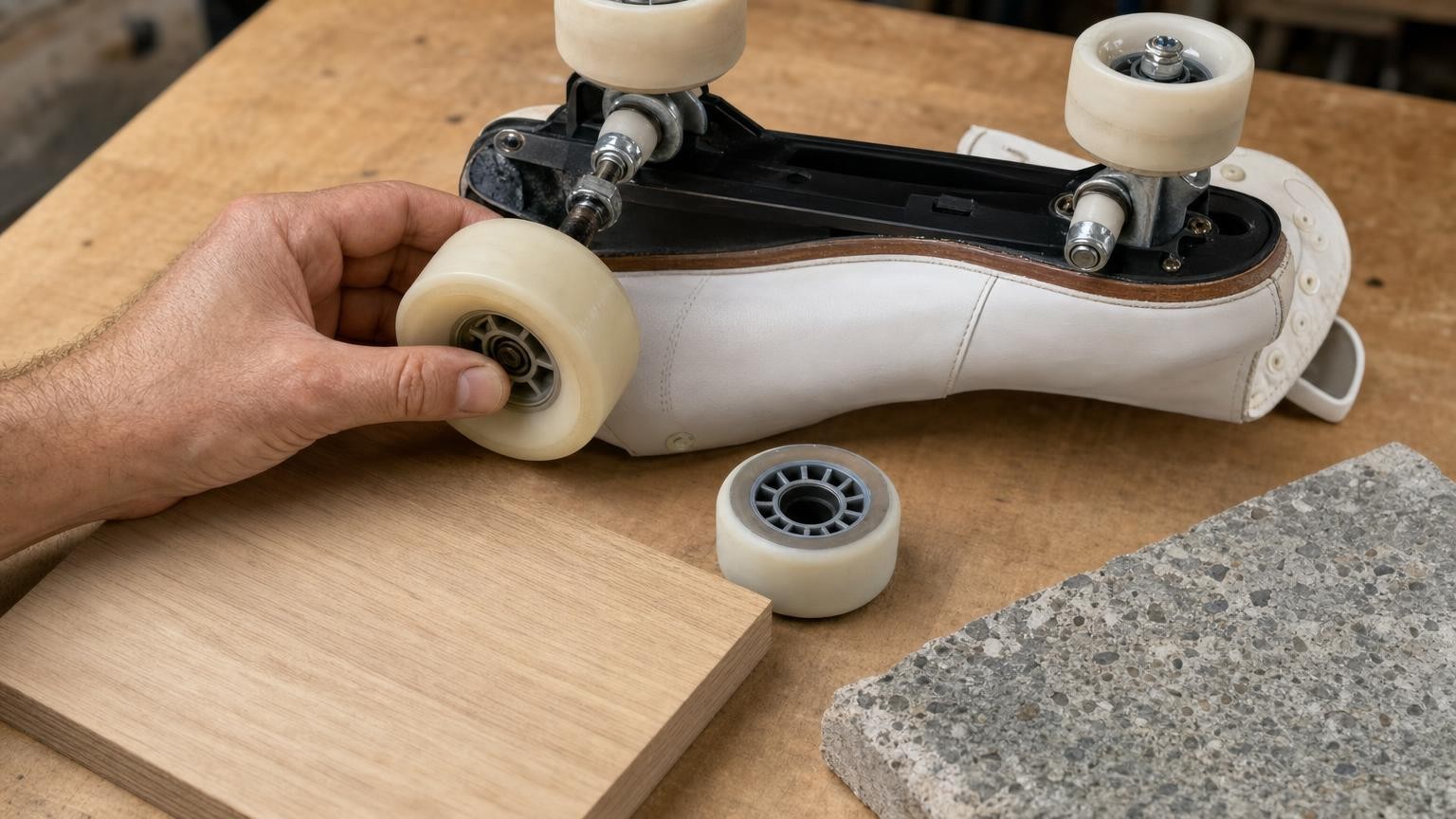
Roller skate wheel specifications can look like a simple collection of numbers, but no single figure determines how a skate will feel. Diameter influences ride height and the way a wheel carries speed. Hardness affects deformation, grip and vibration. Profile changes how the wheel engages with the floor, while the hub supports the polyurethane and holds the bearings in position.
These features work as a system. Rider weight, technique, skate geometry and surface condition also affect the result, so specifications are best treated as comparative clues rather than guarantees. Understanding the main trade-offs can nevertheless help you narrow the choices and avoid buying a wheel that conflicts with your priorities.
Start with the surface and the kind of skating
Begin with where and how you expect to skate. Smooth indoor floors are comparatively predictable, allowing wheels to prioritise precise response, easy transitions or controlled release. Rough outdoor paths usually place greater value on vibration damping and the ability to roll over small cracks, joints and debris. Mixed-surface skating requires a compromise because a wheel that feels comfortable outside may feel less direct indoors.
Your skating style matters too. Recreational cruising often favours comfort and sustained roll. Rhythm and dance skating may put greater emphasis on controlled edges, quick footwork and predictable transitions. Agility-focused skating tends to reward responsiveness and manageable wheel dimensions. There is no specification that is automatically best for all these uses.
Surface labels such as “indoor” and “outdoor” can be helpful starting points, but they do not describe every floor. A polished rink, coated sports floor, textured concrete path and rough pavement all interact differently with polyurethane. Dust, moisture, temperature and wear can further change available grip. When comparing wheels, consider the actual surfaces you encounter most often rather than relying only on broad category names.
Wheel diameter: roll, acceleration and responsiveness
Wheel diameter is normally expressed in millimetres. A larger-diameter wheel generally carries momentum more readily and meets small surface irregularities at a shallower angle. This can make cracks and textured ground feel less disruptive. The trade-off is that a larger wheel may take more effort to accelerate and can feel less immediate during rapid direction changes.
A smaller wheel tends to feel more responsive when starting, stopping or changing direction. It also lowers the skate slightly, which can create a more connected sensation. However, smaller wheels may lose momentum sooner and react more noticeably to rough surfaces.
Diameter cannot be considered without the skate itself. Increasing it raises the boot and changes leverage around the trucks. It also reduces clearance between the wheel and the plate, boot or mounting hardware. During a turn, the trucks articulate and the wheels move relative to the boot and plate. If clearance is inadequate, contact can occur – sometimes called wheel bite – interrupting the wheel’s rotation.
Before moving to a substantially different diameter, check the skate manufacturer’s guidance and inspect the available space throughout the steering range. Two skates that accept the same axle and bearing format may not have the same usable wheel clearance.
Durometer and polyurethane: hardness is only a starting point
Durometer is intended to indicate the hardness of the wheel material. In broad terms, softer polyurethane deforms more readily under load. That deformation can help the wheel conform to surface texture, improving grip and reducing the amount of vibration transmitted through the skate. Softer wheels are therefore often associated with comfort on rougher ground.
Harder wheels deform less and tend to feel more direct. On a suitable smooth surface, they may roll with a lively response and release from the floor more readily during turns or deliberate sliding movements. They also transmit more surface texture, especially when used outside or on imperfect flooring.
The printed hardness number is not a complete description of performance. Polyurethane chemistry affects rebound, damping, wear and the way a wheel responds under repeated loading. Two wheels with apparently similar ratings can feel different because they use different formulations, hubs, profiles or testing methods. Ratings stated on different durometer scales are also not directly interchangeable.
Temperature and condition can alter the experience further. Polyurethane may feel different in colder or warmer environments, while wear can change the profile and contact patch. A hardness rating is most useful when comparing closely related wheels from the same range, but it should not be treated as an exact prediction across every brand and construction.
Wheel profile and contact patch: edges, stability and release
The profile is the shape of the wheel across its rolling surface and edges. A wheel with rounded or strongly radiused edges tends to move onto and off its edges progressively. That can suit skaters who want fluid transitions or who do not want the outer edge to engage abruptly.
A squarer profile places more material towards the edges and may provide a more defined feeling when the wheel is loaded laterally. This can feel stable and predictable, although the exact result depends on the compound, width and surface. Edge shape changes as the wheel wears, so a wheel that starts with crisp shoulders may become increasingly rounded over time.
Width and contact patch are related but not identical. Overall width includes parts of the wheel that may not touch the floor, while the contact patch is the portion actually loaded against the surface. A wider wheel can provide a broader base, but width alone does not determine grip. Polyurethane deformation, rider load, inflation-free material behaviour, profile, floor texture and contamination all influence how much of the wheel is effectively engaged.
Narrower wheels may make crossovers and close footwork easier by reducing bulk around the skate, while wider wheels may feel more planted. Neither tendency overrides compound and profile. A narrow soft wheel can still generate substantial grip, and a wide hard wheel may release more readily on a smooth floor.
Hub construction: support, weight and consistency under load
The hub is the central structure that locates the bearings and supports the surrounding polyurethane tyre. Its size, shape and stiffness influence how much the urethane can flex under load.
A larger or stiffer hub generally leaves a thinner layer of polyurethane between the hub and the floor. This construction can limit deformation and produce a more immediate response. It may also help the wheel hold its intended shape during harder cornering. However, material choice and spoke design affect weight, so hub size by itself does not tell you whether the complete wheel is light or heavy.
A smaller core leaves a deeper section of polyurethane. Depending on the formulation, that can provide more scope for damping and deformation. The resulting feel may be less rigid, but it can also be comfortable on uneven surfaces. More usable urethane does not automatically mean a longer service life because wear depends on compound, alignment, skating habits and surface abrasiveness.
Hub quality also matters for consistent bearing seating. Bearings should fit as intended without being loose or requiring inappropriate force. As with other wheel features, neither a rigid nor flexible construction is universally superior. The useful question is whether the support characteristics suit the desired balance of response and comfort.
How the specifications work together
Looking at complete combinations is more useful than choosing from one number. Consider these general tendencies:
- A tall, soft wheel with a substantial polyurethane layer may smooth rough paths and carry momentum effectively, but it can feel less agile and will require sufficient skate clearance.
- A small, hard and relatively narrow wheel may feel quick and lively on a smooth floor, while transmitting more vibration and reacting strongly to debris or joints outdoors.
- A broad wheel with defined edges and a supportive hub may feel stable when loaded laterally, though its actual grip still depends on compound and floor condition.
- A rounded, moderately sized wheel may provide progressive transitions and a balanced feel, but it will not automatically deliver the comfort of a softer formulation or the roll-over ability of a larger diameter.
Rider weight changes how much a wheel deforms, and truck adjustment affects how readily the skate turns. Plate geometry, wheelbase and boot support also shape the experience. A wheel cannot be expected to compensate fully for a poorly adjusted or unsuitable skate setup.
It is therefore better to rank your priorities than chase an imagined perfect combination. If rough-ground comfort comes first, some loss of immediate response may be acceptable. If precise indoor footwork is the priority, direct feedback may matter more than vibration isolation.
Fit and compatibility checks before buying
Wheel suitability includes mechanical fit, not just ride characteristics. Before ordering, check:
- Axle and bearing format: Confirm that the bearings required by the wheel are suitable for the skate’s axles. Do not assume every roller skate uses the same dimensions.
- Overall clearance: Check space around the boot, plate, trucks and mounting hardware with the skate both upright and turned.
- Wheel width and offset: Wheels can place their inner and outer faces differently relative to the bearings. Excess inward extension may create contact, while excess outward extension can change the stance and loading.
- Spacers and speed rings: Determine whether the skate or wheel setup calls for bearing spacers, axle washers or speed rings, and use components of the appropriate dimensions.
- Axle engagement: Ensure the axle nut can be fitted and secured correctly without binding the wheel or leaving unsuitable play.
Product descriptions do not always provide every measurement needed to assess an unusual combination. Consult the documentation for the plate, skate and wheel rather than relying on a broad claim that a component fits “most” skates.
Bearings matter, but ratings do not define the whole ride
Bearings affect how freely and consistently a wheel rotates, but their rating does not determine grip, vibration damping or wheel response. Those characteristics primarily come from the wheel, surface and wider skate setup.
A higher bearing rating alone does not guarantee a better skating experience. Cleanliness, lubrication, seal or shield design, manufacturing tolerances, correct installation and current condition all influence real-world performance. A well-maintained, appropriately fitted bearing may perform more consistently than a nominally higher-rated bearing contaminated by dirt or installed under unwanted side load.
Bearings also cannot turn a hard wheel into a comfortable outdoor wheel or make an incompatible diameter clear the plate. Treat them as an important rotating component, but keep their role separate from the properties of the polyurethane and hub.
A practical way to choose and reassess
Start by identifying the surface on which you skate most. Next, decide which quality matters most: grip, comfort, manoeuvrability or sustained roll. Use diameter, hardness, profile, width and hub construction to build a balanced shortlist, then verify mechanical fit before buying.
Once the wheels are in use, inspect how they wear. Roller skate wheels can wear unevenly because positions experience different loads. Rotation may help distribute wear, provided it follows appropriate guidance for the wheel and skate. Keep bearings clean according to their design, and check wheels for damage, severe flattening or changes that affect clearance and predictable rolling.
Published specifications are valuable, but they are not guarantees of a particular sensation. The most confident choice comes from connecting those specifications to your surface, skating style and hardware – then reassessing the setup as the wheels wear and your priorities develop.