


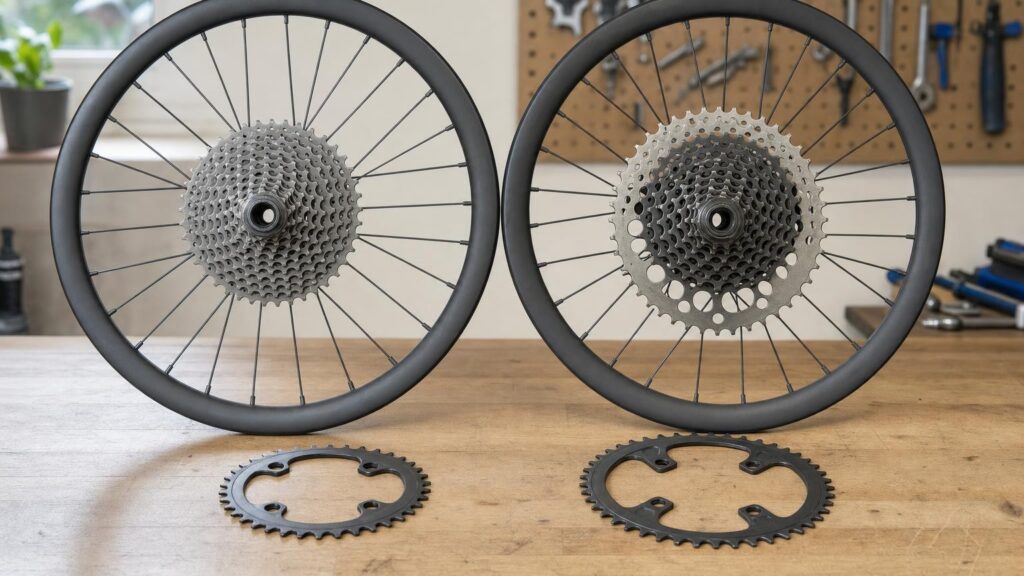
Why the speed count tells only part of the story
A bicycle described as 9-speed, 12-speed or 22-speed is telling you about its drivetrain configuration, not necessarily how its gears will feel on the road or trail. The label may indicate the number of rear sprockets, or the theoretical number of combinations obtained by multiplying the chainrings by the rear sprockets.
That number does not reveal whether the easiest gear is low enough for climbing, whether the highest gear suits faster riding or how much cadence changes with each shift. For a useful comparison, examine chainring and sprocket tooth counts, overall range, spacing between ratios and effective wheel size. Mechanical limits and component compatibility also matter, particularly when choosing replacement parts or planning an upgrade.
From tooth counts to gear ratios
A basic bicycle gear ratio is calculated by dividing the number of teeth on the selected front chainring by the number on the selected rear sprocket:
Gear ratio = chainring teeth ÷ rear sprocket teeth
For example, a 40-tooth chainring paired with a 20-tooth sprocket gives a ratio of 2:1. In simplified terms, the rear wheel turns approximately twice for each full revolution of the cranks. Pairing that chainring with a 10-tooth sprocket creates a 4:1 ratio. This travels farther for each crank revolution but requires more pedal force under otherwise identical conditions.
At the easier end, a 32-tooth chainring paired with a 40-tooth sprocket gives a ratio of 0.8:1. The wheel turns less than once per crank revolution, allowing more pedal revolutions for a given distance. That can be helpful on climbs, when carrying luggage or when riding over difficult surfaces.
- A larger front chainring creates a harder gear and more wheel rotation per crank revolution.
- A smaller front chainring creates an easier gear.
- A smaller rear sprocket creates a harder gear.
- A larger rear sprocket creates an easier gear.
These relationships explain why the number of sprockets is not enough to judge climbing ability. A drivetrain with more rear sprockets is not automatically easier than one with fewer. Its lowest gear depends on the largest rear sprocket, the selected chainring and the effective wheel size.
Lowest gear, highest gear and total range
The lowest gear normally combines the smallest chainring with the largest rear sprocket. This is the figure to examine when climbing, loaded riding or low-speed control is important. The highest gear usually combines the largest chainring with the smallest rear sprocket. It determines how far the bicycle travels per pedal revolution at the upper end.
Consider an illustrative double-chainring drivetrain with 50- and 34-tooth chainrings and an 11-34 cassette. Its lowest ratio is 34 ÷ 34, or 1.00. Its highest ratio is 50 ÷ 11, or approximately 4.55. Those figures describe the useful extremes more clearly than the nominal speed count.
Total gear range compares the highest ratio with the lowest. Divide the highest ratio by the lowest and express the result as a percentage. In this example, 4.55 ÷ 1.00 gives an overall range of approximately 455%.
Range is the span between the easiest and hardest gears, not the number of steps within that span. Two drivetrains can have similar ranges but divide them differently. One might use smaller, more frequent steps, while another reaches comparable extremes through fewer and larger jumps. Similar percentages can also conceal different priorities: one drivetrain may extend lower for climbing, while another extends higher for speed.
Gear spacing: what changes between shifts
Gear spacing describes the size of the change from one ratio to the next. Closely spaced sprockets usually produce smaller changes in cadence when shifting. Wider gaps cover more range with a given number of sprockets, but each shift is likely to feel more noticeable.
For example, shifting from a 20-tooth sprocket to an 18-tooth sprocket increases the resulting gear ratio by about 11%. Moving from 20 teeth to 16 increases it by 25%. The exact sensation depends on cadence, terrain, shift direction and effort, but the second change is substantially larger.
Smaller steps can be useful for steady road riding, where a rider may want to maintain a narrow cadence range. Larger steps may be acceptable for varied terrain, off-road use or everyday transport where reaching suitable low and high gears matters more than fine adjustment. Neither arrangement is universally better. The relevant question is whether the spacing suits the intended terrain and the rider’s tolerance for cadence changes.
Why more nominal speeds may not mean more useful gears
On double- and triple-chainring bicycles, multiplying the number of front and rear positions overstates the number of meaningfully distinct gears. A 2×11 drivetrain has 22 theoretical combinations, but some produce very similar ratios. Others may place the chain at an unnecessarily sharp angle.
A medium rear sprocket used with the larger chainring can produce nearly the same ratio as a smaller sprocket used with the smaller chainring. These are separate mechanical combinations, but they may not offer meaningfully different riding gears. Changing chainrings can also interrupt the progression because a front shift may need to be followed by one or more compensating rear shifts.
A single-chainring drivetrain generally presents a more linear sequence. Every rear shift moves to the next available ratio, with no duplicated front-ring combinations. This simplicity does not guarantee closer spacing or greater range. Covering a large range with one chainring may require bigger jumps between some sprockets. The usefulness of the sequence matters more than the theoretical total of available combinations.
How wheel size changes the result at the ground
A drivetrain ratio describes the relationship between crank and wheel rotations, but it does not state how far the bicycle travels. With the same ratio, a larger effective wheel diameter covers more ground per revolution and therefore creates a higher effective gear.
This is important when comparing bicycles with different wheel formats. Tyre width and profile also influence rolling diameter, so a nominal wheel label may not provide enough information for a precise comparison.
Two optional measurements account for wheel size:
- Gear inches are calculated by multiplying the drivetrain ratio by the wheel’s effective diameter in inches.
- Development describes the approximate distance travelled per crank revolution, based on the ratio and wheel circumference.
Ratios alone may be adequate when comparing bicycles with similar wheels and tyres. When wheel formats differ significantly, gear inches or development provide a clearer view of how the gearing translates into movement at the ground.
Choosing between single, double and triple chainrings
Single chainring
A single-chainring drivetrain removes the front shifter and front derailleur, reducing the number of controls and making the shift sequence straightforward. Purpose-designed drivetrains may also use chainring tooth profiles and related features to manage chain retention.
Range and spacing must both come from the rear cassette. A cassette covering a large range may use more noticeable jumps, while one with close ratios may limit the lowest gear, the highest gear or both. Check the actual tooth counts rather than assuming that a single-ring drivetrain has a particular range.
Double chainring
A double chainring can combine a substantial overall range with relatively close spacing at the cassette. It may suit riders who want low climbing gears as well as smaller cadence changes. The trade-offs include front shifting, overlapping ratios and the need to choose sensible combinations of chainring and sprocket.
Triple chainring
A triple chainring can provide a low inner ring and multiple ways to manage cadence across varied conditions. It also creates more ratio overlap, additional shifting decisions and greater front-derailleur complexity. Its suitability depends on terrain, load and whether the rider values fine control more than operational simplicity.
On multi-ring drivetrains, avoid routinely using the most extreme diagonal chain lines, such as the largest chainring with the largest rear sprocket or the smallest chainring with the smallest sprocket. This is known as cross-chaining. Selecting another front ring and compensating at the rear can often produce a similar ratio with a straighter chain line.
Derailleur capacity and the limits behind the numbers
A rear derailleur must move the chain between sprockets, clear the largest sprocket and take up changes in chain length across different gear combinations. Maximum sprocket size and total capacity are related but separate constraints.
Maximum sprocket size is the largest rear sprocket a derailleur is designed to clear in a stated configuration. Total capacity, also described as chain-wrap capacity, is the amount of tooth difference the derailleur cage must accommodate across the drivetrain.
For a multi-ring drivetrain, required capacity can be estimated with this calculation:
(largest chainring minus smallest chainring) + (largest rear sprocket minus smallest rear sprocket)
For a 50/34 chainset and an 11-34 cassette, the calculation is 16 + 23 = 39 teeth. A suitable derailleur must have enough total capacity and be designed to clear the 34-tooth sprocket. Satisfying one requirement does not establish that the other is satisfied.
Chain length, derailleur geometry and the bicycle’s hanger arrangement also affect setup. A longer cage does not automatically make every large cassette compatible. Check the manufacturer’s stated limits for the exact derailleur and drivetrain configuration.
Compatibility is more than matching the speed label
Two components carrying the same nominal speed label are not necessarily interchangeable. Before buying a replacement or upgrade, check the complete drivetrain system.
- Shifter and derailleur operation: Cable pull, derailleur movement or the relevant electronic protocol must match.
- Cassette and freehub fit: The cassette must use a mounting interface compatible with the rear hub.
- Chain specification: The chain must suit the sprocket count and the relevant chainring and cassette designs.
- Chainring suitability: Tooth profile, ring spacing and intended chain type can affect shifting and retention.
- Front shifting: A double or triple requires a compatible shifter, front derailleur, chainring arrangement and frame mounting provision.
- Crank and bottom bracket: Axle, shell, bearing and chain-line requirements must be considered together.
- Tooth limits and capacity: Verify maximum sprocket size, permitted chainring difference and total derailleur capacity.
Compatibility can vary between component generations even when the sprocket counts are identical. Manufacturer documentation or advice from a qualified bicycle workshop is more dependable than matching parts by speed count alone.
A practical way to compare gearing before buying
- Record the tooth counts. Note each chainring and the smallest and largest rear sprockets. A complete cassette sequence is needed to assess spacing.
- Calculate the lowest ratio. Divide the smallest chainring by the largest rear sprocket.
- Calculate the highest ratio. Divide the largest chainring by the smallest rear sprocket.
- Compare total range. Divide the highest ratio by the lowest and express the result as a percentage.
- Inspect the steps. Compare adjacent sprocket sizes and account for overlaps or compensating shifts on multi-ring systems.
- Allow for wheel and tyre size. Use development or gear inches when effective wheel diameters differ meaningfully.
- Verify mechanical limits. Check maximum sprocket size, derailleur capacity, chain requirements and every relevant component interface.
Finally, match the figures to the intended riding. Steep terrain, luggage and frequent low-speed riding may make the lowest ratio the priority. Steady riding can make close spacing more valuable. Some riders may prefer the simpler controls of a single chainring, while others may accept front shifting in exchange for different range and spacing characteristics.
A sound comparison is therefore not simply 9-speed versus 12-speed. Consider the lowest and highest gears, total range, shift spacing, wheel size and compatibility together – then relate them to terrain, preferred cadence, carried load and tolerance for noticeable jumps between gears.
Continue exploring on Frowse
Discover More Frowse Insights
- Tempered Glass, PET, TPU and Liquid Adhesive Screen Protectors Explained
- Pressurised and Traditional Espresso Baskets Do Different Jobs
- The Roof-Rack Fit Problem: Rails, Fixing Points and Clamp Systems Explained
- Why a Universal Remote May Not Replace Every Original Remote Function
- Why Mechanical Pencil Leads of the Same Diameter Perform Differently