


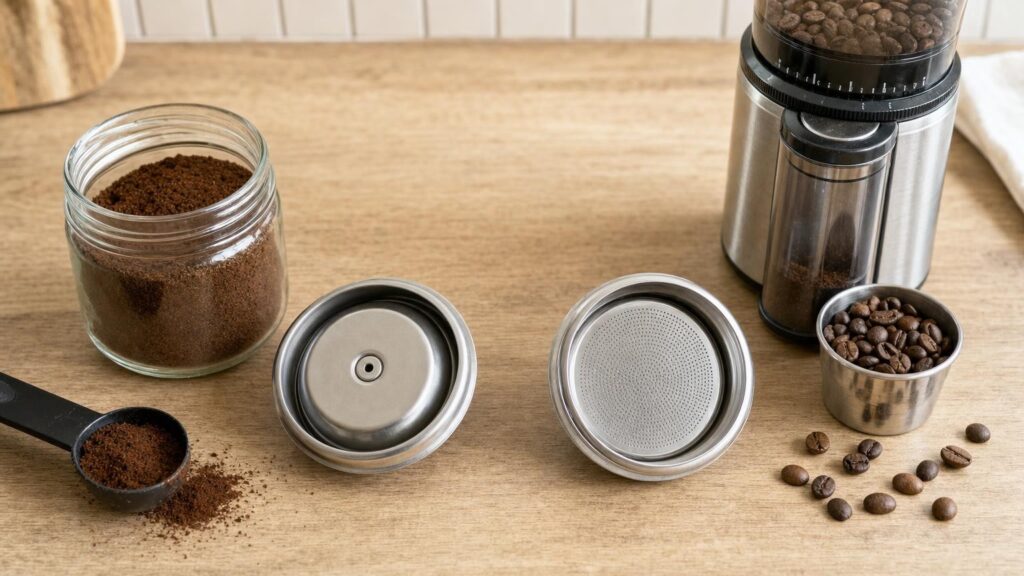
The filter basket inside an espresso machine may look like a simple metal cup, but its design has a major influence on how coffee flows and how much control the user has over extraction. Traditional single-wall baskets rely mainly on the prepared bed of coffee to provide resistance. Pressurised dual-wall baskets add a restriction after the coffee bed, making them more tolerant of pre-ground coffee and less precise preparation.
This does not make one type universally better than the other. Each solves a different problem. Understanding those differences can help you choose a machine, grinder or replacement basket that suits the way you actually want to make coffee.
Why the basket changes the way espresso is made
Espresso machines push hot water through ground coffee under pressure. For the brewing process to work as intended, the water must meet enough resistance that it does not simply rush through the basket. The location and source of that resistance differ between basket types.
With a traditional basket, resistance comes primarily from the coffee itself. Grind size, dose, distribution and tamping all affect how easily water can pass through the bed. Small preparation changes can therefore produce noticeable changes in flow and taste.
A pressurised basket introduces an additional flow restriction beneath the coffee. Water may move relatively freely through the grounds, but the brewed coffee then has to pass through a small outlet or similarly restrictive structure. This can stabilise the visible flow even when the grind is not ideally matched to espresso.
The choice is therefore about more than basket construction. It affects how forgiving the machine is, what kind of grinder is useful and how clearly the result reflects your preparation technique.
Single-wall and dual-wall baskets: what the terms actually mean
Traditional or single-wall baskets
A traditional basket has one main perforated base. Looking inside it, you will usually see many small holes across part of the bottom. Once brewed coffee passes through these holes, it leaves the basket without an additional pressure-forming chamber.
These baskets are also described as non-pressurised. That term does not mean the machine brews without pressure. It means that the basket itself does not add the same kind of downstream restriction found in a pressurised design.
Pressurised or dual-wall baskets
A pressurised basket typically combines an inner perforated layer with a second layer or restricted outlet below it. Coffee passes through the inner section and collects briefly before being forced through the smaller exit. Exact construction varies, but the purpose is broadly the same: to create additional resistance after water has passed through the coffee bed.
Dual-wall and double-wall are commonly used for this construction. These terms should not be confused with single-shot and double-shot baskets. Shot labels generally refer to intended dose capacity or serving format, while wall labels describe the basket’s construction. A double-shot basket can be either traditional or pressurised.
Where pressure and flow resistance come from
In a single-wall basket, the coffee bed acts as the main flow regulator. Finer particles leave narrower pathways for water, while coarser particles generally allow it to pass more quickly. Dose and distribution also matter because they change the depth and consistency of the bed.
If the grind is too coarse or the dose is unsuitable for the basket, water may flow quickly and extract too little from the coffee. If the grind is too fine, or the basket is overfilled, flow may become excessively slow or stall. Uneven distribution can create easier pathways through the bed, so parts of the coffee receive more water than others.
This sensitivity is useful when you want control. The way the shot flows provides feedback, and grinder adjustments can be used to change the result. However, it also means that an unsuitable grinder or inconsistent preparation becomes readily apparent.
With a pressurised basket, the restricted outlet contributes resistance even if the coffee bed does not provide enough on its own. Dose and grind still affect brewing, but their influence on visible flow can be less direct. The basket can produce a controlled-looking stream from grounds that would run too quickly in a traditional basket.
This added resistance should not be mistaken for correcting every extraction problem. It can moderate flow, but it cannot restore aroma lost from stale coffee or guarantee that water has extracted the coffee evenly.
Why pressurised baskets suit pre-ground coffee
Pre-ground coffee is produced for broad usability rather than for one particular basket, machine and recipe. Even coffee labelled for espresso may not have exactly the grind needed by a specific traditional basket. Its behaviour can also change as it ages and releases gases or absorbs moisture from the surrounding air.
A pressurised basket helps accommodate this uncertainty. Because its outlet adds resistance, the user does not have to rely entirely on the grind to control flow. This can be valuable when buying pre-ground coffee, using a grinder with limited adjustment or prioritising quick, repeatable preparation.
The practical routine may also be less demanding. Reasonably consistent dosing and level distribution still help, but tiny changes in grind and tamp are less likely to dominate the result. That can make a pressurised system more approachable for someone who does not want espresso preparation to become a detailed hobby.
The compromise is reduced diagnostic clarity. If a shot tastes unbalanced, the restricted outlet can make it harder to determine how much of the result came from grind, dose, coffee condition or preparation. The basket smooths over some visible symptoms that a traditional basket would expose.
Grind sensitivity, control and the role of the grinder
A traditional basket works best as part of a complete setup. A grinder suitable for espresso needs to make small, repeatable adjustments within the fine range and produce grounds consistently enough for an even coffee bed. The user then adjusts the grind as the coffee changes or when using a different bean or roast.
This process is often called dialling in. It involves observing how the coffee flows and, more importantly, tasting the result before making measured changes. Grind is usually the main adjustment, but dose and beverage yield can also influence extraction.
A basic grinder that changes in large steps may place one setting on the fast side and the next on the slow side. In that situation, a single-wall basket can be frustrating because the available settings may not provide the desired flow. A pressurised basket is generally more tolerant of this limitation.
Shoppers should therefore consider the grinder and basket together:
- Choose greater tolerance if you mainly use pre-ground coffee, have a simple grinder or want minimal adjustment between bags.
- Choose clearer control if you have a capable espresso grinder and want to tune flavour through grind, dose and yield.
- Allow for learning if moving to a traditional basket. Faster or slower shots are feedback rather than necessarily a fault with the machine.
A more demanding basket is not automatically an upgrade if the grinder and routine cannot support it. Conversely, someone who enjoys active adjustment may find a pressurised basket limits the usefulness of a precise grinder.
Crema can look similar while meaning something different
Crema is the foam-like layer that can form on top of espresso. Its appearance is influenced by several factors, including the coffee’s freshness, roast, dissolved gases, brewing conditions and the way liquid exits the basket.
The small outlet of a pressurised basket can agitate and aerate the brewed coffee, creating a pronounced foam layer. This can make the drink look visually similar to an espresso made from freshly ground coffee in a traditional basket, even when the coffee bed was not optimally prepared.
That appearance can be useful for presentation, but crema volume alone is not a reliable measure of extraction quality. A thick layer does not prove that the shot is balanced, while a thinner layer does not automatically mean the coffee is poor.
Assess the drink as a whole. Consider whether the flow appeared stable, whether the texture suits the intended drink and, above all, whether the espresso tastes balanced rather than sharply sour, hollow, harsh or excessively bitter. Visual clues are most useful when combined with taste.
Cleaning and blockage risks differ
Both basket types collect coffee oils and fine particles, so both require routine cleaning. In a traditional basket, the visible perforations can trap grounds. Holding the basket up to a light can make blocked holes easier to spot, although residue may still remain on surfaces that are not immediately obvious.
A pressurised basket has an additional chamber or narrow outlet that may be harder to inspect. Fine particles or dried residue can obstruct this restriction, potentially causing unusually slow, irregular or misdirected flow. Because the outlet is deliberately small, keeping it clear is particularly important.
Follow the machine and basket manufacturer’s cleaning instructions, including any guidance on soaking, cleaning products or removable components. Avoid forcing unsuitable objects into small holes, as this can damage or enlarge them.
Basket cleaning is only one part of espresso machine care. The portafilter, shower screen, group area, drip tray and milk system may have separate cleaning needs. Descaling addresses mineral deposits within relevant water pathways and is not a substitute for removing coffee oils from the basket.
Basket swaps are not automatically compatible
Replacing a pressurised basket with a traditional one can look like a simple way to gain more control, but compatibility involves more than matching the advertised diameter. Before buying, check the machine or portafilter documentation where available and consider all of the following:
- Diameter: The basket must fit the portafilter accurately, but the nominal measurement alone may not describe every fitting detail.
- Rim shape: Ridged and ridgeless designs can interact differently with the portafilter’s retaining spring.
- Depth: A deeper basket may contact the internal base of the portafilter or leave insufficient clearance.
- Dose capacity: Basket capacity should suit the amount of coffee used and the available space below the machine’s shower screen.
- Outlet clearance: The basket bottom must not interfere with internal supports, a spouted base or other portafilter structures.
- Machine arrangement: Some machines or portafilters are designed around a particular pressure-control system, insert or basket style.
A basket that physically drops into the portafilter may still fit poorly when filled, fail to lock into the group correctly or sit at the wrong height. Changes may also expose the limitations of the grinder. Confirming mechanical fit is only the first step; the basket must also suit the complete brewing system.
Choose the basket that matches the whole setup
A pressurised basket is a practical choice for pre-ground coffee, modest grinders and users who value convenience over detailed adjustment. Its added restriction makes brewing more forgiving and can provide consistent-looking results despite variation in grind.
A traditional basket is better suited to users who have a capable grinder and want direct control over extraction. It makes grind, dose and distribution more influential, but that sensitivity also provides clearer feedback and greater scope to shape flavour and texture.
Neither design should be judged in isolation. Consider the coffee you buy, the grinder you own, the time you want to spend adjusting and the compatibility of the machine and portafilter. The most suitable basket is the one that works coherently with the rest of your setup and your preferred level of involvement.
Continue exploring on Frowse
Discover More Frowse Insights
- What Dishwasher Salt and Rinse Aid Actually Do
- Porcelain, Stoneware and Earthenware: What the Names Really Mean
- Why Mechanical Pencil Leads of the Same Diameter Perform Differently
- How Fabric Softener Affects Absorbency, Static and Fabric Feel
- Why Hand-Blender Wattage Does Not Predict Blending Performance