





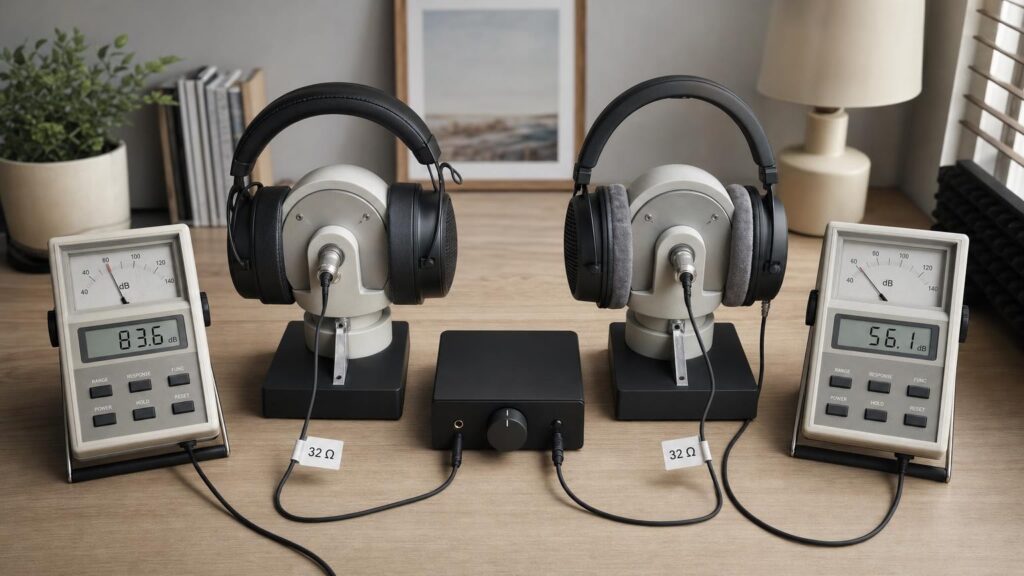
An impedance figure is often treated as a shortcut for judging whether wired headphones need a powerful source. Low-impedance headphones are assumed to be easy to drive, while high-impedance models are assumed to require a separate amplifier. That rule is appealingly simple, but it is not reliable.
Impedance describes an important part of the electrical load presented to the source. It does not, by itself, reveal how loudly the headphones will play from a given signal. For that, you also need to consider sensitivity, the source’s voltage and current capabilities, available headroom and output impedance.
The practical question is therefore not whether a headphone has a high or low ohm rating. It is whether a particular source can drive that particular headphone to the required level cleanly and consistently.
What headphone impedance actually describes
Headphone impedance, measured in ohms, describes opposition to the alternating electrical signal supplied by an audio source. It is related to resistance, but it is not necessarily the same as the simple direct-current resistance you might measure with a basic meter. Headphones contain electrical and mechanical elements whose behaviour can change with signal frequency.
The impedance printed on a specification sheet is usually a nominal value. The actual impedance may vary across the audible frequency range, sometimes substantially depending on the driver design. This means that a headphone labelled 32 ohms does not necessarily behave as an exact 32-ohm load at every frequency.
The rating is still useful. It gives a source designer or shopper a broad indication of the electrical load and helps when comparing the source’s output specifications. Higher impedances generally draw less current at a given voltage, while lower impedances generally draw more. However, impedance alone does not tell you:
- How much sound the headphones produce from a given electrical input
- How much voltage is needed for a desired listening level
- Whether the source can supply enough current cleanly
- How much headroom remains for musical peaks
- Whether source output impedance will alter the headphones’ tonal response
Those questions require more information, starting with sensitivity.
Sensitivity is the missing half of the volume question
Sensitivity indicates how much acoustic output a headphone produces for a stated electrical input. In broad terms, more sensitive headphones need less input to reach the same sound level than less sensitive ones.
The difficulty is that manufacturers do not always express sensitivity in the same way. Two common formats are decibels for one milliwatt, written as dB/mW, and decibels for one volt, often written as dB/V. These references are not interchangeable.
A dB/mW figure describes output for a specified amount of electrical power. A dB/V figure describes output for a specified voltage. The amount of power produced by one volt depends on impedance, so two headphones with equal dB/mW sensitivity but different impedances will not necessarily have equal dB/V sensitivity.
Consequently, it is misleading to compare the numerical values directly when one specification uses dB/mW and another uses dB/V. They must first be converted to a common reference, using the relevant impedance. Even then, the result should be treated as an informed estimate because measurement methods, fixtures and reporting conventions may differ.
Voltage, current and power: what the headphones ask of the source
Voltage, current, impedance and power are linked. In simplified terms, voltage provides the electrical pressure, current describes the flow, and power is the rate at which electrical energy is delivered. For a predominantly resistive load, current can be estimated by dividing voltage by impedance, while power can be estimated from voltage squared divided by impedance.
This helps explain why different headphones place different demands on a source:
- Higher-impedance headphones tend to need more voltage to receive a given amount of power, but draw less current at that voltage.
- Lower-impedance headphones can receive more power from a lower voltage, but may demand more current.
Neither category is automatically difficult. A high-impedance headphone with strong sensitivity may play adequately from a source that can provide enough voltage. A low-impedance but insensitive headphone may require considerable current and power, potentially challenging a small output stage.
Power ratings also need context. A source might provide substantial power into a low impedance but run out of voltage into a high impedance. Another might offer ample voltage but struggle to deliver current into a very low load. A single headline power number does not describe performance into every possible headphone.
Why equal impedance can produce very different results
Consider two hypothetical headphones that are both rated at 32 ohms. Headphone A has a sensitivity of 100 dB/mW, while Headphone B is rated at 90 dB/mW under an equivalent measurement method. At the same power input, Headphone A would produce substantially more acoustic output. Their identical impedance ratings do not make them equally easy to drive.
The reverse misconception is that a lower impedance must always mean greater volume. Imagine a sensitive 300-ohm headphone and a relatively insensitive 32-ohm headphone, with both sensitivities expressed in comparable dB/V terms. If the high-impedance model produces more output per volt, it could play louder from a source that has adequate voltage swing. The low-impedance model might demand more current while still producing less sound.
These examples are illustrative rather than promises of exact listening levels. Real results depend on frequency, fit, measurement method, the audio material and the source’s behaviour under load. The central lesson remains: impedance identifies the nature of the load, while sensitivity indicates how effectively electrical input becomes acoustic output.
The source matters as much as the headphones
To assess a pairing, look for source specifications such as maximum output voltage, output power into stated impedances, current capability and output impedance. A power figure is most useful when the load used for the measurement is reasonably close to the headphones being considered.
For example, a source rated only at 32 ohms gives useful information about lower-impedance operation but may not reveal how much voltage it can provide into 300 ohms. Likewise, a rating at a high impedance may say little about current delivery into a demanding low-impedance load.
Signs of insufficient drive can include inadequate maximum volume, compressed or harsh-sounding peaks, audible distortion as level rises, or too little headroom for quieter recordings. Lack of headroom matters because average listening level is not the whole story. Short musical peaks can require considerably more output than the average passage.
The position of a volume control is not a universal indicator of amplifier effort. Volume-control scales and gain structures vary widely. One device may reach normal listening level at 30 per cent, while another reaches it at 80 per cent without being any closer to distortion. What matters is the clean output available, not the visual position of the control.
Output impedance and its effect on sound
A source also has its own output impedance. This sits electrically between the amplifier and the headphones, where it can interact with the headphone’s changing impedance across frequency.
If the headphones have a strongly varying impedance curve, a relatively high source output impedance can change the voltage delivered at different frequencies. The result may be a shift in frequency response rather than simply a change in overall volume. The extent and direction of that shift depend on the headphone design.
Source output impedance can also affect electrical damping, which relates to how firmly the amplifier controls driver motion. Descriptions of audible damping effects should be treated cautiously because the outcome depends on the complete design, but low output impedance is generally the more predictable and broadly compatible choice.
You may encounter rules based on keeping source output impedance below a particular fraction of headphone impedance. Such ratios can be useful guidance, but they are not compatibility guarantees. A nominal headphone rating does not show its full impedance curve, and it does not reveal sensitivity or the source’s maximum clean output.
How to assess a headphone and source match
A practical specification check can be carried out in a few steps.
- Find the headphone’s nominal impedance. Use it to understand the approximate electrical load, while remembering that actual impedance may vary with frequency.
- Identify the sensitivity format. Check whether it is stated in dB/mW, dB/V or another reference. Do not directly compare figures that use different units.
- Examine source output at a relevant load. Look for voltage or power data measured near the headphone’s impedance. If only power is given, voltage can be estimated when the load is known, and vice versa.
- Consider both voltage and current demands. High-impedance designs may expose a voltage limit, while very low-impedance designs may expose a current limit.
- Allow useful headroom. A pairing that only just reaches the desired average level may not have enough reserve for quieter masters or brief peaks.
- Check source output impedance. A low value generally reduces the likelihood of unwanted interaction with the headphone’s impedance curve.
- Treat incomplete specifications cautiously. Figures from different manufacturers may use different measurement conditions. Calculations can guide a decision, but they cannot remove uncertainty from missing data.
Also consider how the headphones will actually be used. A desktop audio interface, portable music player, phone adaptor and home amplifier may have very different output capabilities. A headphone can be an easy match for one source and an unsatisfactory match for another without changing any of its own specifications.
When a separate headphone amplifier is genuinely useful
A dedicated headphone amplifier makes sense when the current source cannot provide adequate clean voltage or current, does not offer enough headroom, or has an output impedance that interacts poorly with the headphones. It can also be useful for practical reasons, such as adding a convenient physical volume control, supporting a required connection, switching between sources or integrating headphones into a desktop audio system.
An amplifier is less likely to provide a meaningful improvement when the existing device already reaches the required listening level with clean peaks, low noise and suitable output impedance. More rated power is not automatically audible if the headphones are already being driven within their needs.
Extra amplification also cannot repair a poor recording or fundamentally change the headphones’ inherent tuning. An amplifier may alter the result if its own frequency response, distortion, noise or output impedance differs, but that is not the same as every adequately powered headphone benefiting from a more powerful box.
Before buying additional equipment, identify the specific limitation. If the issue is simply an unsuitable tonal balance, different headphones or considered equalisation may address the preference more directly. If there is audible noise with sensitive headphones, an amplifier designed mainly for high output power may not be the appropriate solution. The useful amplifier is the one that solves a defined electrical or practical problem.
Judge the headphone-source system, not one rating
Impedance is not a difficulty score. It describes the electrical load, while sensitivity indicates the acoustic output produced for a stated input. The source must then supply the necessary voltage and current cleanly, with enough headroom and a suitable output impedance.
When comparing wired headphones, check whether sensitivity is quoted per volt or per milliwatt, examine source performance into a relevant load and avoid assuming that lower ohms always means easier to drive. A separate amplifier is worthwhile when it addresses a real limitation, not merely because an impedance number looks high.
Continue exploring on Frowse
Discover More Frowse Insights
- How Fabric Softener Affects Absorbency, Static and Fabric Feel
- What Makes a Paintbrush Hold Paint, Cut Cleanly and Keep Its Shape?
- Why a Tripod’s Load Rating Does Not Tell You How Steady It Will Be
- Why a Power Bank Delivers Less Capacity Than Its Label Suggests
- Why Matt, Eggshell, Satin and Gloss Paint Labels Are Not Universal