





Fabric softener can make freshly washed laundry feel smoother, smell more fragrant and cling less when it comes out of the dryer. Those benefits come with a trade-off: the conditioning layer responsible for softness and static control can also change how fabric interacts with water.
This matters most when a textile has a practical job to do. A bath towel needs to absorb water, while sportswear may be designed to move perspiration away from the skin. For these items, a softer feel does not necessarily mean better performance. The outcome depends on the fabric, the softener format, the amount used and how often it is applied.
Why softness can change fabric performance
Washing, rinsing and drying can leave fibres feeling rough or stiff. Fibres may rub against one another, stand in less orderly directions or build up static charge during tumble drying. Fabric softeners address these effects primarily by changing fibre surfaces.
The conditioning ingredients act as lubricants between fibres. This can reduce friction, create a smoother hand-feel and help garments drape more freely. Reduced friction can also limit the static cling that is especially noticeable when synthetic garments tumble together.
However, a surface that has been made smoother and less easy to wet may not take up water as readily. That is not equally important for every load. A reduction in absorbency may be inconsequential for casual outer clothing, but more noticeable in towels, cleaning cloths or other items expected to soak up moisture.
What fabric softener leaves on fibres
Fabric softeners do not fundamentally repair worn fibres. Instead, they deposit conditioning compounds onto their surfaces. These compounds are attracted to fabric during the rinse or drying process and leave a thin lubricating layer behind.
The layer can produce several related effects:
- Less fibre-to-fibre friction, creating a smoother feel.
- Reduced static cling, particularly in tumble-dried synthetic fabrics.
- A change in how readily the textile surface is wetted by water.
- Deposited fragrance that remains after washing and drying.
- Gradual residue accumulation if the product is used heavily or repeatedly.
The effect should therefore be understood as conditioning rather than restoration. Softener may make an older item feel more pleasant, but it cannot rebuild damaged fibres, restore stretched elastic or reverse physical wear.
Liquid softener and dryer sheets work at different stages
Liquid fabric softener
Liquid softener is normally introduced during the rinse stage, often through the washing machine’s designated dispenser. It becomes diluted in rinse water and is distributed across the wet load. Correct dispenser use matters because adding concentrated softener directly to fabric may produce uneven deposits or marks.
The result depends partly on dosing and rinsing conditions. More liquid does not automatically produce better softness. Excess product can leave laundry feeling coated and may contribute to deposits in the dispenser or other areas through which the liquid passes.
Dryer sheets
Dryer sheets are used in a tumble dryer rather than the washing machine. Heat, movement and direct contact help transfer conditioning material from the sheet to the drying laundry. They are commonly used to reduce static and add fragrance while producing a smoother feel.
Transfer may not be perfectly uniform because it depends on contact between the sheet and moving textiles. Dryer sheets also require tumble drying, so they are not an equivalent choice for items that are line-dried or should not be exposed to dryer heat.
Neither format is universally better. Liquid softener conditions during rinsing and can be used without tumble drying, while dryer sheets act later and are closely associated with static control in the dryer. Appliance instructions, product directions and garment care labels should guide how either format is used.
The link between softness and lower absorbency
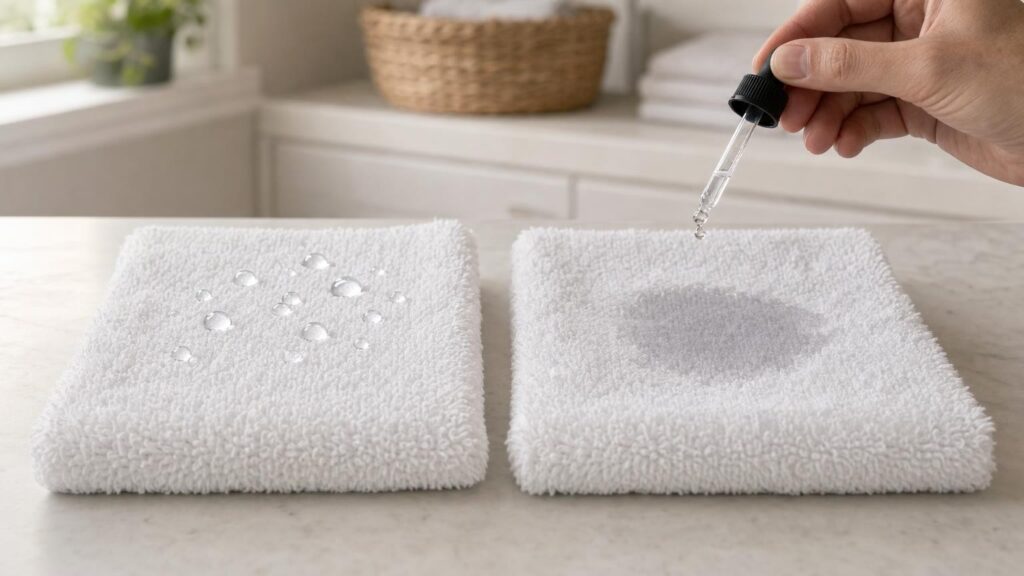
For water to enter an absorbent textile efficiently, it first needs to spread across and wet the fibre surfaces. A deposited conditioning layer can make those surfaces less wettable. Water may bead, spread more slowly or take longer to move into the textile structure.
This does not necessarily mean that a treated towel will absorb no water. The more realistic concern is a change in the speed or efficiency of uptake. A towel can feel fluffy and luxurious in the hand while taking longer to pull water away from the skin.
Repeated treatment may make this effect more noticeable because new conditioning material is applied in successive laundry cycles. How much remains will vary with the product, dose, fabric, wash routine and subsequent rinsing. Occasional use and routine use may therefore produce different experiences.
Shoppers should separate two qualities that are easy to confuse:
- Perceived softness describes smoothness, flexibility and how the material feels against the skin.
- Absorbency describes how readily and how much moisture the material takes up.
A product can improve the first quality while compromising the second.
Why cotton, synthetics and blends respond differently
Cotton
Cotton is naturally capable of absorbing substantial moisture into its fibres. That makes it useful for towels, face cloths and many household textiles. Because water uptake is central to these items, a surface coating that slows wetting can create a noticeable performance trade-off.
Cotton may still feel softer after conditioning, particularly when it would otherwise dry stiffly. The decision is therefore not simply whether softener works, but whether softer touch or maximum moisture uptake matters more for the item.
Synthetic fibres
Common synthetic fibres generally absorb less water into the fibre itself than cotton. Their laundry concerns are often different. They can generate noticeable static during tumble drying, and some synthetic garments are engineered to transport moisture through their construction rather than absorb it in the same way as cotton.
Softener can be appealing for synthetics because reduced friction helps control static. However, deposited material may interfere with the surface behaviour expected from moisture-wicking clothing. Residue can also complicate odour removal if it traps material on or around the fibres. The garment manufacturer’s care instructions are especially important for technical fabrics.
Blended fabrics
A cotton-synthetic blend combines fibre types, so its response may sit somewhere between them. The exact result depends on the proportions, yarn structure, finish and intended use. A blended everyday shirt and a blended performance top may require different treatment even if their fibre labels look similar.
Rather than relying only on fibre names, consider what the finished item is meant to do. Absorption, rapid drying, stretch, weather resistance and moisture movement can all be more important than softness.
Towels and sportswear expose the biggest trade-offs
Towels
Softener can make towels feel smoother, smell more fragrant and appear pleasantly lofty. Yet towels are purchased primarily to remove water. Frequent conditioning may reduce how quickly loops and fibres become wet, making a towel feel less effective despite its softer finish.
Someone who prioritises a plush hand-feel may accept occasional softener use. Someone who wants maximum absorbency may prefer to limit it or leave it out. Correct washing, thorough rinsing and avoiding excessive detergent can also help prevent towels from feeling burdened with residue.
Sportswear and technical clothing
Performance clothing often manages moisture through carefully chosen fibres, fabric construction and surface treatments. A conditioning deposit may alter that system by reducing wetting or obstructing the movement of moisture across fibre surfaces.
This is why many specialist garments need to be treated differently from ordinary cotton clothing. Softener can also mask odours temporarily with fragrance without removing their underlying source. Care-label directions should take precedence over a general household laundry routine, particularly for moisture-wicking garments, stretch fabrics and other technical textiles.
Static control, fabric feel and fragrance retention
Static develops when materials rub together and exchange electrical charge. Dry air and tumble drying can make the effect more obvious, particularly with synthetic fibres. By lubricating fibre surfaces and reducing friction, conditioners can reduce cling, crackling and garments sticking together.
The same lubrication changes tactile qualities. Fabric may feel smoother, less crisp and more flexible. Whether that is desirable depends on the item. Softness suits many everyday garments and bed linens, while some shoppers may prefer untreated crispness in certain shirts or household textiles.
Fragrance is another major reason people choose softener. Because fragrance is deposited on the fabric, it can remain noticeable after the wash. Its presence is not evidence that the textile is cleaner, however. Cleaning comes mainly from the wash process, detergent action, agitation and rinsing. Scent changes the sensory impression rather than proving that soil or odour-causing residue has been removed.
Build-up on laundry and in the washing machine
Using more than the directed amount can leave fabric feeling waxy, heavy or less breathable. It may also increase residue in the softener dispenser and in machine areas exposed to the product. A partially blocked or dirty dispenser can then release liquid poorly or retain stale deposits.
Practical habits can reduce these problems:
- Measure according to the product directions rather than estimating generously.
- Use the washing machine compartment specified for fabric softener.
- Do not pour concentrated liquid directly onto garments unless the instructions explicitly permit it.
- Clean the dispenser regularly in line with the appliance manual.
- Follow the machine manufacturer’s maintenance guidance.
- Reduce or pause softener use if laundry begins to feel coated or loses useful performance.
If residue is already present, the appropriate cleaning method depends on the appliance and textile. Avoid improvised machine-cleaning combinations and follow the manufacturer’s instructions instead.
Choosing when softener is worth the compromise
Fabric softener is most useful when the main goals are a smoother feel, lasting fragrance and reduced static in suitable everyday laundry. It is less compelling when the textile’s primary purpose depends on rapid water absorption, moisture movement or a specialist surface treatment.
Before choosing a liquid softener or dryer sheet, ask four questions:
- What does the item need to do? Prioritise absorbency for towels and cloths, and moisture handling for performance wear.
- What is it made from? Cotton, synthetics and blends do not respond in identical ways.
- How will it be dried? Dryer sheets require tumble drying, whereas rinse-cycle liquids do not.
- Is regular treatment necessary? Occasional use may provide the preferred feel without applying a new layer in every cycle.
The best choice is not automatically the strongest scent or softest immediate result. It is the option that preserves the qualities you value in each type of laundry. Treat softener as a selective finishing product rather than an essential part of every wash, and let care labels and practical performance guide the decision.
Continue exploring on Frowse
Discover More Frowse Insights
- How Denim Weight, Weave and Stretch Change a Pair of Jeans
- Oscillating, Impact and Rotary Sprinklers: How Their Watering Patterns Differ
- Why the Number on a Toaster Dial Usually Is Not Minutes
- Clumping Clay, Silica and Plant Fibre: How Cat-Litter Materials Behave Differently
- How Steam Irons Produce, Control and Lose Steam