





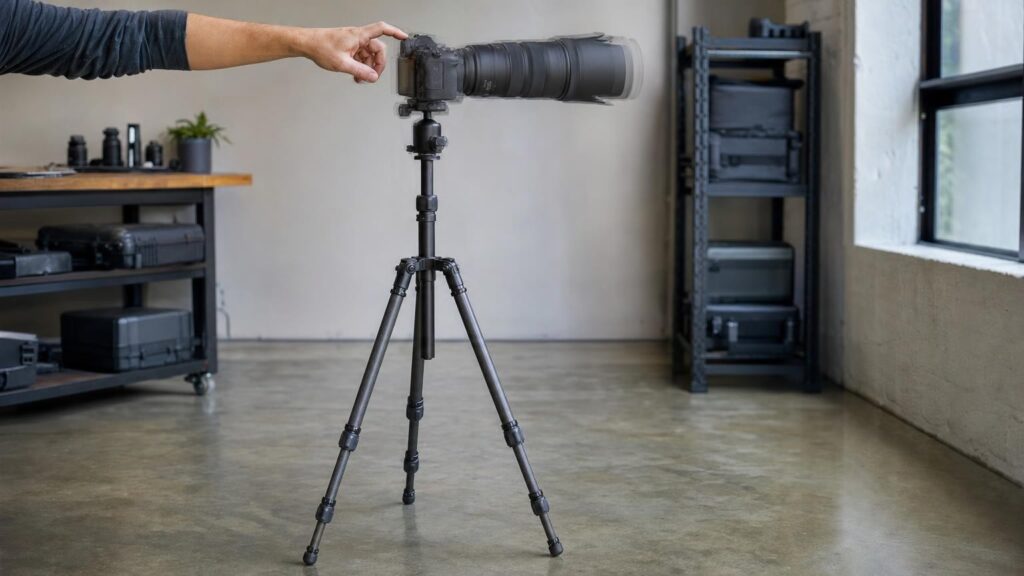
A tripod load rating can look like the simplest way to compare supports. If one model is rated for more weight than another, it may seem reasonable to assume that it will also be steadier. In practice, the figure answers a narrower question. A tripod may hold a camera without its legs slipping or its head creeping, yet still flex when touched, vibrate after the shutter is released or become vulnerable to wind.
Steadiness depends on the entire support system: the geometry and extension of the legs, the materials used, the locks and joints, the centre column, the head, and the balance of the camera and lens. Understanding those factors is more useful than treating the largest load figure as a performance score.
What a tripod load rating actually tells you
A published load rating generally indicates the amount of equipment weight a manufacturer considers the tripod, head or complete kit able to support under its chosen conditions. It may reflect the ability of the structure to carry that load, the ability of the locks to remain secure or the head’s resistance to slipping.
The difficulty is that testing methods and definitions are not necessarily consistent between manufacturers. One figure might be conservative, while another might represent a limit that says little about practical photographic performance. Ratings for tripod legs and heads may also be stated separately, so the lower-rated component can become the relevant constraint.
Most importantly, supporting weight is not the same as holding it completely still. A structure can carry a substantial load and still twist slightly, transmit vibration or take several seconds to settle after adjustment. Load ratings therefore help rule out obviously unsuitable combinations, but they do not provide a universal comparison of rigidity or vibration control.
The three parts of steadiness: rigidity, damping and resistance to tipping
Tripod stability becomes easier to assess when it is divided into three related qualities.
- Rigidity is resistance to bending and twisting. A rigid tripod moves less when the camera is touched, the head is adjusted or wind pushes against the equipment.
- Damping describes how quickly vibration dies away. Two tripods may flex by a similar amount, but one may stop oscillating sooner.
- Resistance to tipping depends on the footprint, centre of gravity and balance of the equipment. A support can be rigid but still become vulnerable if its stance is narrow or a heavy lens extends far beyond the centre.
No single specification captures all three. A heavy tripod may resist tipping well but still have movement in its joints. A very stiff lightweight model may control flex effectively but need careful positioning in strong wind. The practical question is not simply whether a tripod is strong, but how it behaves when disturbed.
Leg geometry matters more than the headline number
Leg-tube diameter has a major influence on stiffness. Wider tubes generally resist bending and twisting better than narrower ones, although wall thickness, construction and material also matter. The diameter of the upper leg sections is useful, but the narrowest sections deserve attention because they often become the weakest part of the extended structure.
Section count creates another trade-off. More sections allow a tripod to fold into a shorter package, which is valuable for travel. They also add joints and require each successive tube to be narrower. A four- or five-section leg can be highly practical, but it may be less rigid at full extension than a similarly constructed leg with fewer sections.
Extension changes performance too. A tripod that feels solid with its lower sections retracted may become noticeably more flexible when every section is deployed. Shoppers should therefore compare tripods at the height they expect to use, not only in their most favourable configuration.
Leg taper is not automatically a flaw. It is an unavoidable feature of telescoping designs. The relevant issue is whether the final sections become too slender for the camera, focal length and conditions involved. A traveller who usually works near ground level may rarely need those sections, while a tall photographer who routinely extends everything will depend on them.
Materials change vibration behaviour and carrying weight
Aluminium and carbon-fibre are the most familiar tripod-leg materials, but the material label alone does not determine performance. Tube diameter, wall construction, joint design and manufacturing quality can outweigh a simple material comparison.
Aluminium tripods are often attractive when cost matters, and their extra mass can make them feel planted. Aluminium can transmit vibration readily, however, and it may feel cold in the hand in low temperatures. It can also be easier to dent permanently after a significant impact, depending on the tube design.
Carbon-fibre can provide high stiffness for relatively low carrying weight and often damps vibration differently from metal. That makes it appealing for photographers who travel or walk long distances. It is not automatically steadier in every case: a slim carbon-fibre tube can still flex more than a substantially larger aluminium one, and construction quality remains important.
Other materials may appear in the apex, joints, locks or centre column. Their contribution is best judged as part of the assembled tripod. A premium leg material cannot compensate for loose hinges, a flexible central chassis or a poorly matched head.
Locks, joints and the apex are part of the support system
Every connection is a possible source of movement. Leg locks must clamp the tubes firmly, leg hinges must hold their selected angle, and the apex must connect the three legs without excessive twisting.
Twist locks can make a folded tripod compact and may allow several locks to be released in one movement. Flip locks provide visible lever positions and can be quick to operate. Neither style is inherently steadier. Performance depends on clamping force, adjustment, cleanliness, wear and how confidently the user operates the mechanism.
Leg-angle stops also affect real-world usability. Positive, easily engaged stops help users establish a consistent stance. On uneven ground, independent leg angles can be more useful than a theoretically rigid design that is difficult to position securely.
Check for play where each leg meets the apex. A small amount of movement at that point can become more obvious at camera height. Ease of maintenance matters as well, particularly around sand, dust or water. Locks that can be cleaned and adjusted may remain dependable for longer, provided maintenance instructions are followed.
Why centre columns and stance can transform performance
A raised centre column acts like a lever. It places the camera farther above the point where the three legs meet, increasing the effect of small movements. Even a strong column usually makes the system less rigid when extended, especially near its maximum height.
For demanding exposures, it is generally preferable to obtain most of the working height from the legs and use the column sparingly. A tripod that reaches eye level only through extensive column use may not perform like one that reaches the same height mainly through its legs.
A wider stance usually improves resistance to tipping and can lower the camera’s centre of gravity. Lowering the tripod often improves stability further, although a very wide stance requires more floor or ground space. Uneven terrain may force compromises, so secure foot placement and sensible leg angles matter more than visual symmetry.
Some tripods allow a column to be reversed or positioned horizontally. These arrangements can be useful for low-level or overhead work, but moving the camera away from the centre creates an off-axis load and greater tipping leverage. One or more legs may need to be positioned beneath the extended camera, and the complete setup should be checked carefully before use.
A hook beneath the apex or column is sometimes used to add ballast. Weight can improve resistance to tipping, but a swinging bag may introduce movement in wind. If ballast is used, it should not exceed the support’s limits and is generally more effective when it cannot sway freely or pull the tripod sideways.
The head, camera and lens form one mechanical system
Tripod legs are only part of the support. A head that flexes, creeps after tightening or has play in its controls can undermine otherwise rigid legs. Ball heads offer quick adjustment, while pan-and-tilt and geared designs provide different levels of directional control. The best type depends on the subject and desired speed, not merely its load rating.
Clamp security and plate fit are equally important. A plate should attach firmly to the camera or lens foot, and the clamp should hold it without detectable play. Friction controls can help prevent a heavy or unbalanced setup from suddenly dropping when the main lock is loosened, but they do not correct poor balance.
Equipment shape matters as much as total mass. A compact, heavy camera positioned over the apex can be easier to support than a lighter camera with a long lens extending forward. The long lens creates greater leverage, magnifying small movements in the head and joints. Using a lens collar, where the lens is designed for one, can place the mounting point closer to the combination’s centre of gravity.
This is why simply adding the weights of the camera and lens does not fully describe the task. Focal length, balance, wind area and how the equipment is mounted can all change the support required.
How to compare tripods for the way you actually shoot
Begin with the conditions in which steadiness matters most. Long focal lengths make small angular movements more visible. Long exposures give vibration more time to affect the image. Wind increases pressure on legs, straps, cameras and large lenses. Close-up work can also be demanding because tiny shifts alter framing and focus.
Then consider practical constraints. A highly rigid tripod is of little value if its packed size or weight means it is regularly left at home. Conversely, an exceptionally compact model may disappoint if it must always be used at full extension in exposed locations. Working height should be assessed with minimal centre-column extension, while packed length should include the head if it will normally remain attached.
When possible, carry out a few simple checks with the tripod set to the intended height:
- Apply gentle pressure near the camera platform and feel how much the structure twists or bends.
- Tap a leg or lightly disturb the camera, then observe how quickly movement settles.
- Check for play at the leg hinges, locks, centre column, head and plate.
- Adjust the head and see whether framing shifts after the controls are tightened.
- Repeat the checks with the narrow lower leg sections and centre column extended.
- Assess whether the controls can be operated securely with cold hands or gloves if that reflects intended use.
Some movement is normal, particularly in portable equipment. The aim is to identify whether the compromise suits the photography. Slight flex may be acceptable for occasional travel portraits in calm conditions, but less acceptable for long-lens work, repeated long exposures or shooting in exposed landscapes.
Conclusion: treat load rating as a boundary, not a performance score
A tripod’s load rating is useful for checking that a camera system falls within the stated capacity, and allowing sensible headroom can help account for accessories and awkward balance. It should not be read as a direct measure of sharpness, rigidity or resistance to vibration.
Look instead at the complete mechanical system: leg diameter and section count, extension, materials, locks, joints, apex, centre column, stance, head and camera balance. Judge these features at the height and in the conditions in which the tripod will actually be used.
The most suitable choice is rarely the model with the largest number on its specification sheet. It is the tripod that provides enough steadiness while remaining practical to carry, quick enough to set up and appropriate for the equipment and subjects involved.
Continue exploring on Frowse
Discover More Frowse Insights
- Roller Skate Wheels Explained: Diameter, Hardness, Profile and Hubs
- What Makes a Paintbrush Hold Paint, Cut Cleanly and Keep Its Shape?
- Bypass, Anvil and Ratchet Secateurs: How to Choose the Right Cutting Mechanism
- Foil vs Rotary Electric Shavers: How the Cutting Mechanism Changes the Shave
- Why Garden Hoses Lose Flow and Why Their Connectors Do Not Always Fit