





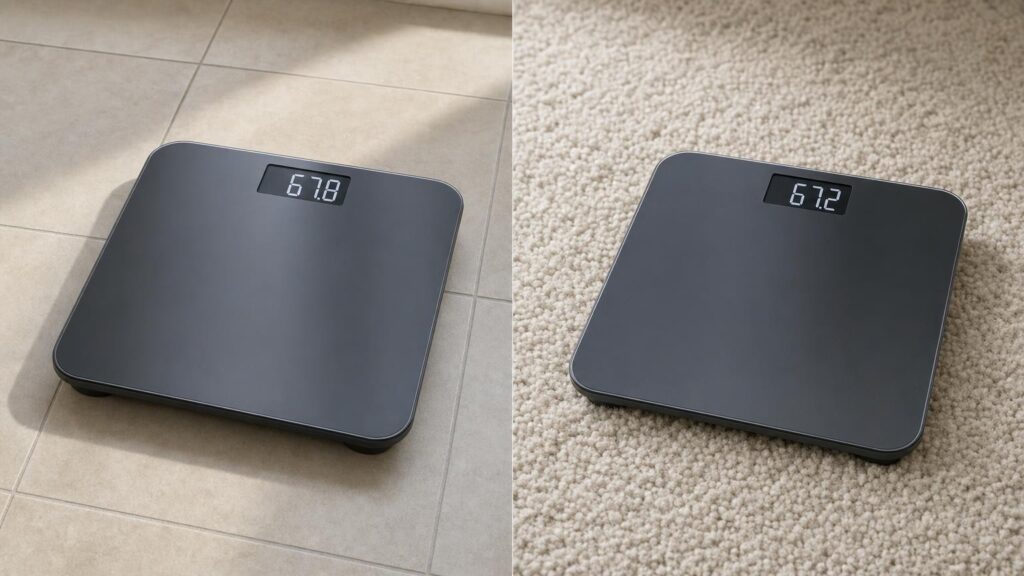
A bathroom scale may show one reading on a tiled floor and another after being moved onto carpet, vinyl or uneven boards. This does not necessarily mean that your weight has changed or that the scale is defective. The floor is effectively part of the measuring system: it supports the scale’s feet, while the scale’s frame transfers force to its sensors.
If that support changes, the casing may tilt, flex or rock. Force can then be distributed differently between the measuring elements. Understanding this interaction helps explain why stable placement and repeatable technique can be more important than a display offering very small increments.
How a digital bathroom scale measures weight
Most digital bathroom scales use load cells fitted with strain gauges. A load cell is designed to deform by a very small, controlled amount when force is applied. The attached strain gauges change their electrical resistance as the load cell bends. Electronics inside the scale process these small changes and convert them into the number shown on the display.
A scale commonly has several sensing points positioned around the platform, often near its corners. When you stand on it, the frame and platform transfer force through these points. The electronics combine the signals to estimate the total load.
This process relies on the scale being supported as its designers intended. Its feet need to make stable contact with the floor, and the platform must move or flex within its designed range. If one foot sinks into a soft surface or rests in a gap, forces may no longer travel through the frame in the same way.
The scale is therefore not measuring in isolation. The result depends on an entire mechanical path: you, the platform, the chassis, the load cells, the feet and the floor beneath them.
Why hard, flat floors usually give more repeatable results
A hard, level surface normally gives each foot a consistent support point. Tile, stone, concrete or firm wood can work well when the surface is flat and the scale does not rock. The important qualities are rigidity, stability and even contact rather than the name of the flooring material itself.
Carpet presents a different mechanical condition. The feet may sink into the pile and compress the underlay, while the bottom of the scale’s casing may touch fibres that were not intended to support it. The degree of compression can also change as you step on, move your feet or shift your balance. This can alter the way force reaches the sensors.
Hard flooring is not automatically ideal. Raised tile edges, deep grout lines, warped boards or textured surfaces can leave a foot partly unsupported. Some vinyl and laminate floors also have a degree of movement, particularly when installed over a soft or uneven layer. A scale that rocks when pressed at a corner is unlikely to provide its best repeatability.
Placing a rigid board over carpet may create a firmer base, but only if the board is large enough, does not flex and remains stable. It should not be assumed to reproduce the conditions of a solid floor perfectly. The manufacturer’s placement instructions remain the first reference point.
Frame rigidity, feet and platform design
The scale’s construction influences how sensitive it is to its surroundings. A rigid chassis helps preserve the intended relationship between the platform, sensors and feet. If the structure twists when one corner is loaded or when the floor is slightly uneven, the load cells may receive a different distribution of force.
Platform material alone does not establish rigidity. Glass, metal and plastics can all be used in effective designs, but their thickness, shape, supports and attachment to the underlying frame matter. A platform may look solid while still relying on a relatively flexible internal structure.
Very slim scales can be easy to store and visually unobtrusive, but thin construction can make resistance to bending and twisting more demanding to engineer. This does not mean every slim scale is less consistent. It means that appearance and thickness are not reliable substitutes for information about placement requirements or repeatability.
Feet also deserve attention. Their shape, spacing and grip affect how securely the scale sits. Broad, non-slip feet may provide stable contact on a smooth floor, while small feet may be more affected by grout lines or soft surfaces. Some feet form part of the sensing assembly, so they should not be removed, packed underneath or modified unless the instructions explicitly permit it.
Corner loading and where you stand
Although multiple load cells are intended to measure total force, where and how you stand can still affect a reading. Standing off-centre places more load on some sensors than others. A well-designed scale should account for ordinary differences in stance, but no physical measuring system is completely unaffected by extreme corner loading, frame flex or unstable support.
For more repeatable measurements, place both feet in a similar position each time and stand still with your weight distributed naturally. Avoid stepping onto one edge and then gradually transferring your weight if the instructions recommend a different technique. Do not deliberately lean forwards or backwards to influence the display.
Contact with surrounding objects is another source of variation. Resting a hand on a basin, wall or worktop transfers some force away from the scale. Conversely, pulling on a fixture can add force. Even when contact is used only for balance, it means the scale is no longer carrying the same proportion of your weight.
A stable stance matters more than achieving mathematically perfect foot placement. The practical aim is to use a similar position and stepping method each time so that technique does not become an additional variable.
Calibration, zeroing and moving the scale
Several processes are sometimes grouped together as “calibration”, but they are not identical. Factory calibration establishes how the scale converts sensor signals into units of weight. Zeroing identifies the unloaded state that should correspond to zero. A scale’s wake-up cycle activates its electronics and may include an automatic zero check.
Moving, lifting or rotating a scale changes the mechanical conditions around its feet and frame. Some models may need to be placed in position, activated and allowed to return to zero before the next measurement. Others are designed for direct step-on use. Following the stated start-up procedure is important because an apparently ready display does not always mean that a recently moved scale has completed every required step.
Do not store objects on the platform if the instructions require it to remain unloaded. A constant load can interfere with automatic zeroing or leave the scale unavailable when you want to use it. Similarly, repeatedly moving the scale between storage and measurement locations introduces more opportunities for a foot to land differently.
If practical, keep the scale in one orientation and one marked location. This reduces changes in floor contact and makes comparisons more meaningful.
Resolution is not the same as accuracy or precision
Scale specifications and advertising can use measurement terms loosely, so it helps to separate four ideas:
- Display resolution is the size of the increment shown, such as the step between one displayed value and the next.
- Accuracy describes how close a measurement is to the true value under stated conditions.
- Repeatability is the ability to give similar results when the same load is measured repeatedly under the same conditions.
- Sensitivity refers to how the instrument responds to a change in applied load.
A display with smaller increments does not prove that the underlying sensors can identify real changes of that size accurately or repeatedly. Electronics can show additional digits even when floor instability, frame movement, zero drift or normal measurement variation is larger than the displayed step.
Conversely, a scale with coarser increments may still be useful if it behaves consistently in the intended location. For everyday comparisons, dependable repeatability can be more informative than a fine-looking number that fluctuates from one attempt to the next.
Accuracy statements are most meaningful when accompanied by clear conditions, limitations or a stated tolerance. Unsupported phrases such as “high precision” do not explain how the scale behaves across different loads, surfaces or positions.
A practical test for comparing floors and consistency
You can compare candidate locations without trying to establish an absolute reference value. The objective is to find the setup that produces the smallest spread under similar conditions.
- Choose a firm area large enough for every foot to sit on the same surface, away from grout gaps, board edges and obvious slopes.
- Place the scale in a fixed orientation and check whether it rocks when gentle pressure is applied near each corner.
- Use the manufacturer’s wake-up and zeroing procedure, particularly if the scale has just been moved.
- Take several readings using the same stance and stepping technique. Step off fully between attempts and let the display reset as instructed.
- Record all the readings rather than selecting the one you expected or preferred.
- Repeat the process on another candidate surface, keeping the other conditions as similar as reasonably possible.
Look at the spread of the results. A cluster of similar readings indicates better repeatability than readings that vary widely, even if one isolated result appears more believable. This test cannot establish true accuracy because you do not have a traceable reference load, but it can reveal rocking, inconsistent zeroing or sensitivity to floor conditions.
Avoid testing by holding improvised heavy objects while standing on the scale. This can make stance less stable and may exceed the platform or user limits. If a reading remains erratic on an appropriate surface after the setup instructions are followed, consult the troubleshooting guidance rather than trying to alter the feet or casing.
What to assess before choosing a bathroom scale
Start with the place where the scale will actually be used. A design intended for hard, level flooring may be inconvenient if the available space is carpeted or crossed by deep grout lines. Check whether the product instructions specify surface requirements and whether you can leave the scale in a stable position.
Useful design and information cues
- A stable footprint: feet should be sensibly spaced and suited to the intended floor, with no obvious tendency to slide or rock.
- A rigid platform and chassis: construction should resist noticeable twisting during normal use.
- Clear setup instructions: useful guidance should explain placement, activation, zeroing and what to do after moving the scale.
- Appropriate capacity: the stated operating range should comfortably cover the intended user without treating overload capacity as a measure of accuracy.
- Readable increments: choose a display you can see easily, but do not assume that extra decimal places guarantee better measurement.
- Practical dimensions: the platform should accommodate a stable stance while fitting completely within the firm area of floor available.
Comparison is easier when sellers or manufacturers provide specific measurement information rather than broad promotional language. Even then, remember that stated performance may depend on correct placement, temperature, load range and operating procedure. A specification cannot compensate for a scale that will sit partly on a rug or rock across uneven tiles.
Smart features and body-composition estimates may be relevant to some shoppers, but they do not remove the basic mechanical requirement for stable support. Consider connectivity and extra metrics separately from the quality of the weight measurement itself.
Prioritise repeatability where you will use the scale
Different floors can produce different bathroom-scale readings because they change how the scale is supported and how force travels through its frame to the load cells. Soft flooring can compress, uneven flooring can create corner loading, and a flexible or rocking base can redistribute force between sensors.
For useful comparisons, place the scale on a firm, level and stable surface, keep its position consistent, allow it to zero correctly and use a repeatable stance. When choosing a scale, prioritise suitable feet, a stable structure and clear operating guidance over fine display increments alone. The most useful scale is not necessarily the one showing the most digits, but the one that behaves consistently in the location where you intend to use it.
Continue exploring on Frowse
Discover More Frowse Insights
- Conventional, Beam and Hybrid Wiper Blades: What Changes Against the Glass
- Single-Coil, Humbucker and Active Pickups: How the Hardware Shapes the Signal
- Bypass, Anvil and Ratchet Secateurs: How to Choose the Right Cutting Mechanism
- How a Rice Cooker Knows When the Water Is Gone – and What Fuzzy Logic Changes
- What the Tilt Mechanism Under an Office Chair Actually Changes