





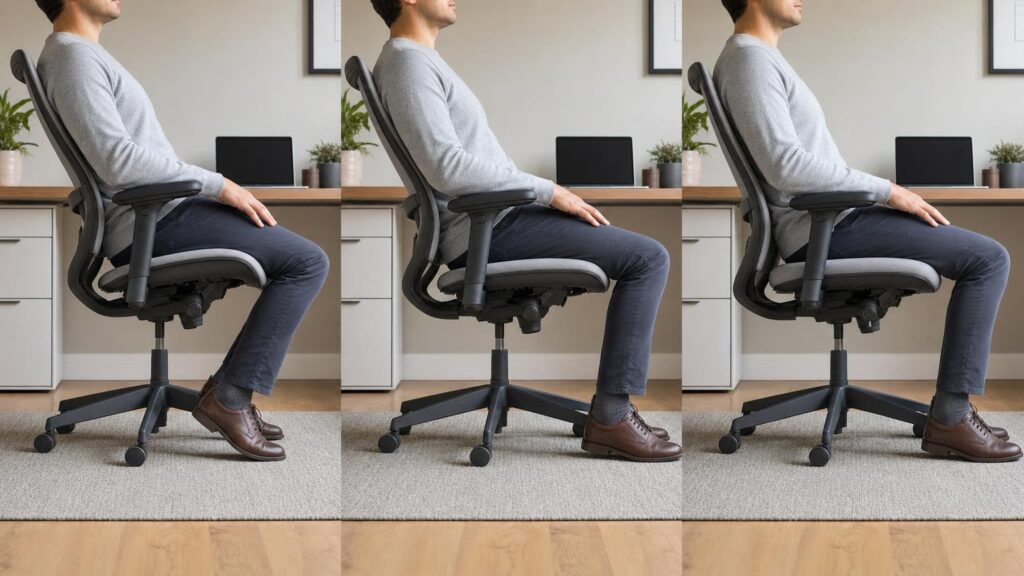
The controls beneath an office chair do more than determine whether it can lean backwards. The mechanism controls where the chair pivots, whether the seat moves with the backrest, how much force reclining requires and whether the chair can be held at different angles.
This is why two chairs described as “reclining” or “ergonomic” can feel markedly different. One may rock as a single unit, lifting the front of the seat as it moves. Another may recline the backrest while keeping the seat nearly level. A third may coordinate both movements at different rates.
Understanding these motions is more useful than relying on a mechanism name alone. Terms are not always applied consistently in product listings, so shoppers should look for descriptions, diagrams or demonstrations that reveal what actually moves.
The five details that reveal what a tilt mechanism actually does
Most office chair mechanisms can be compared through five practical details.
- Pivot location: This is the point around which the chair or seat rotates. A pivot near the middle of the seat produces a different motion from one positioned closer to the front.
- Moving parts: Check whether the seat and backrest move together, move at different rates or operate independently.
- Seat-to-backrest relationship: Some mechanisms preserve a largely fixed angle between the seat and backrest. Others open that angle as the user reclines.
- Resistance adjustment: Often called tilt tension, this changes how much effort is required to lean back. Its adjustment range and effectiveness can vary by design.
- Locks and stops: A chair may lock only when upright, lock at several positions or remain in a free-moving mode. A recline limiter may restrict travel without holding the chair at an intermediate angle.
These details describe the experience more reliably than broad marketing language. They also make it easier to decide whether a chair suits upright desk work, occasional rocking, deeper reclining or regular changes of position.
Centre tilt: a rocking motion from beneath the middle of the seat
A centre-tilt mechanism places the pivot beneath or around the central portion of the seat. The seat and backrest generally tip backwards together while maintaining roughly the same angle relative to each other. The resulting motion feels like the chair is rocking as one unit rather than the backrest opening away from the seat.
Because the pivot is near the centre, the front edge of the seat travels upwards as the user leans back. How noticeable this is depends on the chair’s geometry and tilt range, but it can change foot contact with the floor. A user whose feet are comfortably planted while upright may find that the heels become lighter or lift during a deeper tilt.
The appeal of centre tilt is its straightforward movement. It can provide a simple rocking action and may be easy to understand from a small set of controls. The trade-off is that reclining changes the angle of the entire sitting platform. It does not create the same opening movement between the torso and thighs as a mechanism whose backrest moves farther than its seat.
When assessing centre tilt, look beyond the label. Check how high the seat edge rises, whether the movement can remain unlocked for rocking and whether there is only an upright lock or a choice of locking angles.
Knee tilt: moving the pivot forwards changes the feel
Knee tilt is also commonly a linked movement in which the seat and backrest tip together. The important difference is that the pivot is positioned nearer the front of the seat, around the area beneath the user’s knees rather than the seat centre.
Moving the pivot forwards reduces the amount by which the front seat edge rises during recline. The rear of the chair still descends as it tilts, but the area supporting the thighs follows a smaller arc than it would with a central pivot. This can make it easier to maintain foot contact while rocking or leaning back.
Knee tilt should not be confused with a stationary seat and independently reclining backrest. Although the motion may feel more grounded than centre tilt, the seat usually still changes angle along with the backrest. The relationship between the two parts may remain substantially fixed.
Useful specifications include the available tilt range, resistance control and locking positions. The name identifies the broad pivot arrangement, but it does not by itself reveal whether the chair offers free movement, multiple locks or only upright and unlocked modes.
Synchro tilt: coordinated seat and backrest movement
A synchro-tilt mechanism links the seat and backrest so that they move together at different rates. As the user leans backwards, the backrest reclines farther than the seat tilts. This opens the angle between the torso and thighs while limiting how much the front of the seat rises.
That coordinated movement distinguishes synchro tilt from whole-chair rocking. The seat is not necessarily fixed, but it follows a shallower path than the backrest. This can support transitions between a relatively upright working position and a more open reclining position without tipping the entire sitting platform by the same amount.
The term does not define one universal movement ratio. Nor does it guarantee a particular recline range, number of lock positions or set of adjustments. Some mechanisms may allow continuous free movement with an upright lock, while others may offer several fixed positions or a limiter. The initial angle and range can also differ.
Shoppers should therefore seek a side-view demonstration or clear diagram. Watch the seat and backrest separately: if the backrest travels noticeably farther while the seat tilts only modestly, the mechanism is displaying the coordinated action associated with synchro tilt.
Simple back recline: when the seat stays substantially level
Some office chairs use a hinge or joint that allows the backrest to recline while the seat remains substantially level. Rather than rotating the entire chair around a point beneath the seat, the mechanism opens the angle between the backrest and sitting surface.
This creates a different body motion. The thighs remain at a more consistent angle to the floor while the upper body moves backwards. Whether that feels supportive depends partly on the backrest shape, hinge position and how the chair maintains contact with the user as it moves.
A backrest-only recline is not automatically more adjustable than a tilt mechanism. Some designs have resistance control, locks or recline stops, while others offer only a simple spring action or a small travel range. It is also worth checking whether the description really means that the seat stays level. Listings sometimes use “back recline” as a general phrase even when the seat tilts too.
Tension, locks and stops are separate features
Chair descriptions often group several controls under the word “tilt”, but they perform different jobs.
- Tilt tension changes the resistance against reclining. Increasing tension generally requires more force to move the chair; reducing it makes the movement easier. It does not necessarily alter the maximum angle or create a lock.
- A tilt or recline lock holds the mechanism at a defined position. A chair may have an upright lock, several selectable positions or another arrangement specified by the manufacturer.
- A recline limiter or stop sets how far the mechanism is allowed to travel. When the user leans forwards, the chair may still return from the limit rather than remaining fixed there.
These distinctions matter when comparing specifications. “Adjustable tilt” could refer only to resistance, only to a lock or to several separate controls. A stated number of positions may describe locking angles or limiter settings, which are not necessarily the same experience.
Also check how a lock releases. With some spring-loaded movements, it may be necessary to place pressure against the backrest before disengaging the lock. The appropriate operation should be confirmed in the chair’s instructions rather than assumed from another model.
How mechanism design affects everyday sitting
For predominantly upright keyboard and mouse work, the first question is whether the chair provides a stable upright position. A free-floating mechanism may be useful for regular movement, but only if its resistance can be set so that the user is not unintentionally pushed forwards or dropping backwards.
People who like to rock may prefer a smooth, unlocked movement. Centre and knee tilt can both provide a whole-chair rocking sensation, although knee tilt generally produces less rise at the front edge. Synchro tilt feels different because the backrest and seat follow separate but coordinated paths.
For reclining during reading, calls or pauses between tasks, consider how far the backrest travels and what happens to the seat at the same time. A deeper advertised recline does not explain whether the knees rise, whether the feet stay planted or whether the backrest can be held at a useful intermediate position.
Resistance is another practical issue. A control is useful only if its available range suits the user and is convenient to adjust. If several people share a chair, an accessible tension control may matter more than it would on a chair set up once for one person. Mechanism design, spring characteristics and individual body weight all influence how much effort the movement requires, so written descriptions cannot always predict the exact feel.
How to interpret specifications before choosing
When a listing uses vague phrases such as “rocking function”, “reclining back” or “multi-function mechanism”, use the following checklist.
- Identify the pivot. Look for a side-view image or video showing whether rotation begins beneath the seat centre, near the front edge or at the backrest hinge.
- Watch each component. Determine whether the seat and backrest move together, move at different rates or whether only the backrest moves.
- Check the seat angle. Confirm whether the front edge rises and whether the seat remains substantially level during recline.
- Separate movement from locking. Find out whether the chair is designed to float freely, lock upright or lock at multiple angles.
- Clarify stated positions. Determine whether they are actual locks or merely limits that control maximum recline.
- Confirm tension adjustment. Check whether resistance is adjustable and whether it uses a dedicated knob, lever or another control.
- Consider control access. Controls should be identifiable and practical to reach from the seated position where intended. A manual can clarify functions that product photographs do not show.
If the available information does not explain what the seat does while the backrest moves, the mechanism remains only partly described. That missing detail can be more important than the recline angle quoted in isolation.
Choose the motion, not just the mechanism name
Centre tilt, knee tilt, synchro tilt and simple back recline describe meaningfully different approaches to chair movement. Centre tilt rocks around the middle of the seat, knee tilt moves the pivot forwards, synchro tilt coordinates different rates of seat and backrest travel, and backrest recline can leave the seat largely level.
However, the category name is only a starting point. Resistance range, available locks, recline limits and control layout can change how two mechanisms in the same category behave. The most dependable comparison is to identify the pivot, observe which parts move and confirm exactly what each control does. Choose the motion that matches how you plan to sit rather than relying on a broad promise that the chair simply “tilts” or “reclines”.
Continue exploring on Frowse
Discover More Frowse Insights
- Full-Grain, Top-Grain, Split and Bonded Leather Upholstery Explained
- Why Scissors Stop Cutting Even When the Blades Still Feel Sharp
- Why a Desk Lamp’s Lumen Rating Does Not Reveal How Well It Lights a Work Surface
- Why Battery Voltage Does Not Tell You How a Cordless Lawn Mower Will Cut
- Why Hand-Blender Wattage Does Not Predict Blending Performance