





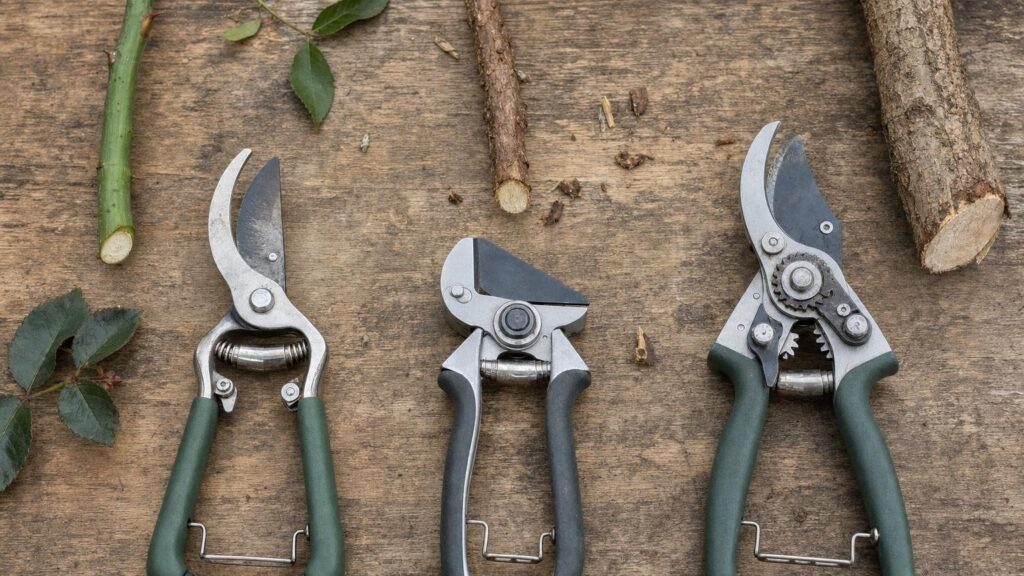
Secateurs can look broadly similar while behaving very differently at the stem. The cutting mechanism affects how cleanly they cut, how much hand effort they require, how quickly you can work and which types of growth they handle best. Choosing well therefore means looking beyond a headline cutting diameter.
The three terms shoppers commonly encounter are bypass, anvil and ratchet. Bypass and anvil describe how the blade meets the stem, while ratchet describes a mechanism that completes a cut through several squeezes. Understanding that distinction makes it easier to compare secateurs on their real suitability rather than assuming that one design is universally better.
Why the cutting mechanism matters
A stem is not a uniform material. Young green growth is flexible and moisture-rich, mature wood is denser, and dead branches can be hard or brittle. A cutting action suited to one may damage another or demand unnecessary effort.
The mechanism also influences control. A clean, direct cut may be important when pruning living plants in a confined area, while maximum neatness may matter less when reducing dead material before disposal. Users with limited grip strength might prefer a tool that spreads the work over several hand movements, provided the slower action suits the task.
Cutting capacity should therefore be treated as one part of the decision. Blade condition, leverage, handle fit and the hardness of the material all affect what a pair of secateurs can cut comfortably in practice.
Bypass, anvil and ratchet: the mechanisms explained
Bypass secateurs
Bypass secateurs use two parts that pass closely alongside one another, much like scissors. One is the sharpened cutting blade and the other supports the stem as the cut is made. Correct alignment allows the blade to slice through the fibres instead of simply compressing them.
This shearing action can produce a controlled, tidy cut, making bypass secateurs a common choice for live growth. Their narrow cutting head can also help when reaching into crowded plants. Performance depends heavily on a sharp edge, suitable blade overlap and a pivot without excessive looseness.
Anvil secateurs
Anvil secateurs have a sharpened upper blade that closes onto a broad, usually flat support called the anvil. Rather than two blades passing each other, the stem is cut against this supporting surface.
The supported action can be effective on firm, dead or woody material. However, the stem may be compressed between the blade and anvil before it separates. This means a blunt, damaged or poorly aligned tool can crush softer living tissue rather than leaving a clean cut.
Ratchet secateurs
Ratchet secateurs use a staged mechanism. Instead of completing the cut with one continuous squeeze, the handles can be released and squeezed again while the blade remains part-way through the material. Each movement advances the cut until the stem separates.
Ratchet does not necessarily describe the blade geometry. Many ratchet secateurs use an anvil arrangement, although the force-multiplying mechanism can be combined with other blade configurations. When comparing products, check both the cutting action and the blade arrangement rather than treating “ratchet” as a third blade type in every case.
How each design treats live and dead growth
For living stems, cut quality often takes priority. A well-maintained bypass tool slices through the fibres with relatively little crushing, provided the stem is positioned properly within the blades. This makes it useful for close pruning where accuracy and a tidy cut matter.
That advantage declines when the blades become blunt or loose. A gap between the blade and supporting part can allow fibres to bend, tear or become trapped. Very hard dead wood can also place more strain on a fine bypass edge and pivot than the user expects.
Anvil secateurs support the stem across a wider surface. This can make them practical for hard, dry or dead growth, where some compression is less consequential. They are also useful for rough reduction work in which speed and durability matter more than the appearance of every cut.
On green, soft stems, however, an anvil designs can pinch or bruise material if the edge is not sharp or the contact surface has become uneven. They are not automatically unsuitable for every living stem, but shoppers should recognise the trade-off between supported cutting force and fine tissue control.
Ratchet action is valuable when the resistance of a stem would make one direct squeeze difficult. Whether the resulting cut is neat depends on the associated blade geometry, sharpness and alignment. The presence of a ratchet alone does not guarantee either a clean cut or suitability for live growth.
Effort, speed and realistic cutting capacity
Direct-action secateurs aim to finish the cut in one squeeze. They can be quick for repeated light pruning, but the hand must produce enough force at the hardest point of the cut. Handle length, pivot position and blade shape influence how effectively that hand force reaches the cutting edge.
A ratchet mechanism divides the same job into stages. This can reduce peak hand effort because the user does not need to close the blade through the whole stem at once. The trade-off is extra movement and time. For a small number of resistant stems, that may be worthwhile; for numerous thin stems, repeatedly cycling the ratchet may feel unnecessarily slow.
A stated maximum diameter is not a promise that every stem of that size will cut comfortably. Capacity varies with:
- the species, hardness and moisture content of the stem
- whether the material is green, mature or dead
- blade sharpness and cutting-edge condition
- pivot adjustment and overall leverage
- where the stem sits within the blade opening
- the user’s grip strength, hand size and technique
A tool may technically accept a thick stem while still requiring awkward or excessive force. Trying to twist the secateurs or rock the blade sideways can damage the edge, pivot or plant. For consistently thicker branches, loppers offer longer handles and greater leverage, while a pruning saw is often more appropriate for substantial woody growth.
Access, control and comfort around the plant
Cutting performance is only useful if the tool can reach the intended stem. A slim bypass head may fit between neighbouring shoots more easily than a broad anvil head. Curved blades can help retain a stem during the cut, although the exact shape also affects visibility and positioning.
Handle length changes both leverage and manoeuvrability. Longer handles may make cutting easier but can feel cumbersome in dense plants. Shorter models can improve close control yet provide less leverage. Grip span is equally important: handles that open too widely may be tiring or difficult to control, particularly for users with smaller hands.
Check whether the locking control is easy to reach without placing fingers near the blade, and whether it works naturally for the preferred hand. Spring resistance matters too. A strong spring opens the handles decisively but can add fatigue during repetitive work; a weak or poorly retained spring may make the action feel inconsistent.
Ratchet models can reduce the highest force required, but they ask the hand to repeat the squeezing motion. Some users find that easier, while others prefer one smooth cut. Labels such as “ergonomic” are not a substitute for checking handle shape, grip span, weight and operating sequence.
Blade, anvil and pivot construction
Material descriptions can indicate how a tool is intended to perform, but no single label guarantees quality. Blade steel, heat treatment, edge geometry and manufacturing accuracy work together. A hard cutting edge may retain sharpness well, yet it can be more difficult to sharpen and may be vulnerable to chipping if misused. A more easily sharpened edge may require attention more often.
Surface coatings can help reduce friction or provide some corrosion protection, but they do not remove the need to clean and dry the tool. Coatings also wear in areas of repeated contact. Stainless steel may resist corrosion better than some alternatives, but edge quality and care still matter.
On anvil secateurs, inspect the support surface as well as the blade. A deeply marked or deformed anvil can impair contact. A replaceable anvil is potentially useful, provided replacements are actually available.
The pivot should allow smooth movement without obvious side-to-side blade play. An adjustable pivot gives the owner some scope to correct looseness or blade alignment as parts wear, although overtightening can make the action stiff. Non-adjustable pivots simplify the design but can be harder to remedy once play develops.
Handle materials affect weight, stiffness and feel. Metal bodies may offer rigidity, while reinforced or composite constructions can reduce weight. Covers and soft grips can improve comfort, but their shape, durability and security are more important than the presence of padding alone.
Sharpening and routine maintenance differ by design
All secateurs benefit from having sap, soil and plant debris removed after use. Drying the tool and applying suitable lubrication at the pivot helps preserve smooth movement. Maintenance should follow the maker’s instructions, especially before taking apart spring-loaded or ratcheting assemblies.
For bypass secateurs, sharpening should preserve the blade’s intended bevel rather than creating a new angle indiscriminately. The flat side should remain suitable for close passage against the supporting blade. After sharpening, check that the blades overlap correctly and move without binding or leaving an excessive gap.
On anvil models, the cutting blade still needs an appropriate edge, but the condition of the anvil is equally significant. Grooves, embedded debris or uneven wear can prevent consistent contact. If the anvil is reversible or replaceable, use only the procedure and parts intended for that tool.
Ratchet secateurs add teeth, pawls or related moving parts that can collect sap and debris. These need to move freely for the staged action to hold securely. Cleaning should be careful rather than aggressive, and lubrication should be applied only where appropriate so that it does not attract excessive dirt.
Replacement parts and long-term ownership
A serviceable pair of secateurs can remain useful after a spring weakens or a blade wears. Before buying, check whether the blade, anvil, spring, pivot hardware and locking component can be replaced. The existence of removable screws does not by itself mean that compatible parts will be obtainable.
Availability matters more than a vague claim that a tool is repairable. Look for clearly identified part numbers, sensible fitting guidance and a realistic route to obtaining components. Ratchet assemblies can contain proprietary parts, making future repair more dependent on the manufacturer’s support.
Also consider whether normal adjustment is possible without complete disassembly. An accessible pivot adjustment and replaceable spring can make routine ownership easier. By contrast, a permanently fastened pivot may turn ordinary wear or misalignment into a reason to replace the whole tool.
Choosing the right mechanism for the work
Start with the material you cut most often rather than the largest diameter printed on the packaging.
- Choose bypass secateurs when clean, controlled pruning of living growth is the priority and you are willing to maintain blade sharpness and alignment.
- Consider anvil secateurs for dead, hard or woody stems where a supported cutting action is useful and minor compression is less important.
- Consider ratchet secateurs when reducing peak hand effort matters more than completing every cut in one quick squeeze. Confirm whether the accompanying blade geometry suits your plants.
Then assess fit and ownership: grip span, handle length, spring resistance, lock position, pivot adjustment and replacement-part availability. Treat capacity figures as an upper reference rather than a routine working target, and move to loppers or a pruning saw when the work becomes too thick or resistant.
No mechanism is best for every gardener or every plant. The soundest choice combines an appropriate cutting action with comfortable handling, realistic capacity and a design that can be cleaned, adjusted and maintained over time.