





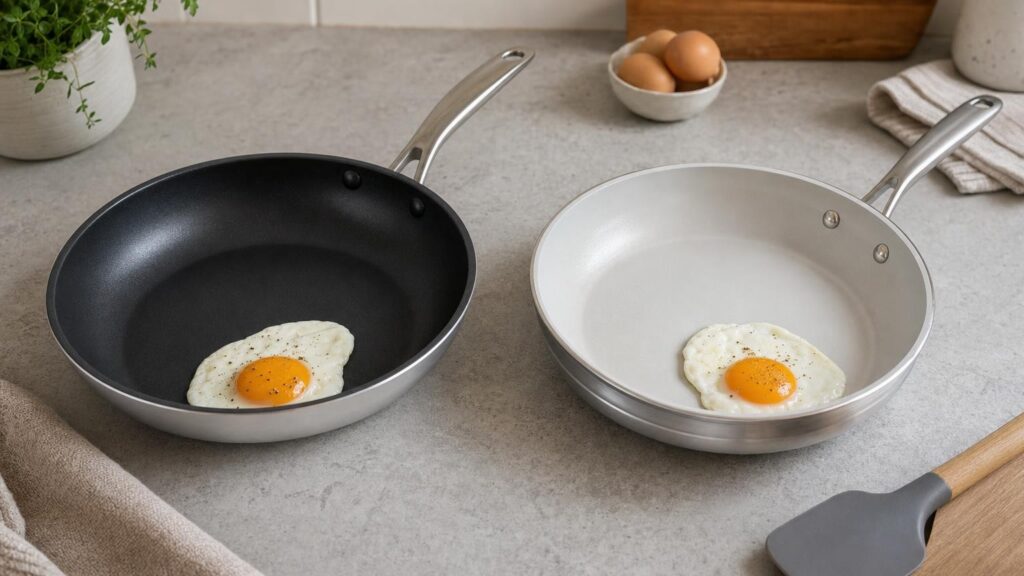
“Non-stick” describes a cooking result, not a single material. The two most common routes to that result are PTFE-based coatings and coatings marketed as ceramic. Although both can release delicate foods with little added fat, their chemistry, construction and ageing behaviour are quite different.
A PTFE pan uses a fluoropolymer as the low-friction cooking surface. A ceramic non-stick pan usually has a silica-based sol-gel coating that cures into a hard, glass-like layer. It is not normally a pan made from solid ceramic, nor is it the same as traditional vitreous enamel.
These distinctions matter when comparing pans. The coating affects food release and maintenance, while the metal body underneath largely determines weight, heating response and hob compatibility. Looking at the whole construction is more useful than relying on broad labels such as “ceramic”, “stone” or “granite”.
What PTFE non-stick coating actually is
PTFE stands for polytetrafluoroethylene. It is a fluoropolymer with very low surface energy, which means other materials have difficulty bonding to it. On cookware, that characteristic helps eggs, pancakes, fish and other easily damaged foods separate from the surface.
The PTFE is not generally a loose sheet placed over the pan. It is applied as part of an engineered coating system and cured onto the metal body. Depending on the design, that system can include a primer that helps the coating adhere, one or more intermediate layers and a topcoat intended to provide the final cooking surface.
Manufacturers may also incorporate mineral or other reinforcing particles into parts of the coating. These additions can help a coating system resist routine wear, but they do not make the surface immune to scratching, overheating or damage from sharp utensils. Nor does the presence of a named reinforcement automatically establish how durable a pan will be in a particular kitchen.
PTFE itself provides the characteristic easy release. The surrounding formulation and application process influence how securely the coating attaches to the pan, how it feels under a utensil and how well it tolerates repeated cooking and cleaning.
What “ceramic” non-stick coating actually is
Most cookware sold as ceramic non-stick is metal cookware coated through a sol-gel process. In simplified terms, a liquid formulation containing silica-related ingredients is applied to the pan and cured to create a hard, inorganic, glass-like network.
This use of “ceramic” is a category description rather than a complete material specification. It does not mean the pan is shaped from clay and fired like traditional ceramic cookware. It also differs from enamel, where a glassy layer is fused to metal using a different manufacturing process and is not normally intended to behave like a conventional non-stick coating.
Fresh sol-gel surfaces can provide very easy initial release. They are hard and can be produced in a range of colours and finishes. However, hardness should not be confused with permanent non-stick performance. A surface can remain visibly intact while becoming less effective at releasing food.
The word “ceramic” alone reveals little about the formulation, layer structure, substrate or recommended cooking conditions. Two pans carrying the same category label may therefore differ substantially in weight, heat distribution and useful coating life.
The pan beneath the coating matters
The coating is only the uppermost part of a frying pan. Most of its mass, shape and thermal behaviour come from the substrate beneath it.
Aluminium
Aluminium is widely used because it conducts heat well and responds relatively quickly when hob power changes. Thickness and shape matter: a substantial, well-formed body will usually distribute heat and resist distortion better than a very thin one, although it will also weigh more.
Aluminium is not inherently compatible with induction hobs. An aluminium non-stick pan intended for induction normally requires a magnetically responsive base or bonded layer. Shoppers should check the stated hob compatibility rather than infer it from the coating.
Hard-anodised aluminium
Hard anodising creates a controlled oxide layer on aluminium, producing a harder and more corrosion-resistant exterior or substrate surface. A pan described as hard-anodised can still have PTFE or ceramic non-stick applied to its cooking side. “Hard-anodised” describes treatment of the aluminium, not the identity of the food-release coating.
Stainless steel and clad constructions
Stainless steel is durable and can provide an induction-compatible exterior when an appropriate magnetic grade is used. Because stainless steel conducts heat less readily than aluminium, pans may combine it with an aluminium core, a bonded base or another heat-spreading layer.
Clad construction can improve heat distribution and structural stability, but designs vary. A bonded disc base behaves differently from material extending through the full body and sidewalls. Neither format is automatically best for everyone: weight, price, responsiveness and the size of the cooking area all affect the practical choice.
Whatever the metal, a flat base and suitable burner size help promote even heating. The coating cannot compensate fully for an undersized heating element, a badly distorted pan or a body that develops pronounced hot spots.
Coating layers, surface finish and real-world cooking
Layer count is often presented as a simple sign of quality, but the number by itself is not enough to judge a pan. A well-applied system depends on surface preparation, adhesion, formulation, curing and appropriate thickness as well as the nominal number of coats.
- Primers help connect a non-stick system to the prepared metal substrate.
- Intermediate layers may add body, reinforcement or wear resistance.
- Topcoats provide the cooking surface and much of its release character.
- Surface texture affects how utensils move across the pan and how readily residues lodge in microscopic irregularities.
A thicker coating is not necessarily better if it is poorly bonded or improperly cured. Equally, visible speckles or a rough “stone” appearance do not prove that a surface is stronger. Such terms can describe colour and texture as much as meaningful material composition.
The coating is thin relative to the body, so it has less influence on heat storage than the underlying metal. A heavy pan may continue cooking after the heat is reduced, while a lighter aluminium body may react more quickly. Both could carry a similar type of non-stick topcoat yet feel very different in use.
Why PTFE and ceramic coatings lose performance differently
All coated cookware is subject to wear. The important distinction is that visible damage and declining food release are not always the same thing.
PTFE systems can be damaged by abrasion, gouging and excessive heat. Metal edges, cutting food in the pan, abrasive cleaning powders or repeatedly stacking pans without protection can mark the surface. Deep scratches or areas where coating has detached are signs that the cooking surface has been physically compromised.
High heat is also unhelpful. Non-stick pans can rise in temperature quickly when heated empty, especially on a powerful burner. PTFE cookware should be used within the maker’s heat and oven guidance, without unattended empty preheating.
Sol-gel ceramic coatings often decline in a less visually obvious way. The pan may still look smooth and intact while food begins to cling. Repeated heating can change the surface, and extremely thin films of polymerised oil or cooked-on residue can reduce its release performance. Oil sprays and excess fats that leave stubborn deposits may make this more noticeable.
This does not mean every PTFE surface peels or every ceramic coating quickly becomes sticky. Formulation, construction, cooking temperature, cleaning and frequency of use all matter. It does mean that a hard-looking ceramic surface is not necessarily maintaining its original non-stick properties simply because it has no obvious scratches.
Heat, utensils and cleaning: habits that affect useful life
Coated pans usually perform best for low- to medium-temperature tasks rather than prolonged, aggressive heating. Practical habits can help preserve either technology:
- Preheat moderately. Avoid leaving an empty pan unattended. Add food, fat or liquid at the appropriate stage and follow the manufacturer’s instructions.
- Match the burner to the base. A flame extending around the sides or a heating zone much larger than the pan wastes energy and can overheat handles or outer surfaces.
- Use gentle utensils. Wood, silicone and suitable heat-resistant plastics are less likely to gouge a coating. Even where metal utensils are permitted, sharp edges and forceful scraping can shorten useful life.
- Clean without abrasion. Allow the pan to cool, then use normal washing-up liquid and a soft sponge or cloth. Sudden cooling of a very hot pan may also stress or distort some constructions.
- Remove films rather than cooking over them. If the maker permits it, soaking and gentle cleaning can loosen residue. Avoid harsh scouring unless the care instructions specifically allow it.
- Check dishwasher guidance. A pan described as dishwasher-safe may tolerate machine washing, but repeated exposure to strong detergents can still affect finishes or coating performance. Maker guidance should take priority.
- Protect pans in storage. A cloth or pan protector between stacked pieces helps prevent one base from rubbing against another pan’s cooking surface.
A non-stick pan is not the ideal tool for every job. Cooking that depends on very high surface temperatures, forceful scraping or building a strongly browned residue may be better suited to uncoated stainless steel, carbon steel or cast iron. Using coated cookware for the tasks it handles well can be more effective than expecting one pan to cover every technique.
Choosing between PTFE and ceramic for the way you cook
There is no universal winner. The better choice depends on which compromises fit your cooking habits and material preferences.
PTFE is often attractive for effortless low-temperature release. It suits delicate foods and cooking where easy cleanup is a priority. Buyers should be comfortable following moderate-heat guidance and treating the surface as a replaceable coating rather than a lifetime finish.
Ceramic non-stick may appeal to shoppers who prefer a sol-gel coating. It can offer excellent release when new and a hard, often colourful surface. The trade-off is that declining release may occur without dramatic visible damage, making careful temperature control and removal of residue particularly important.
Neither coating label answers questions about balance, handle comfort, base flatness or hob compatibility. Before buying, consider:
- the foods and temperatures used most often;
- whether the pan will be used on gas, electric, ceramic or induction;
- the weight that can be lifted and controlled comfortably;
- the stated oven, utensil and dishwasher guidance;
- whether replacement after coating wear is acceptable;
- the clarity with which the substrate and coating type are described.
It is also useful to separate chemistry preferences from performance claims. Labels such as “stone”, “granite” and “diamond” may refer to appearance, particles in a formulation or a branded coating system. They do not, on their own, explain the complete composition or guarantee durability.
Conclusion: Judge the whole pan, not just the coating name
PTFE and ceramic non-stick pans reach a similar cooking goal through different materials. PTFE relies on a low-surface-energy fluoropolymer coating. Ceramic non-stick generally uses a silica-based sol-gel layer with a hard, glass-like character.
Those surfaces also age differently. PTFE systems can suffer from scratches, gouging and excessive heat, while ceramic release may decline as the surface changes or develops persistent residue. In both cases, moderate heating, gentle utensils and appropriate cleaning can help preserve performance.
The coating name is only one part of the buying decision. Substrate thickness, heat distribution, weight, base design, induction compatibility and care instructions can have just as much influence on everyday use. Clear material information and a construction suited to your hob and cooking style are more meaningful than decorative claims or layer counts viewed in isolation.