





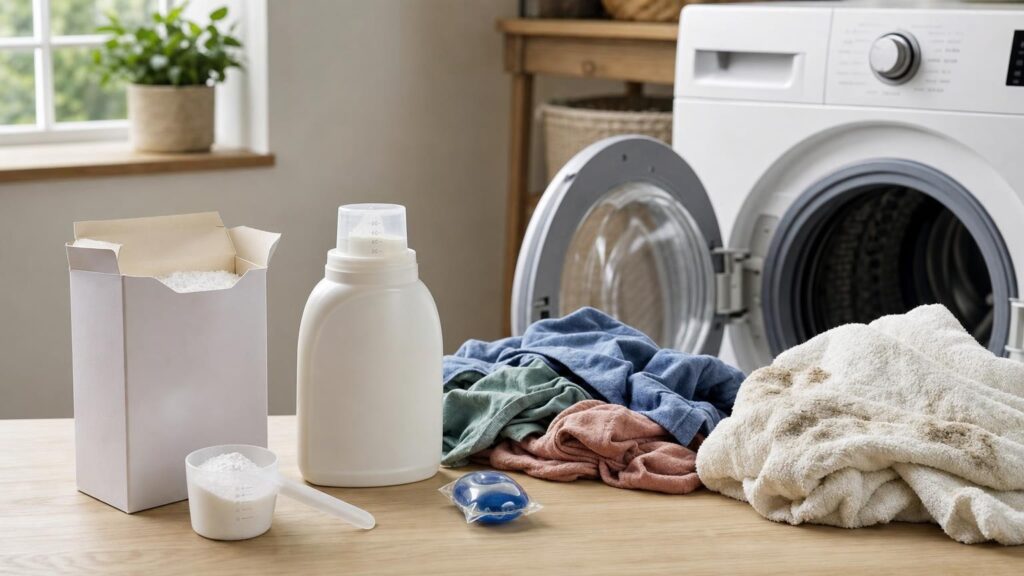
Choosing laundry detergent often looks like a choice between a box, a bottle and a convenient pre-measured capsule. Yet format affects much more than storage and handling. It influences how ingredients are kept stable, how they enter the wash, whether the dose can be adjusted and how reliably the detergent performs under different conditions.
None of the three formats is automatically best. Cleaning performance depends on the complete formulation as well as water hardness, cycle length, wash temperature, load size, fabric type and the stains being treated. Understanding those factors is more useful than relying on a simple rule about powder, liquid or capsules.
Detergent format is part of the formula
A detergent is a delivery system for several ingredients that need to remain effective during storage and then work together in water. A powder keeps most ingredients in a dry form. A liquid contains ingredients dissolved or suspended in a water-based mixture. A capsule encloses a measured liquid, gel, powder or combination of formulations inside a water-soluble film.
These structures create different possibilities and compromises. Dry ingredients can sometimes be separated into granules to reduce unwanted interaction during storage. A liquid must keep its ingredients stable while they share the same environment. Multi-compartment capsules can separate some components until the wash begins, but they still provide a fixed dose.
The format therefore affects formulation design, but it does not determine quality by itself. Two detergents in the same format may use different surfactants, enzyme systems, builders, fragrances and bleaching ingredients. The label and dosing instructions remain more informative than the physical form alone.
What the main ingredients do
Most laundry detergents combine several ingredient groups, although the exact blend varies:
- Surfactants help water wet fabric and loosen oily or particulate soil. They also help keep removed dirt suspended so that it can be rinsed away rather than settling back onto clothing.
- Enzymes break down particular types of stains. Different enzymes may target proteins, starches, fats or components associated with plant-based foods and fabric wear. Not every detergent includes the same enzyme range.
- Builders and water-softening systems reduce interference from calcium and magnesium in hard water. This allows surfactants to work more effectively and can help control mineral deposits.
- Oxygen-based bleaching agents help remove certain coloured stains and maintain the appearance of suitable pale or white fabrics. They are distinct from chlorine bleach and are not present in every detergent.
Other ingredients may control foam, keep soil suspended, adjust acidity, protect the formulation, add fragrance or improve the appearance of fabrics. Because formulations differ within every format, shoppers should not assume that all powders contain bleach, all liquids use the same enzymes or all capsules reproduce the contents of a bottled liquid.
Why dry and liquid formulations have different strengths
Powders can provide a useful environment for ingredients that are less straightforward to keep together in a water-based bottle. Components can be placed in separate particles or granules and combined when the detergent dissolves. This can make powder a practical format for formulations containing builders and oxygen-based bleaching systems.
The trade-off is that powder must first dissolve. If conditions are unfavourable, undissolved particles can remain in the dispenser, collect in folds of fabric or leave visible residue. Moisture entering an open box can also cause clumping and make accurate measuring more difficult.
Liquids are already dispersed in a fluid carrier, so they can mix readily with wash water when correctly dosed and placed. They are also convenient for treating some stains directly before washing, particularly greasy marks, provided the product and garment instructions permit this use.
However, a stable liquid formula has limits. Ingredients sharing a bottle may interact over time, so formulators must balance concentration, stability and compatibility. Some components that work well in dry products may be difficult to include in the same way in a conventional liquid. This does not mean liquid is weak – only that it may achieve its performance through a different ingredient balance.
Capsules can contain concentrated formulations and, where compartments are used, keep selected ingredients apart until the film dissolves. Their central practical advantage is repeatable dosing. That same feature reduces flexibility when the load is unusually small, lightly soiled or needs a dose that falls between the manufacturer’s stated capsule quantities.
Dissolution, dispersion and the wash cycle
Detergent cannot work properly if it does not reach the wash water and fabrics. Temperature, cycle duration, placement and machine loading all influence that process.
Powder generally has more time to dissolve in a longer cycle with adequate water movement. Cool water, a very short programme or an overloaded drum may make complete dissolution more difficult. Using more powder than the conditions can handle can add to residue problems rather than improve cleaning.
Liquid avoids the need to dissolve solid particles, but it still needs to distribute through the load. Pouring it into the wrong compartment, using an unsuitable dosing device or packing the drum too tightly may interfere with distribution. Machine and detergent instructions should determine whether a liquid belongs in a dispenser or in a dosing device placed in the drum.
Capsule film needs contact with water and enough movement to break down as intended. A capsule trapped between tightly packed items, added in the wrong order or used in conditions outside its instructions may not release its contents evenly. Many products instruct users to place the capsule in the empty drum before adding laundry, but the specific packaging directions should take priority.
Residue is not always evidence that an entire format is unsuitable. It can indicate excessive dosing, poor placement, an overloaded machine, unsuitable cycle conditions or a product exposed to moisture during storage. Checking these variables is more useful than simply switching formats without identifying the cause.
Water hardness changes the job detergent must do
Hard water contains higher levels of dissolved calcium and magnesium. These minerals can interfere with surfactants and increase the amount of work the formulation must do before it can remove soil effectively. Builders and other water-softening ingredients help manage this interference.
This is why many detergent labels specify different doses for soft, medium and hard water. A dose that is adequate in a soft-water area may be insufficient in harder water, particularly for a large or heavily soiled load. Equally, using a hard-water dose where it is not needed can waste detergent and make rinsing more demanding.
Format alone does not settle the hard-water question. Some powders have substantial builder systems, while liquids and capsules may use other approaches. Shoppers should check the formulation information and dosing table rather than assuming one format always manages minerals better.
If local hardness is unknown, it can often be checked through the water supplier or another reliable local source. That information is useful whenever comparing stated doses or estimating how many washes a pack will actually provide.
Fixed doses versus adjustable dosing
Powder and liquid allow the dose to be adjusted, which can be valuable when laundry habits vary. A small load of lightly worn clothing may need less detergent than a full drum of muddy sportswear. Hardness, load size and soil level should all be considered within the manufacturer’s directions.
This flexibility only helps if the detergent is measured accurately. Pouring liquid by eye or using an unmarked scoop can turn an adjustable format into an inconsistent one. A clearly marked cap, dosing cup or scoop makes it easier to follow the recommended amount.
Capsules remove routine measuring. For households that usually wash similar full loads under similar conditions, that consistency can be convenient. It also reduces the chance of an accidental heavy pour. However, one capsule may be more detergent than a very small load needs, while demanding conditions may call for a different dose according to the label.
Adding another capsule should not be an automatic response to every dirty load. It creates a large step up in dose and may exceed what is needed. Conversely, habitual underdosing can leave insufficient cleaning ingredients to deal with soil and hard-water minerals. Overdosing can waste product, create excess foam in some machines, make rinsing more difficult and contribute to deposits.
Matching the format to stains, fabrics and washing habits
Oily stains and pre-treatment
Liquid detergent can be convenient for applying a controlled amount to some greasy or oily marks before washing. This is not suitable for every fabric or every product, so both care labels and detergent instructions matter. Prompt treatment and the correct wash programme may be as important as format.
Pale and white loads
Suitable whites and pale colourfast items may benefit from a detergent containing an oxygen-based bleaching system, especially where food, drink or other coloured stains are common. Such systems are frequently associated with powders, but shoppers should confirm the actual ingredient claims rather than infer them from the box.
Colours and delicate fabrics
Colour-care detergents may omit bleaching ingredients that could affect colour over repeated washing, while detergents for wool, silk or other delicate materials may use specialised formulations. A general distinction between powder and liquid cannot replace the garment care label. The wrong wash temperature, agitation level or detergent type can matter more than whether the product is poured or scooped.
Cool and quick everyday washes
Households that mainly run cool, short cycles should pay particular attention to rapid dissolution and dispersion. Liquid or capsule formats may appear convenient for these routines, but capsule placement and load size still matter. A powder designed and dosed for the selected conditions may also work well. Product directions offer a better guide than format stereotypes.
Storage, handling and the real cost per wash
Shelf price does not reveal the practical cost of detergent. The relevant figure is the cost of the correct dose for a household’s normal water hardness, load size and soil level. A large pack is not necessarily better value if inaccurate measuring leads to regular overdosing.
Powder packaging can be bulky, and scooping may create dust or spills. The product should be kept dry and closed so that humidity does not cause clumping. Liquids are compact for their dose in some formulations, but drips around caps and dispensers can cause waste and mess. Measuring aids also need to remain legible and convenient.
Capsules are tidy and quick to use, but their fixed dose can be poor value for frequent small loads. Their film is sensitive to moisture, so dry storage and handling with dry hands are important. As with all detergents, they should remain in their original container and be stored according to the safety information on the pack, away from children and anyone who may mistake them for another item.
Packaging size, storage space and ease of handling may also influence the decision. Someone who finds a heavy bottle awkward may value capsules or a smaller powder pack, while another shopper may prefer the dose control and fewer individual portions of a bulk powder or liquid.
Choose the formulation, not just the format
A sensible choice starts with normal washing conditions rather than a universal ranking. Consider the following questions:
- Is the local water soft, medium or hard?
- Are loads usually small or full, lightly worn or heavily soiled?
- Are cool quick cycles common, or are longer programmes normally used?
- Is direct stain pre-treatment important?
- Are whites, colours or specialist fabrics washed most often?
- Does the formula provide the relevant surfactants, enzymes, builders or bleaching system?
- Can the recommended dose be measured and stored reliably?
Powder offers adjustable dosing and can support useful dry ingredient combinations, but it needs suitable dissolution conditions and protection from humidity. Liquid disperses readily and can simplify pre-treatment, though its water-based formulation involves its own compatibility compromises. Capsules provide convenience and dosing consistency, but their fixed quantity and dependence on correct placement reduce flexibility.
The best choice is therefore the product whose formulation, dose and instructions fit the machine, water, fabrics and wash habits in the household. Format matters, but it is only one part of an effective wash.
Continue exploring on Frowse
Discover More Frowse Insights
- Clumping Clay, Silica and Plant Fibre: How Cat-Litter Materials Behave Differently
- Why Matt, Eggshell, Satin and Gloss Paint Labels Are Not Universal
- Why One Glue Cannot Bond Every Household Material
- How a Rice Cooker Knows When the Water Is Gone – and What Fuzzy Logic Changes
- Airflow, Airspeed and Nozzle Shape: How to Judge a Leaf Blower’s Real Capability