





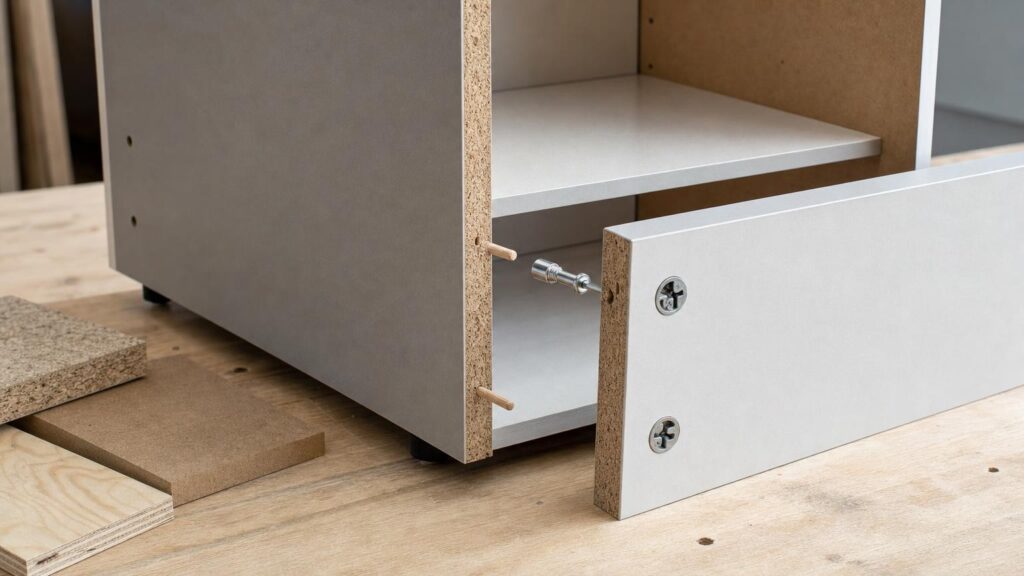
Flat-pack furniture is a method of manufacture and delivery, not a single standard of quality. Two similar-looking cabinets can behave very differently over time because their core boards, surface layers, edge protection and joint systems are not the same. Assembly quality, expected loads and placement also influence how well each piece lasts.
Looking beyond colour and dimensions helps reveal whether an item is likely to resist wobbling, spills, knocks and repeated moves. The most useful approach is to assess the whole construction rather than judging one material or fastener in isolation.
What the Core Board Contributes
The core is the structural material beneath the visible finish. Common options include particleboard, medium-density fibreboard and plywood. Each can be suitable when correctly specified, but each has different strengths and limitations.
Particleboard
Particleboard is made from wood particles bonded and pressed into sheets. It allows manufacturers to create broad, flat components efficiently and is widely used for shelves, cabinet sides, desks and wardrobes. Its surface can be smooth and consistent, but its internal structure is relatively coarse.
Standard particleboard is vulnerable when an edge or fixing point is crushed. Screws may hold adequately on first assembly, yet repeated removal can enlarge the hole and reduce grip. Areas around cam fittings can also deteriorate if the connector is overtightened, misaligned or subjected to repeated sideways movement.
Moisture is particularly important. A covered face may wipe clean, but exposed edges, drilled holes and damaged corners can absorb liquid. Swollen particleboard usually does not return to its original dimensions after drying.
MDF
Medium-density fibreboard is made from much finer wood fibres. It has a uniform texture and can produce smooth faces and shaped profiles, making it useful for painted doors, drawer fronts and decorative panels. Its consistency can also support clean machining.
MDF is generally dense and can make furniture feel substantial, although that density adds weight. Edges and fixing points still require care. Ordinary screws driven directly into the material can lose purchase if repeatedly removed, and unsupported sections may sag when the span and load are too great.
Like standard particleboard, MDF needs protection from moisture. Damaged coatings, unsealed holes and exposed lower edges can become routes for absorption. A swollen or softened area is more serious than a superficial mark on the finish.
Plywood
Plywood is built from thin wood veneers arranged in layers, usually with neighbouring grain directions crossing one another. This layered structure can provide useful strength and screw-holding performance while reducing the tendency to split in one direction.
However, the word plywood does not by itself guarantee durability. The number and quality of layers, internal gaps, face quality, thickness and bonding all matter. Poorly supported plywood can still flex, thin face veneers can be damaged, and exposed layers may chip or separate if moisture reaches unsuitable bonding.
Thickness and support matter too
Material names are only part of the comparison. A thicker shelf, shorter unsupported span or well-placed centre support may matter more than a nominally stronger board used too thinly. When comparing bookcases, desks or media units, consider where the load will sit and whether shelves have central supports, fixed dividers or reinforced front edges.
Veneer, Laminate and Foil Are More Than Finishes
The visible surface is often different from the core. A wood-like appearance could come from real wood veneer, a resin-based decorative laminate such as melamine-faced material, or a thin decorative foil. These layers influence appearance and everyday wear, but they do not transform the core underneath.
Wood veneer is a thin layer of real wood. It can provide natural variation and may allow limited refinishing, depending on its thickness and the coating above it. Deep sanding is risky because it can cut through the veneer and expose the board beneath. Veneer can also chip at corners or lift if bonding fails.
Melamine and other laminates provide a hard, wipeable surface available in many colours and patterns. They can resist ordinary staining and light wear well, but corners may chip and damaged areas can be difficult to disguise. Performance at seams and edges remains dependent on the quality of sealing and adhesion.
Decorative foil is generally a thinner applied surface. It can create a consistent finish and cover shaped components, but abrasion, heat or moisture may cause worn areas or lifting, particularly around corners and frequently handled edges.
A finish described as wipe-clean should not be assumed to make the whole item waterproof. Liquid can still enter through joints, exposed holes, damaged edges and the underside of panels.
Why Edge Banding Is a Durability Detail
Cut edges reveal and expose the core board, so they commonly receive strips of edge banding. This detail does more than improve appearance: it protects vulnerable areas from knocks, abrasion and liquid ingress.
Inspect which edges are covered, not just the most visible front edge. The lower edges of side panels, the perimeter of doors, shelf fronts, desktop corners and edges around cut-outs may experience concentrated wear. An edge beside a sink, floor or regularly handled door has different demands from one enclosed inside a dry cabinet.
Thicker edge material may offer more impact protection than a very thin strip, but adhesion and coverage are equally important. Look for gaps, lifting corners, uneven trimming or exposed core material. A neat edge cannot guarantee long life, yet poor attachment creates an obvious route for damage.
Rounded or softened edges can be less prone to sharp corner chips, while broad work surfaces benefit from continuous protection around high-contact areas. Even good edge banding remains vulnerable if water is allowed to sit at a seam.
How Flat-Pack Joints Carry Loads
Flat-pack joints usually combine several components with different jobs. Understanding those jobs helps explain why one missing or poorly fitted part can affect the entire structure.
- Cam locks and connector bolts pull two panels together. The bolt engages with the rotating cam, which clamps the joint when turned to the correct position.
- Dowels align panels and help resist sideways movement. They are not necessarily intended to provide all the clamping force by themselves.
- Screws may secure hardware, connect panels or attach a back. Their effectiveness depends on the correct hole size, board condition and installation depth.
- Brackets reinforce corners or transfer loads across a wider area. They work best when the surrounding board and fixing points remain sound.
- Back panels help a cabinet stay square and resist racking, where the rectangular frame shifts towards a parallelogram shape.
A thick-looking side panel does not guarantee stability if the joints are loose or the back offers little anti-racking support. Conversely, a modestly sized cabinet can feel rigid when its connectors are correctly aligned and its back is securely fixed around the perimeter.
During assembly, fittings should be tightened firmly according to the instructions rather than forced. Overtightening can crush the board around a cam, strip a screw hole or distort a bracket. Undertightening leaves movement that can enlarge fixing points over time.
Wobble Is Usually a System Problem
Instability is not always caused by weak material. A cabinet may wobble because it was assembled out of square, a cam did not engage fully, the back panel is loose or the floor is uneven. Long unsupported shelves and heavy loads placed far from supports can add further movement.
Before retightening every fastener, identify the direction of the wobble. If the frame shifts diagonally, inspect the back and corner alignment. If one foot lifts, check the floor and any levelling features. If a single joint opens, examine its cam, bolt, dowel and surrounding board for damage.
Moving assembled furniture by pushing or dragging can impose sideways forces that the joints were not designed to handle. Emptying the item and lifting it as directed reduces stress, although larger pieces may need partial dismantling. Follow the supplied assembly, moving and wall-fixing instructions for the particular item.
Dismantling, Reassembly and Moving Home
Furniture intended to remain in one place faces different demands from furniture expected to move repeatedly. Each assembly cycle can wear holes, compress board around fittings and damage dowels if parts are pulled apart at an angle.
Cam-and-bolt systems can sometimes be dismantled cleanly when the cams are fully released and the panels are separated straight. Problems arise when fittings are forced, screws are mixed up or connectors are installed in the wrong holes during reassembly.
Screws driven directly into particleboard or MDF generally offer less tolerance for repeated removal than metal threaded inserts. An insert gives a machine screw a durable metal thread, but it is not an automatic guarantee: the insert must still be securely anchored in sound material. Replaceable fittings are helpful only when compatible parts can be identified and the panel around them is undamaged.
Label components and hardware during dismantling, protect corners in transit and keep screws associated with their original positions where practical. If a connection already feels loose, moving the furniture assembled may accelerate damage.
Moisture, Heat and Everyday Placement
Placement can matter as much as the surface specification. Spills on a fully covered face may be easy to wipe away, while the same liquid reaching a raw underside or drilled joint can cause lasting swelling.
Check whether lower panel edges sit close to a floor that may become damp during cleaning. In humid rooms, condensation and limited airflow can expose backs, corners and hidden surfaces to moisture. Furniture placed against a cold or damp wall may face conditions quite different from those in a dry living space.
Local heat also deserves attention. A hot object can mark some foils, coatings and laminates, while sustained heat may affect adhesives or cause local distortion. Use the item only in the conditions described by its manufacturer and avoid assuming that a heat-resistant-looking surface protects every seam and edge.
Repairability and Sensible Maintenance
Minor problems are easier to address before movement causes wider damage. Periodically check accessible fittings, but tighten only when necessary and avoid using excessive force. If a joint will not close, disassemble it far enough to confirm alignment rather than trying to pull it together with the fastener.
Small areas of lifting edge banding may sometimes be reattached with an adhesive appropriate to the materials, provided the core is dry, flat and intact. Surface scratches can occasionally be disguised, but a cosmetic repair does not restore structural strength.
Worn fixing points require a repair suited to the load and material. Simply installing a larger screw can split or further weaken the board. A suitable insert, repair fitting or relocated fixing may be possible, but only where there is enough sound material and the change does not compromise alignment.
Replacement is often more sensible when board has swollen substantially, layers have separated, a cam housing has fractured or a load-bearing panel has cracked. These are structural failures rather than ordinary surface wear.
Conclusion: Assess the Whole Construction
A useful assessment starts with the core but does not end there. Identify whether the main panels are particleboard, MDF or plywood, then consider their thickness, unsupported spans and expected loads. Examine the surface finish and check whether vulnerable edges, holes and cut-outs are properly covered.
Look at how cam locks, bolts, dowels, screws, brackets and back panels work together. Consider whether the piece will face spills, humidity, heat or repeated moves, and whether its fixing points are likely to tolerate dismantling.
No single feature determines durability. A well-supported board with protected edges, correctly fitted joints and effective anti-racking support can outperform a more impressive-sounding material used without those details. Shopping with the whole construction in mind makes it easier to distinguish a suitable piece of flat-pack furniture from one that may struggle with its intended use.
Continue exploring on Frowse
Discover More Frowse Insights
- Why the Hook on a Tape Measure Is Supposed to Move
- Why Vacuum Storage Bags Slowly Reinflate – and What to Check Before Buying
- What the Tilt Mechanism Under an Office Chair Actually Changes
- Clumping Clay, Silica and Plant Fibre: How Cat-Litter Materials Behave Differently
- How to Read Bicycle Gearing Beyond the Number of Speeds