





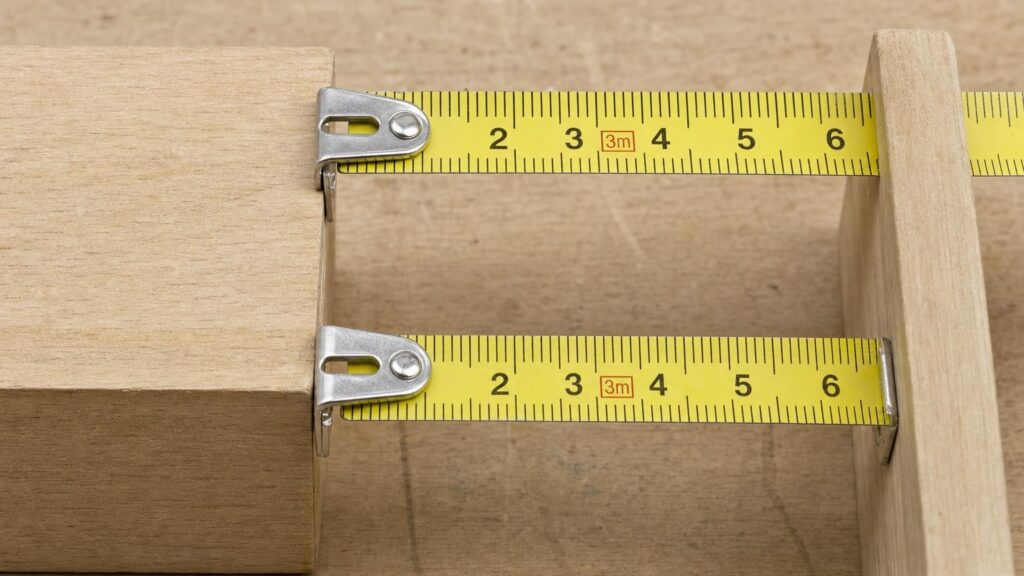
Pick up a retractable tape measure and gently move its metal end hook. The slight movement can feel like loose construction, but on a correctly made tape it is deliberate. The hook slides by approximately its own thickness so the blade can account for whether the hook is pulled against an outside edge or pushed against an inside surface.
This small detail is central to reliable measuring. Understanding how it works also makes it easier to assess blade markings, accuracy information, standout, retraction and signs of wear when choosing or checking a tape measure.
The loose hook is a feature, not a fault
The end hook is normally attached through slots or oversized holes that allow a small amount of movement along the length of the blade. This movement should be controlled and limited. It is not intended to let the hook twist freely, lean at an angle or rattle unpredictably.
The purpose is to compensate for the thickness of the hook. Without that compensation, a measurement taken by hooking the tape over an edge would differ from one taken by pressing the hook against a surface. The sliding attachment allows the zero reference to change position according to the method being used.
This means that tightening or fixing a moving hook is not usually an improvement. Doing so can remove the built-in compensation and introduce a consistent error. What matters is whether the hook moves smoothly in the intended direction and returns to a repeatable position under light pulling or pushing pressure.
How the hook compensates for outside and inside measurements
For an outside measurement, such as measuring the length of a worktop from an exposed edge, the hook catches over the edge and is pulled outwards. Its outer face becomes the measurement reference. The small outward shift compensates for the metal between that face and the end of the blade.
For an inside measurement, such as checking the distance from a wall to the side of a cabinet, the hook is pushed against the starting surface. It slides inwards so its inner face becomes the reference. When the movement matches the hook thickness, both methods should produce substantially consistent readings.
Technique still matters. Pulling the blade at an angle, failing to seat the hook fully or pressing hard enough to bend it can alter the starting point. Holding the hook part-way through its travel can also create an uncertain reading. Apply only enough pressure to seat it in the appropriate push or pull position.
The hook should sit squarely against the reference surface. On rounded, rough or damaged edges, it may be difficult to establish exactly where the measurement begins. Repeating the measurement can reveal whether the setup is stable.
What the blade markings can – and cannot – tell you
A tape measure’s scale should suit the work and the user. Depending on the intended market, a blade may carry metric units, imperial units or both. Scale divisions, numbering frequency and visual contrast vary, so it is worth checking that the smallest markings you expect to use are easy to identify without guesswork.
The edge of the hook or the blade’s nominal zero position is the reference for ordinary measurements. Other markings may indicate fractions, common intervals, construction layouts or dimensions relevant to particular trades. These additions can be useful, but only if their meaning is understood. Unfamiliar symbols should not be treated as measurement points without consulting the manufacturer’s information.
Fine graduations do not automatically mean that a tape can deliver an equally fine level of accuracy. The printed lines may be narrow and closely spaced while hook wear, blade curvature, viewing angle or manufacturing tolerance creates greater uncertainty. Readability and repeatability are often more useful than having the densest possible scale.
Look for markings that remain clear where the tape receives the most use, especially near the hook. A scale that is technically detailed but difficult to distinguish in normal lighting can encourage reading errors.
Accuracy classes, tolerances and useful precision
Some tapes display an accuracy class, conformity mark or stated tolerance associated with a recognised standard. These indicate limits on permissible measurement error under specified conditions. The applicable classes, symbols and testing conventions vary by market, so a class should be interpreted through the relevant standard or manufacturer documentation rather than assumed to mean the same thing everywhere.
An accuracy indication is more informative than scale fineness alone, but it does not prevent errors caused by damage or technique. It also does not mean that every reading will be exact. Temperature, blade support, alignment, tension and the condition of the hook can all influence practical results.
Match the expected precision to the job. Approximate room dimensions, general household placement and rough material estimates may not demand the same tolerance as cabinet fitting, machining or setting out components that must meet closely. For precision-critical or regulated work, a retractable tape may need to be checked against a suitable reference or replaced by a more appropriate measuring instrument.
Blade curvature, standout and reach are different things
Most retractable tape blades have a curved cross-section. This shape helps the thin blade resist folding when extended horizontally. A wider or more deeply curved blade can often feel stiffer, but stiffness also depends on material, thickness and overall design.
Standout is generally the unsupported distance for which an extended blade can remain substantially straight before buckling. It can be valuable when one person is measuring across a gap, but it is not the same as accuracy. A blade may have useful standout while still being difficult to align precisely with a small target.
Reach can be used differently in product descriptions. It may refer to the practical distance a person can extend the tape while holding the case, potentially combining blade extension with arm length. Because terminology and test methods are not always identical, compare definitions rather than headline numbers alone.
Greater blade stiffness can make long extensions easier to control, but a broad blade may require a larger or heavier case. A pronounced curve can also make the scale harder to view from an angle or to place flat against some surfaces. For close indoor measurements, compactness and easy handling may matter more than maximum unsupported extension.
The return spring, lock and blade coating
A coiled internal spring stores energy as the blade is pulled out and retracts it when released. The spring should provide enough force to return the blade reliably without making the tape difficult to control. Very forceful retraction can cause the hook to strike the case repeatedly, increasing wear and creating a risk of pinched fingers or a whipping blade.
The lock should hold the blade at the required extension without excessive effort and release predictably. Some movement at the lock may be normal, but slipping under light working tension makes it harder to take repeatable readings. Controls should be accessible from a natural grip rather than forcing the hand into an awkward position.
Blade coatings and surface finishes help protect the printed scale from abrasion, dirt and moisture. Their durability varies with material and use. A highly reflective surface may be easy to wipe clean but harder to read under bright light, while a matt finish can reduce glare. The important question is whether the scale remains legible in the conditions where the tape will be used.
Retraction should be guided rather than allowed to snap back at full speed. Controlled return is kinder to the hook, fasteners, blade edges and internal mechanism.
Hook design and case features that affect real use
Hook shapes vary. A larger hook may be easier to catch on an edge, while a compact hook may interfere less when measuring into corners or along narrow components. Some designs can engage from the side or from more than one direction. This can help when measuring overhead or against awkward shapes, provided the hook remains stable and its reference surfaces are undamaged.
The attachment points matter because they guide the compensation movement. They should allow fore-and-aft travel without excessive sideways play. The hook’s faces should be reasonably flat and square to the blade.
Case grip also affects accuracy in practice. A secure shape and manageable size help the user keep the blade aligned rather than twisting it across the measured distance. If the tape is intended for inside measurements using the case itself against one surface, check whether the housing has a clearly stated case length or another defined reference. Do not assume an unmarked case dimension is exact or easy to add mentally.
When movement becomes wear or damage
Normal hook movement is short, straight and repeatable. Warning signs include substantial sideways twisting, visibly bent metal, loose or damaged fasteners, enlarged attachment slots and a hook that no longer sits squarely. Movement that feels irregular or changes from one attempt to the next can shift the zero point.
Inspect the first section of blade closely because this area experiences frequent bending and impact. Kinks, cracks, curled edges or stretched attachment points can affect both handling and measurement. Worn, peeling or obscured graduations make accurate reading difficult even if the mechanism remains sound.
Retraction problems also deserve attention. A blade that returns inconsistently, jams, grinds or recoils unpredictably may have contamination, blade damage or an internal spring problem. Opening a spring-loaded case can release stored energy and is not an appropriate casual repair for many users.
Damage often results from dropping the case, allowing uncontrolled retraction, using the hook to pull objects or bending the blade beyond its intended form. A tape can continue to retract after such treatment while no longer giving repeatable measurements.
How to check a tape measure before relying on it
A simple inspection can identify obvious problems, although it is not a formal calibration. Use the following routine:
- Inspect the hook. Confirm that it moves along the blade but does not twist excessively. Look for bent faces, damaged fasteners and enlarged slots.
- Check the early blade section. Look for kinks, cracks, worn graduations and distorted edges near zero.
- Compare push and pull readings. Use a stable object or suitable known reference that allows the hook to be pressed against one face and caught over an edge. The readings should agree within the level of precision needed for the task.
- Repeat the same measurement. Measure several times with consistent technique. A reading that changes noticeably may indicate unstable hook seating, poor alignment or damage.
- Test extension and locking. The blade should extend smoothly, remain controlled and stay in place when locked.
- Guide the blade back. Check that retraction is smooth and consistent without letting the hook strike the case at full speed.
If results remain inconsistent after improving the setup, do not rely on the tape for close-tolerance work. Replacement is often more sensible than attempting to reshape the hook by eye. Where measurements have contractual, technical or safety consequences, use professionally verified equipment and the checking procedure required for that work.
Choose for repeatability, not just headline reach
A useful tape measure is one that produces consistent readings in the situations where it will actually be used. Prioritise a clear scale, an appropriate accuracy indication, a stable hook, suitable blade stiffness and a return action that can be controlled comfortably. Consider case size, grip and hook accessibility alongside standout or reach claims.
Above all, do not mistake deliberate fore-and-aft hook movement for poor construction. That movement enables the tape to compensate for the hook’s thickness during both push and pull measurements. It becomes a problem only when wear, bending or loose attachments make the starting point irregular. Understanding the difference helps shoppers choose more intelligently and recognise when a familiar tool can no longer be trusted.
Continue exploring on Frowse
Discover More Frowse Insights
- Suction, Airflow and Floorheads: What Really Determines Vacuum Cleaning Performance
- PTFE vs Ceramic Non-Stick Pans: What the Coatings Really Are
- Speed Class, UHS and V-Rating: How to Read an SD Card
- Where Ink Goes When an Inkjet Printer Is Not Printing Pages
- Roller Skate Wheels Explained: Diameter, Hardness, Profile and Hubs