





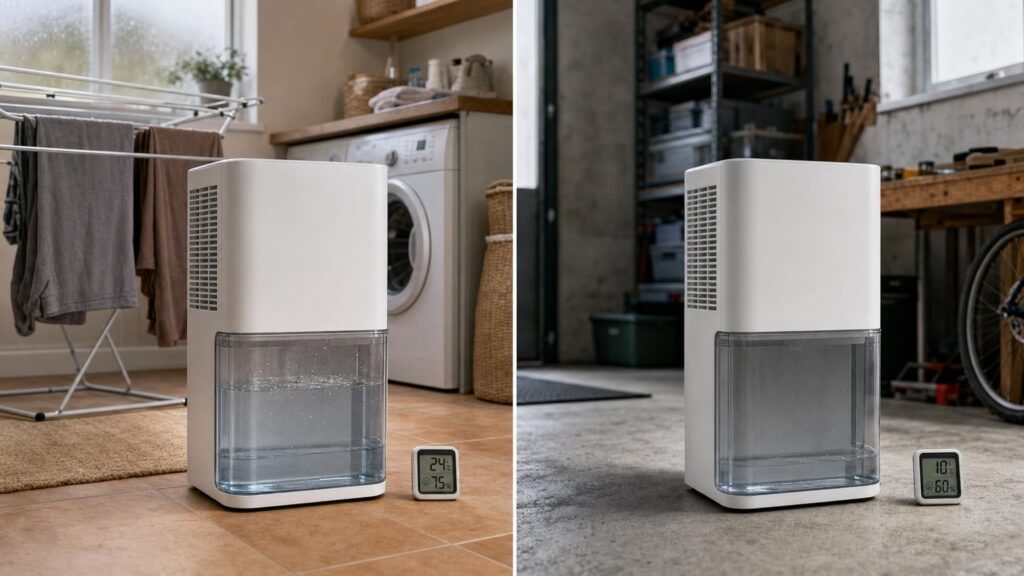
A dehumidifier labelled with a litres-per-day figure may collect far less water in your home than the headline number suggests. That does not automatically mean the appliance is faulty or underpowered. Extraction ratings are measured under specified temperature and relative-humidity conditions, while real rooms continually change.
Understanding those conditions makes it easier to compare dehumidifiers sensibly. It also helps you decide whether a compressor or desiccant design suits the space, how often a tank may need emptying, and whether features such as automatic defrost and continuous drainage matter for your routine.
Why litres per day is not a fixed real-world result
A litres-per-day rating describes how much water a dehumidifier can extract over a defined period under stated test conditions. It is a nominal capacity, not a promise that the appliance will fill containers with that amount every day in every room.
Test temperature and relative humidity are crucial. A warm, very damp test environment offers the dehumidifier a plentiful supply of accessible moisture. A cooler bedroom, garage or utility room at a moderate humidity level presents a different task, even if the same appliance runs for the same number of hours.
Daily collection also declines as the room dries. A dehumidifier may collect water quickly after damp washing is introduced or when first used in a humid space. Once the target humidity is approached, collection should slow and the humidistat may cycle the appliance off. Lower collection can therefore indicate that conditions have improved rather than that performance has deteriorated.
How temperature and relative humidity change extraction
Relative humidity describes the amount of water vapour in the air compared with the maximum that air could hold at its current temperature. Because warmer air can contain more water vapour than cooler air, the same relative-humidity reading does not always represent the same amount of water in the room.
This is one reason ratings obtained in warm, humid conditions can look impressive. There is more moisture available, and the appliance may be operating near conditions that favour its extraction method. In a cooler or less humid room, there is usually less readily available moisture to remove.
Room conditions are also dynamic. Moisture may enter through open doors, ventilation, drying laundry, cooking, bathing or air leakage from outside. Porous materials and furnishings can release stored moisture as the air dries. Conversely, heating the room can reduce the relative-humidity reading even before any water has been removed, because the air’s moisture-holding capacity has increased.
Judge performance over time rather than from one tankful. Consider whether humidity is trending towards the chosen target, whether condensation is becoming less frequent and whether the unit is cycling normally for the conditions.
Compressor dehumidifiers: efficient conditions and cold-room limits
A compressor dehumidifier draws room air over a cold surface. When that surface is below the air’s dew point, water vapour condenses into liquid and drains into the tank or through a hose. The processed air is then returned to the room, usually slightly warmer overall because of energy used by the appliance.
This refrigeration-based process generally becomes less productive as the room gets colder. Cooler air often contains less water, and it becomes harder to maintain useful condensation without the cold coil reaching a temperature at which frost can form. Ice obstructs airflow and insulates the coil, so it must be cleared before normal extraction can continue effectively.
For a regularly heated living space, a compressor design may be a logical option. For an unheated garage, store room or other persistently cool area, shoppers should pay close attention to the stated operating-temperature range and defrost behaviour rather than relying only on the largest litres-per-day figure.
Desiccant dehumidifiers: a different response to temperature
A desiccant dehumidifier uses a moisture-attracting material to adsorb water vapour from the passing air. The material is then regenerated using heated air, allowing the captured moisture to be removed and collected.
Because this process does not depend on cooling a coil below the dew point in the same way, desiccant models can retain more useful extraction in low-temperature environments. That can make the design attractive for cool rooms where a compressor appliance would spend more time managing frost or deliver sharply reduced collection.
The trade-offs matter. Regenerating the desiccant requires heat, so these models can contribute more warmth to the room and may use more electricity than a suitable compressor model in warmer conditions. Extra heat may be welcome in a chilly space but less desirable in a heated bedroom or during warm weather.
Neither technology is universally better. The practical question is which design performs appropriately at the temperatures where the appliance will actually operate, with acceptable energy use, noise and heat output.
Defrost cycles and the gap between running time and extraction time
Many compressor dehumidifiers include automatic defrost. When the appliance detects or anticipates frost on the cold coil, it temporarily changes or pauses normal dehumidification so the ice can melt. The fan may continue running, and the machine may still make operating noises, but little or no water may enter the tank during that period.
In a cool room, repeated defrost cycles can create a substantial difference between the time the appliance appears to be running and the time it spends actively condensing water. This does not necessarily indicate a defect. It may be the control system protecting performance and allowing airflow to recover.
Defrost becomes more important when comparing models for unheated spaces. Check whether the manufacturer states a suitable minimum operating temperature and describes automatic defrost. An appliance being technically able to switch on at a low temperature does not by itself show that it will extract efficiently there.
Reading extraction claims without making false comparisons
Two dehumidifiers should not be compared by their headline capacities unless those figures were produced under comparable conditions and conventions. Look for the temperature and relative humidity attached to each rating. A larger figure measured in a more favourable environment may not demonstrate stronger performance in your room.
Keep the following specifications separate:
- Nominal extraction capacity: the stated amount of water removed per day under particular test conditions.
- Tank capacity: how much collected water the internal container can hold before it needs emptying.
- Airflow: the volume of air moved through the appliance, which affects air circulation but does not alone determine water extraction.
- Power consumption: the electrical input under stated conditions, not a direct measure of effectiveness in every room.
- Operating-temperature range: the conditions within which the appliance is intended to run.
- Humidity controls: whether the unit can cycle around a chosen target instead of operating continuously.
Room-size descriptions can be useful as broad guidance, but they cannot account for every building, moisture source or air change. A closed bedroom with occasional moisture is different from a laundry area receiving repeated loads of wet clothing, even if their floor areas are similar. Ceiling height also affects the volume of air, while open doors connect the appliance to a larger effective space.
When specifications are incomplete, avoid assuming that the highest headline rating offers the best value. Clear test conditions and relevant controls may be more useful than a large number that cannot be related to your intended environment.
What the humidistat controls – and what it cannot measure perfectly
A humidistat monitors relative humidity and controls operation around a selected target. When the measured level is above that target, the appliance extracts moisture. As the reading falls, it may reduce activity or stop, restarting later if humidity rises again. This prevents unnecessary continuous operation in a room that has already reached the intended range.
The reading is not a perfect map of the whole room. A sensor inside the appliance measures air near its own intake, where airflow, internal warmth and proximity to a wall can affect the result. Humidity elsewhere may differ, especially in a large room, behind furniture or near a moisture source.
Control systems also work with tolerances rather than switching at an infinitely precise point. This helps avoid rapid on-off cycling. As a result, a display may move above and below the selected target during normal use.
A separate hygrometer placed elsewhere can show a different value without either device necessarily being defective. For more meaningful comparisons, avoid placing the hygrometer directly in the dehumidifier’s outlet airflow and allow readings to settle. Consistent trends are generally more informative than small moment-to-moment differences.
Tank shutoff and continuous drainage in everyday use
Tank size affects convenience, not the appliance’s underlying extraction rate. A small tank can fill quickly in damp conditions even when the nominal daily capacity is much larger. Once full, a float or sensor normally triggers automatic shutoff to prevent continued collection into an overflowing container. Extraction will not resume until the tank is emptied and correctly refitted.
Continuous drainage can reduce supervision, but its practical requirements vary:
- Gravity drainage needs a hose that runs continuously downhill to a suitable drain. Kinks, upward loops or a drain point that is too high can stop the flow.
- Pumped drainage, where offered, can move water to a less conveniently positioned outlet, but shoppers should check the stated lift and routing requirements rather than assume any sink or drain is reachable.
- Hose installation should follow the appliance instructions, including the specified connection size and placement.
Continuous drainage does not increase the rate at which moisture is extracted. It simply gives collected water another route out, allowing the appliance to keep operating without waiting for someone to empty the tank. For unattended or hard-to-reach spaces, reliable drainage may matter more than a modest difference in headline capacity.
Match the rating to the actual room and ownership routine
Start with the room rather than the label. Note whether it is heated, how cool it becomes, its approximate air volume and whether doors will remain open. Identify recurring moisture sources such as laundry and consider how much outside air enters through ventilation or frequent access.
Then assess how the appliance will fit everyday use:
- Choose the extraction technology for the temperature. Compressor and desiccant designs respond differently in cool conditions.
- Compare capacities under like-for-like test conditions. Do not treat unlike ratings as a direct performance ranking.
- Consider the whole moisture load. A room receiving new moisture may require longer operation than a closed space being maintained.
- Plan water disposal. Decide whether regular tank emptying is realistic or whether a correctly routed drain is available.
- Account for noise and heat. Fan, compressor and airflow sounds matter in occupied rooms, while heat output can be either useful or unwanted.
- Set realistic expectations. Collection normally changes as temperature and humidity change, and it should often slow as the room approaches its target.
The most suitable dehumidifier is therefore not automatically the one with the largest litres-per-day number. It is the one whose operating method, controls, drainage arrangements and rated conditions align with the room and the level of supervision you can provide. Read the extraction figure as a conditional measurement, and it becomes a useful comparison tool rather than a misleading daily promise.
Continue exploring on Frowse
Discover More Frowse Insights
- Why One Glue Cannot Bond Every Household Material
- End Grain, Edge Grain and Face Grain Cutting Boards Explained
- What Makes a Paintbrush Hold Paint, Cut Cleanly and Keep Its Shape?
- Why a Washing Machine’s Kilogram Capacity Is Not the Size of Every Load
- Fixed-Speed vs Inverter Air Conditioners: What Compressor Modulation Really Changes