




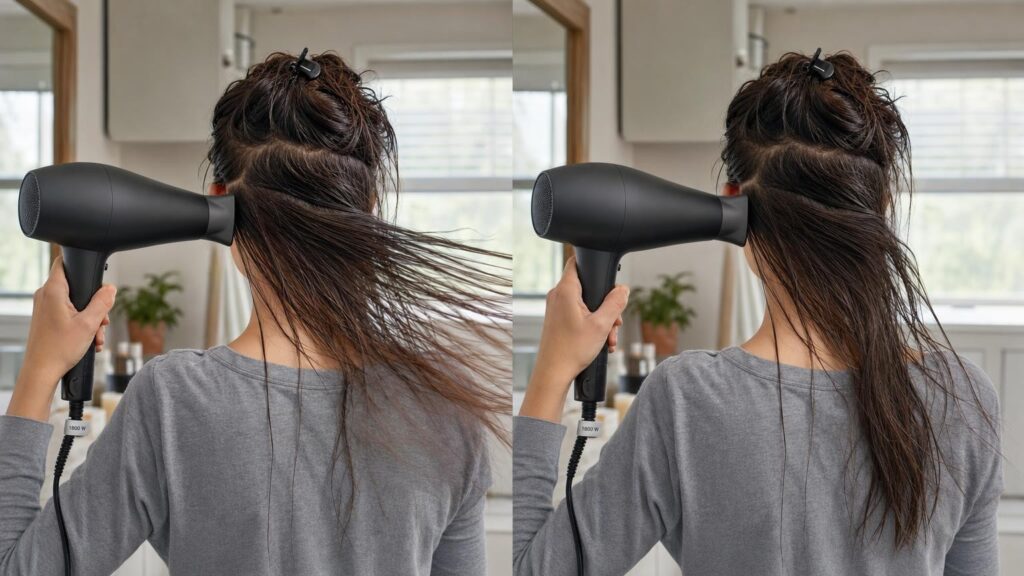
A high wattage can make a hair dryer sound powerful, but it is not a direct measure of drying speed. Wattage tells you how much electrical power an appliance is designed to consume under its rated conditions. It does not tell you how effectively that power becomes useful heat and controlled airflow at your hair.
Two dryers with similar wattage ratings can therefore feel and perform quite differently. One may move a large volume of air efficiently, while another relies more heavily on heat. The shape of the air path, motor and fan design, controls, attachments and condition of the intake all influence the result.
For a useful comparison, treat wattage as one part of a system rather than a performance score.
Wattage is power consumption, not a drying-speed score
A dryer’s wattage rating describes electrical input at its intended supply voltage. Much of that power usually goes to the heating element, with the motor, fan and electronics using the rest. The rating alone does not show how the power is divided or how efficiently the appliance delivers heated air.
This distinction matters because evaporation is not driven by temperature alone. A dryer must also move moist air away from the hair and replace it with drier air. A model that produces plenty of heat but weak airflow may feel very hot without clearing moisture efficiently. Another dryer could use its available power to create stronger, better-directed airflow and achieve a more practical balance.
Wattage can still provide context. Very different ratings may indicate different power demands or design priorities, but a higher number is not enough to establish that one dryer will be faster, quieter or better suited to a particular head of hair.
Drying depends on heat, airflow and air speed working together
Three related factors shape the drying process:
- Heat supports evaporation by raising the temperature of the hair and surrounding water.
- Airflow volume describes how much air the dryer moves over time.
- Air speed describes how quickly that air leaves the dryer and travels through or across the hair.
These factors are connected, but they are not interchangeable. High air speed through a narrow outlet can be useful for directing air at a brush or a small section. A broader flow may cover more hair at once. The useful result depends on whether the air reaches the wet hair, passes through dense sections and carries humid air away.
Excessive heat cannot fully compensate for weak or poorly directed airflow. It may make the hair surface feel hot while leaving dense roots or inner layers damp. Conversely, strong airflow with moderate heat can be effective when it is distributed and directed well.
Technique also changes the outcome. Sectioning dense or long hair gives the airflow a clearer path. Holding the dryer too close can concentrate heat unnecessarily, while constantly moving it may distribute heat more evenly. Ambient humidity, towel drying and how wet the hair is at the start also affect total drying time, so no electrical specification can predict one universal result.
Motor and fan design shape real-world performance
The motor turns the fan that pulls air through the intake and pushes it across the heating element. Its performance has to be considered together with fan geometry, internal resistance and the shape of the outlet.
Motor descriptions such as AC, DC or brushless can indicate broad differences in construction, but the label is not a guarantee of stronger airflow or faster drying. A complete design can affect:
- how consistently the dryer maintains airflow under normal use;
- the balance between air volume and outlet speed;
- the pitch and level of operating noise;
- the size and weight of the housing;
- how the dryer feels when held for an extended styling session; and
- potential wear points and maintenance requirements.
Speed settings are also worth examining. Some dryers provide genuinely distinct airflow levels, while others produce a less noticeable difference between settings. Independent heat and speed controls are particularly useful because they let you reduce temperature without necessarily sacrificing all of the airflow. That can be more versatile than a design in which heat and fan speed are closely tied together.
Intake design and filters can restrict – or preserve – airflow
Before air can leave the nozzle, it must enter through the intake. Intake size, placement and grille design influence how easily the fan can draw air into the dryer. An intake that is repeatedly covered by a hand or obstructed by nearby hair can restrict flow regardless of the wattage rating.
The filter or intake grille also collects dust, lint and loose hair. As debris accumulates, the motor may have to work against greater resistance and less air may pass over the heating element. The practical signs can include weaker airflow, longer drying, a hotter-feeling housing or intermittent thermal cut-out on dryers equipped with protective systems.
A removable or easily accessible filter can make routine maintenance simpler. Follow the manufacturer’s cleaning instructions, unplug the dryer and allow it to cool before handling the intake. Avoid pushing debris farther into the housing or using cleaning methods that the instructions do not permit.
Filter condition is easy to overlook when comparing a familiar older dryer with a new one. A clogged intake can make an otherwise capable appliance feel much less effective, so cleaning is a sensible first check when performance appears to have declined.
Concentrators and diffusers change what the airflow does
Concentrator nozzles
A concentrator narrows the outlet and directs air towards a smaller area. This can improve control when drying in sections, smoothing with a brush or aiming air along the hair. The more focused jet may feel faster because it places airflow exactly where it is needed.
That does not mean the attachment creates extra motor power. It changes the airflow pattern and can increase local air speed while reducing the area covered at one time. A narrow concentrator may be efficient for targeted work but slower if it is swept randomly across a large amount of hair.
Diffusers
A diffuser spreads air through multiple openings over a wider area. It is commonly chosen for curls, waves or styles where a forceful jet would disturb the pattern. Its gentler-feeling distribution can make the process easier to control, but it may not produce the same concentrated drying sensation as a narrow nozzle.
Diffuser shape, depth and fit matter. A deep bowl may hold sections differently from a shallow design, while prongs can help position the attachment closer to roots. Secure attachment fit is important for practical use, particularly when the dryer is angled or moved frequently.
When comparing advertised drying speed, check which attachment and technique make sense for your routine. A dryer that performs well with a concentrator is not automatically the best match for someone who mostly diffuses.
What ionic and ceramic terminology actually describes
Ionic generally means the dryer includes a system intended to generate electrically charged ions in the airflow. These features are commonly marketed in relation to static, flyaways and the way water sits on the hair. However, the word does not reveal the ion output, how the feature is controlled or how noticeable the effect will be on a particular hair type.
Ionic technology should not be treated as another expression of wattage, nor as proof of faster drying. Some dryers allow the function to be switched or adjusted, which may be more useful to shoppers who want flexibility. Results can vary with hair condition, humidity, products and styling method.
Ceramic may refer to a ceramic-coated component, a ceramic-containing heater or another part of the internal heat system. It is often associated with the aim of distributing heat more evenly, but the term is broad. It does not tell you how much ceramic material is present, where it is used or how well the complete dryer controls temperature.
Neither label guarantees uniform heat, reduced damage, healthier hair or a particular drying time. Look instead for usable heat settings, stable airflow and controls that make it easy to choose only as much heat as the task requires.
Match dryer performance to your hair, routine and controls
The right performance balance depends on how much hair you dry and how you style it. Long or dense hair may benefit from airflow that can reach through sections without relying on the hottest setting. Fine, short or easily disturbed hair may place more value on lower, clearly differentiated speed and heat options. Curly routines may depend heavily on diffuser design, while brush styling benefits from controlled, directional flow.
Consider these questions before comparing wattage:
- How long and dense is your hair? More hair can make sustained airflow and comfortable handling especially important.
- Do you rough-dry, brush-style or diffuse? Each method uses airflow differently and may require a different attachment.
- Can heat and speed be adjusted independently? Separate controls provide more ways to balance comfort, drying and styling.
- Is the cool setting convenient? A button that is awkward to hold may be less useful than a setting that fits your normal grip and technique.
- Are the attachments secure and appropriately sized? A nozzle is only useful if it stays in place and directs air as intended.
- Is the dryer manageable? Weight, grip shape, control placement, cord handling and balance matter during longer sessions.
- Can the filter be maintained easily? Accessible cleaning helps preserve the airflow on which performance depends.
A heavy or poorly balanced dryer can become tiring even if its headline specifications look impressive. Likewise, more settings are not automatically better if the controls are difficult to distinguish while the appliance is running.
Voltage and plug compatibility are not optional details
A wattage rating applies at the voltage for which the dryer was designed. Supply voltage and plug formats vary by region, and hair dryers are relatively demanding electrical appliances. Do not assume that a plug adaptor makes a fixed-voltage dryer compatible with another electrical system. A basic adaptor changes the physical plug connection, not the voltage.
A genuinely dual-voltage model is designed to operate at more than one stated voltage, but its instructions still matter. Some switch automatically, while others require a manual selector to be set correctly before connection. Available heat or speed behaviour may also differ between voltage modes, depending on the design.
Before buying for travel or across regions, verify the rating label, supported voltage and frequency, plug type and manufacturer guidance. Also check that any supplied attachments and controls operate as expected in the intended mode. If the compatibility information is unclear, do not infer it from the wattage number or product name.
A better way to compare hair dryers
Start with the way you actually dry and style your hair, then assess the whole airflow system. Wattage provides useful electrical context, but it cannot summarise heater design, fan performance, outlet geometry or control quality.
- Identify the airflow pattern and attachments suited to your routine.
- Look for distinct, practical heat and speed controls rather than simply the highest settings.
- Consider motor, fan and internal design as a complete system, not as isolated marketing labels.
- Check intake placement and whether the filter is easy to access and clean.
- Assess weight, balance, grip and button placement for the length of your typical session.
- Verify voltage, frequency and plug compatibility for the market or destination where it will be used.
The fastest-feeling dryer is often the one that delivers an appropriate combination of heat, air volume and air speed to the right place, with controls and attachments that suit the user’s technique. That cannot be determined from wattage alone.
Continue exploring on Frowse
Discover More Frowse Insights
- Speed Class, UHS and V-Rating: How to Read an SD Card
- Single-Coil, Humbucker and Active Pickups: How the Hardware Shapes the Signal
- Beyond GSM: What Really Makes a Towel Absorbent, Soft and Slow to Dry
- Why the Hook on a Tape Measure Is Supposed to Move
- Why an HDR Badge Does Not Guarantee a Convincing HDR Picture