




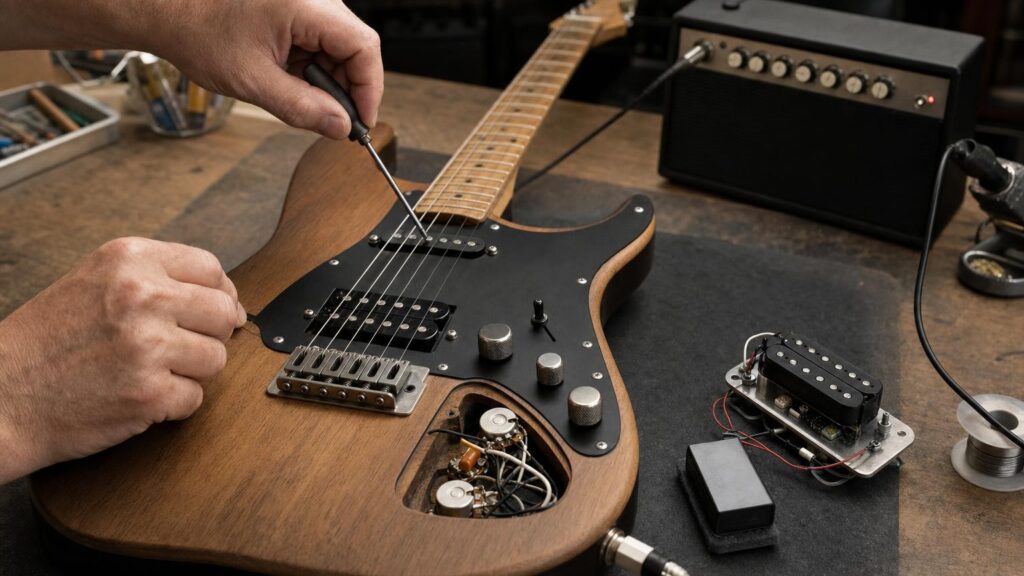
Pickup labels are useful starting points, but they are not complete descriptions of sound. A single-coil, humbucker or active pickup is part of a signal system involving the strings, pickup position, controls, wiring, cable and connected equipment. Change one part and the result can change with it.
Understanding these interactions helps when replacing a pickup, planning a wiring upgrade or choosing between guitars. Rather than treating terms such as “ceramic”, “high output” or “active” as fixed tone labels, it is more useful to ask what problem a design solves and how it will work in the intended instrument.
How a magnetic pickup creates the guitar signal
A conventional magnetic guitar pickup uses a magnetic field and one or more coils of fine wire. Magnetically responsive strings become part of that magnetic system. As a string vibrates, its movement changes the magnetic flux through the coil, inducing a small alternating voltage. That electrical signal then travels through the guitar’s controls and on to an amplifier, effects unit or audio interface.
The magnetic field may come from magnetised pole pieces or from a bar magnet coupled to steel poles or blades. These arrangements distribute the field differently, so the name of the magnet material does not describe the whole magnetic circuit. Pole dimensions, blade shape, magnet placement and the distance between pickup and strings all matter.
String choice matters too. Conventional magnetic pickups need strings containing magnetically responsive material. String construction, gauge and condition can also affect vibration and level, although the pickup remains only one part of what reaches the listener.
Single-coils and humbuckers: practical trade-offs
Single-coil construction
In its basic form, a single-coil pickup has one sensing coil. Its coil dimensions, winding and magnetic structure help set its output and electrical resonance. Many players associate this format with a defined attack and an open high-frequency response, but those are tendencies rather than guarantees. A heavily wound or differently loaded single-coil can behave very differently from another pickup with the same broad label.
The main practical issue is susceptibility to electromagnetic interference. A single coil can receive mains-related hum and other unwanted noise from the surrounding environment. The amount depends on the pickup, guitar shielding, orientation, room, nearby electrical equipment and gain used later in the signal chain. High-gain amplification makes existing noise more noticeable; it does not necessarily mean the pickup itself has become noisier.
How humbuckers cancel hum
A humbucker normally combines two coils arranged so that common interference is substantially cancelled while the string signal is preserved. This requires the coils’ winding and magnetic polarities to work together correctly. It can reduce hum effectively, although it cannot remove every possible source of buzz, radio interference or grounding noise.
Two coils also change the electrical and physical behaviour of the pickup. Their inductance, resistance, spacing and wiring influence output and frequency response. Because the coils sample the string at slightly different points, some harmonic content may combine differently from a narrow single-coil design. This helps explain why humbuckers and single-coils often feel distinct, but it does not support a simple rule that every humbucker is dark or every single-coil is bright.
For shoppers, the useful comparison is therefore broader than “one coil versus two”. Consider acceptable noise, desired response, available mounting space and how the pickup will be loaded by the guitar and connected equipment.
Passive versus active: where electronics change the equation
A passive pickup sends its signal through unpowered guitar controls. Its interaction with volume and tone potentiometers, cable capacitance and the input impedance of connected equipment can strongly influence its resonant response. Changing those loads may make the same pickup sound noticeably different.
An active system includes powered onboard circuitry, usually involving a buffer, preamplifier or both. Buffering can present the sensing element with a controlled load and provide a low-impedance output that is less affected by cable capacitance. A preamplifier may also shape frequency response or increase signal level.
Active does not automatically mean louder, more distorted or appropriate to only one style of music. The actual result depends on the pickup element, circuit design, available headroom and output settings. A strong signal can overload a later pedal or amplifier input, while insufficient circuit headroom can cause clipping within the guitar. Conversely, an active design can be configured for a clean and controlled output.
Powered systems introduce practical requirements. They need the correct power source, space for a battery or electronics and a compatible output-jack arrangement where the jack is used to switch power. Battery access and replacement become maintenance considerations. Mixing active and passive components may also require a carefully planned wiring scheme rather than simply connecting them to the same controls.
Why magnets and winding specifications cannot predict tone alone
Magnet names such as ceramic and Alnico identify material families, not a complete sonic outcome. Magnet strength, grade, size, shape, charge level, location and the surrounding steel parts all affect the field reaching the strings and coil. Two pickups using a similarly named material can therefore perform quite differently.
Winding details are equally interconnected. The number of turns, wire gauge, coil dimensions and winding pattern contribute to resistance, inductance and distributed capacitance. Together with the external controls and cable, these properties help determine the pickup’s level and resonant behaviour.
DC resistance is especially easy to misread. It is straightforward to measure and can sometimes help compare closely related versions of the same design, but it is not a direct measurement of volume, power or quality. Wire gauge, temperature and coil construction affect resistance, while output also depends on magnetic strength, inductance, string movement, pickup height and frequency. A higher resistance figure does not guarantee a louder or “better” pickup.
Output descriptions should likewise be treated as comparative clues, particularly when measurement conditions are not stated. The player’s attack, string type, pickup position and test equipment can all affect the observed signal.
Pickup position changes what the pickup receives
A vibrating string does not move equally at every point along its length. Near the bridge, excursion is generally smaller and the harmonic balance differs from what a pickup receives nearer the neck. This is why moving the same design between positions can change both perceived level and tonal balance.
Position-specific sets may compensate through winding, magnetic strength, pole or blade layout, and physical spacing. Bridge models are often designed to balance with the stronger apparent signal available nearer the neck, but the appropriate pairing depends on the individual guitar and pickup set.
Height adjustment is an important part of installation. Moving a pickup closer to the strings commonly increases signal and can alter attack or balance. Excessive proximity may allow magnetic pull to interfere with free string vibration, particularly with strong magnetic fields. Lowering the pickup can reduce level and change its response. Individual pole adjustment, where available, can help balance strings, but it should be done by listening rather than assuming every pole must follow the same visible curve.
Controls, switching and the rest of the signal chain
Passive pickups interact electrically with the controls attached to them. Potentiometer values affect loading, while the tone capacitor and tone control determine how high frequencies are reduced as the control is turned down. Even with controls fully open, their values can influence the pickup’s resonance.
Cable capacitance also matters, particularly with a passive high-impedance source. Cable construction and length contribute to the load seen by the pickup. Pedal, amplifier and interface input impedance can then alter the result further. This is why a pickup demonstrated through one rig may not behave identically through another.
Switching options add flexibility but require precise terminology:
- Series wiring commonly provides more level and a different resonance than the same coils wired in parallel.
- Parallel wiring retains both coils but changes their combined electrical behaviour, often producing a lower level and a different frequency balance.
- Coil splitting disables part of a multi-coil pickup. It can move the response towards single-coil territory, but it does not make the remaining coil identical to a purpose-designed single-coil.
- Phase switching changes how signals combine. Its effect is most pronounced when two pickups or coils are heard together and can reduce frequencies that cancel between them.
These options may require pickups with multiple accessible conductors, suitable switches and a compatible wiring plan. A two-conductor pickup cannot necessarily support every advertised switching arrangement.
Fit and compatibility checks before buying
A pickup can be electrically appealing yet physically unsuitable. Before ordering, inspect the guitar and confirm the installation requirements rather than relying on labels such as “standard size”.
- Physical format: Measure the pickup cavity, cover, mounting ring or pickguard opening, including available depth.
- Mounting method: Check screw positions, mounting tabs, direct-mount requirements and whether suitable springs or tubing are needed.
- String alignment: Compare pole or blade coverage with the instrument’s string spacing, especially at the bridge.
- Wiring access: Confirm the number of conductors and whether splitting, series, parallel or phase switching is required.
- Controls: Check recommended potentiometer arrangements, tone components and whether existing controls suit the planned circuit.
- Active-system needs: Allow for powered electronics, battery access and any required output jack or control changes.
- Pickup balance: Consider how the new unit’s level and response will combine with pickups remaining in the guitar.
Installation may involve soldering, routing or changes to the pickguard and control cavity. If the guitar is valuable, unusually constructed or difficult to reverse, professional installation may be preferable.
Choose by the problem you need to solve
Begin with the limitation that matters most. If environmental hum is disruptive, prioritise hum-cancelling architecture and good installation practice. If flexible switching matters, look for the necessary coil construction and conductor access. If long cable runs or changing input loads cause inconsistency, buffering or an active system may be useful.
Then consider how the pickup will be used. Clean sounds can reveal balance and transient response, while gain and compression may emphasise noise, level differences and how the signal drives later equipment. Match neck and bridge positions by listening for useful switching transitions rather than assuming identical specification figures will create equal perceived volume.
Where possible, compare pickups in the same guitar or through the same signal chain. Recorded demonstrations can help, but differences in strings, setup, playing, amplifier settings, microphones and production make isolated examples difficult to treat as controlled comparisons.
Read pickup specifications as interacting clues
Pickup category, magnet material, resistance and output descriptions all provide information, but none guarantees a particular sound. The result comes from the complete system: magnetic circuit, coil design, pickup position, height, controls, wiring, cable and downstream equipment.
The most reliable buying approach is to define the practical objective, verify physical and electrical compatibility, and evaluate specifications in context. A pickup is not simply a tone label. It is the first electrical stage of an instrument, and its best match is the one that solves the right problem within that instrument’s complete signal chain.
Continue exploring on Frowse
Discover More Frowse Insights
- Bicycle Tyre Sizes Explained: The Numbers That Determine Rim Fit
- Why More Ceiling-Fan Blades Do Not Automatically Mean More Airflow
- Why Thread Count Cannot Tell You How a Bed Sheet Will Feel
- Powder, Liquid or Capsules? How Detergent Format Affects the Wash
- Why Identical-Looking USB-C Cables Can Perform Completely Different Jobs