




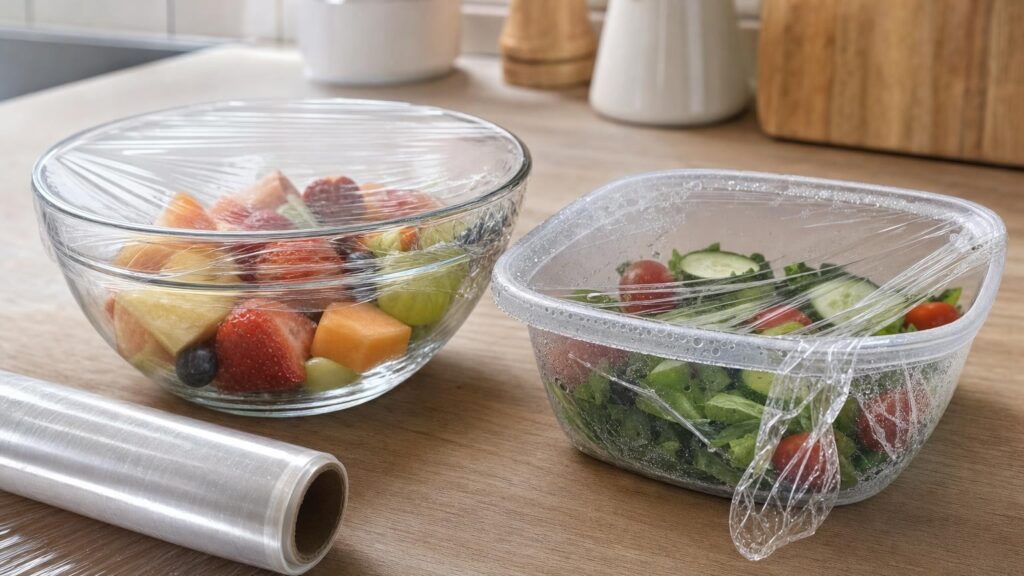
Cling film can be surprisingly inconsistent. One roll grips a glass bowl with little effort, while another lifts from a plastic container almost as soon as it is applied. The difference is not necessarily a sign of poor quality. Plastic wraps that look interchangeable can be made from different polymers, produced at different thicknesses and formulated to favour different qualities.
Cling is also a property of the whole wrapping situation, not just the film. The cleanliness and shape of the container, the amount of overlap, the temperature and even the way the film is pulled from the box can determine whether it forms a useful temporary seal. Strong adhesion may be convenient for covering bowls, but easy handling, puncture resistance or freezer flexibility may matter more for other tasks.
How plastic wrap creates a temporary seal
Cling film is not normally coated with a conventional pressure-sensitive adhesive. Instead, it works because a thin, flexible sheet can make very close contact with another surface. At that distance, weak intermolecular attractions help the film hold on. Some formulations also contain components that increase tack or softness, making close contact easier to achieve.
Stretch matters because it lets the film follow the edge of a bowl or container. Light tension pulls the film against the rim, while its flexibility allows it to conform to small curves and irregularities. Folding the film under an edge or overlapping it around a container can create a mechanical hold as well as surface adhesion.
Wrinkles and trapped air reduce the area of close contact. If only the high points of a crumpled sheet touch the rim, there is less surface available to produce cling. Excessive tension can be counterproductive too: strongly stretched film may pull itself away from a shallow or rounded edge.
This explains why pressing harder is not always the answer. A smooth application with moderate tension and sufficient overlap usually matters more than repeatedly pushing down one small section.
PVC and polyethylene: the main material trade-offs
Many household wraps are based on either polyvinyl chloride, commonly called PVC, or polyethylene, often abbreviated to PE. The material may be stated on the box, although the exact formulation is not always disclosed.
PVC film
PVC wrap is commonly formulated to be soft, stretchy and conformable. These characteristics can help it grip smooth rims and wrap closely around irregular foods or containers. Its combination of tack and flexibility is one reason some PVC films feel especially clingy during use.
That softness does not come from the polymer name alone. PVC films are formulated with additives, and the resulting feel and performance depend on the particular product. Thickness, surface treatment and manufacturing choices also influence how readily the film stretches, tears and adheres.
Polyethylene film
Polyethylene wraps may feel less tacky and can require more deliberate tension or overlap. However, PE is a broad family of materials, and films can be engineered for different levels of softness, stretch and strength. A well-formulated PE film may perform very differently from another roll carrying the same general material description.
Barrier performance also requires nuance. Resistance to moisture vapour, gases and odours are separate properties, and no single polymer description tells the entire story. Film thickness, formulation, the quality of the seal and storage time all matter. A highly clingy film with gaps around the rim may protect less effectively than a less tacky film that has been wrapped securely.
Shoppers should therefore avoid treating PVC as automatically superior because it often clings readily, or PE as automatically preferable for every use. The more useful question is whether a film’s handling, barrier and temperature characteristics fit the intended task.
Why cling changes on glass, metal and plastic
Clean glass and smooth metal often give cling film a favourable surface. They are rigid, so they do not bend away while the film is being stretched, and their smooth surfaces allow broad, close contact. A flat, defined rim also gives the film somewhere to grip.
Plastic containers are more variable. Some plastics have relatively low surface energy, which makes it harder for other materials to spread across and adhere to them. A slightly textured finish creates additional gaps, while a flexible wall can move under tension. Scratches, moulded patterns and rounded rims reduce the uninterrupted contact area further.
The container’s shape can matter as much as its material. A broad, flat glass rim is usually easier to cover than a narrow rim with a lip, even if both surfaces are clean. A deep bowl provides room to fold film down the outside; a shallow tray may offer almost no side wall for overlap.
When film will not stick directly to a container, wrapping it far enough around the sides can help. Film-to-film contact or a complete mechanical wrap may hold more reliably than dependence on the rim alone. For a container with a difficult surface, a fitted lid, elasticated cover or reusable alternative may be more dependable.
Moisture, grease and temperature: hidden causes of weak cling
Water, cooking oil, crumbs and food residue sit between the film and the container. This prevents close contact and may cause the film to slide. Condensation is especially easy to overlook when a chilled bowl is taken into a warmer room.
Before covering a container, wipe the rim and the outer area where the film will sit. Drying the rim is often more effective than pressing repeatedly on a damp edge. If the film has already touched grease or moisture, moving to a clean section may work better than trying to reuse the contaminated part.
Temperature can change handling as well. A cold film may be less flexible than it is at room temperature, depending on its material and formulation. This can make it harder to draw smoothly around corners. Food that is still giving off substantial steam can create condensation beneath the film, and the product’s directions should determine whether it is appropriate for the temperature involved.
Use enough film to create a meaningful overlap and apply light, even tension. Pulling extremely hard can thin the sheet, encourage tears and make it recoil from the edge. Smooth the film progressively rather than trapping air by pressing down all sides at once.
Thickness, width and cutter design affect performance
Material chemistry receives much of the attention, but ordinary physical specifications can have just as much influence on day-to-day use.
- Thinner film can conform closely to curved surfaces and small details, but it may bunch together, puncture or become difficult to separate once folded.
- Thicker film may feel more robust and resist punctures, but it can need more tension to follow a tight rim. Thickness alone does not guarantee greater cling.
- Suitable width allows the sheet to cover the opening and extend down the sides. A narrow roll may be economical for small bowls but frustrating on wide trays if several strips are needed.
- A dependable cutter helps produce a straight edge without stretching or tangling the sheet. A cutting blade, tear edge or dispensing slider is part of the practical performance of the pack, not merely a convenience.
Poor dispensing can waste film before it reaches the container. If a sheet tears unevenly, curls back onto itself or sticks to the roll, its theoretical cling becomes less relevant. When comparing packs, consider how securely the roll sits in the box, how the cutting system is operated and whether the stated width suits the containers used most often.
What microwave and freezer labels actually tell you
A material name does not by itself establish that a particular film is suitable for microwave or freezer use. These instructions apply to the finished product, including its formulation and intended conditions of use.
A microwave-suitability statement may come with qualifications. Directions might require the film to be vented, kept away from the food or used only for certain heating and reheating tasks. The film should not be assumed suitable for conventional ovens, grills or other high-heat environments merely because microwave use is mentioned. Follow the individual pack instructions rather than transferring directions from a previous roll.
Freezer suitability concerns more than whether a film can physically be placed in a freezer. Low temperatures can affect flexibility and resistance to splitting. A freezer-labelled product should still be applied carefully, with sufficient overlap and protection from sharp food edges. For longer storage, the film’s ability to resist punctures and maintain a complete seal may be more important than strong initial tack.
Labels also help distinguish intended food-contact use from general-purpose wrapping. If a film is to touch food directly, use a product labelled for that purpose and observe any restrictions relating to food type, temperature or heating.
Choose by task rather than strongest cling
The best practical choice depends on what is being covered and how long it needs to remain protected.
- Covering a rigid bowl: Prioritise conformability, adequate width and reliable adhesion to the rim. Clean glass or metal often makes this relatively straightforward.
- Wrapping awkward produce: Stretch and resistance to puncturing are useful. A film that folds neatly onto itself may be more helpful than one designed mainly to grip containers.
- Separating portions: Easy dispensing and manageable tack matter because an excessively clingy sheet can be difficult to position between individual items.
- Short-term chilled storage: Look for a complete seal and suitable food-use directions. The condition of the rim can have more effect than small differences in film tack.
- Frozen storage: Check for an explicit freezer-use statement and consider whether the film needs support from a bag, box or rigid container.
- Liquids or transport: Cling film is not a substitute for a secure, leak-resistant lid. Movement and pressure can dislodge a temporary film seal.
A reusable lidded container may be more suitable when contents will be stored repeatedly, transported or protected from crushing. Cling film is most useful when its flexibility solves a problem that a fixed lid cannot, such as covering an irregular shape or a bowl without a matching top.
Disposal claims and the limits of material labels
Environmental and disposal terms describe different characteristics. PVC and polyethylene identify broad polymer types. Recycled content concerns the source of some material in the product or pack. Recyclable relates to whether an item can enter an appropriate recovery system. Compostable and biodegradable refer to different breakdown processes and may require specified conditions.
None of these terms should be treated as interchangeable. A polymer may be technically recyclable, while local household collections do not accept thin films. Food contamination can also affect acceptance. Compostable products may require particular facilities rather than a normal recycling bin or home compost heap.
Check both the pack instructions and local collection rules. Separate the cardboard box, cutter and film if directed, since they may be made from different materials. Material labels can inform a decision, but they do not establish universal environmental superiority or guarantee that an item will be processed locally.
Read the label, then match the film to the surface
Cling film works through a combination of close contact, flexibility, light tension and surface attraction. Its performance depends on the polymer and formulation, but also on thickness, width, temperature, cleanliness and container shape.
When comparing rolls, identify the material where it is disclosed, consider how much stretch and puncture resistance the task requires, and examine the dispensing and cutting design. Check microwave, freezer and food-contact directions rather than making assumptions from the material name. For disposal, use the specific instructions and local rules.
Most importantly, judge cling in context. A film that barely holds on a damp, textured plastic rim may work well on clean glass or when wrapped around an object with sufficient overlap. Apparently weak cling can be a poor match between film, surface and technique rather than evidence of a defective roll.
Continue exploring on Frowse
Explore products on Amazon
Looking for products related to this guide? to enter your own search term.