




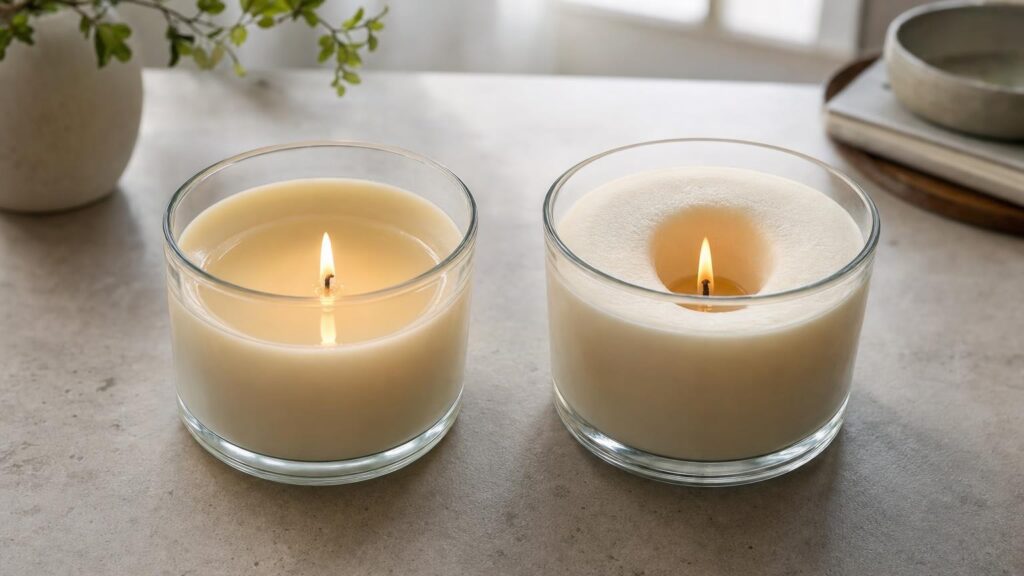
A container candle can look simple, but its burn depends on a carefully balanced system. The wick must draw liquid wax at a suitable rate, the flame must produce enough heat, and that heat must spread through the wax without making the candle unstable. The vessel, fragrance, colour and conditions in the room all influence the result.
This is why tunnelling cannot always be blamed on a short first burn. Burn habits matter, but so do design and formulation. Understanding the difference helps shoppers choose more confidently, use candles appropriately and recognise when a persistent problem is unlikely to be fixed by technique alone.
Why an Even-Burning Candle Is Not Just About the First Burn
Common candle advice places great emphasis on the first burn. Allowing enough time for the melt pool to widen can be helpful, particularly in a broad container. However, the idea that one imperfect session permanently ruins every candle is an oversimplification.
The melt pool is the layer of liquid wax around the wick. Its shape and depth depend on the flame’s heat output, the properties of the wax, the dimensions of the container and the surrounding conditions. Burn duration determines how long heat has to move outwards, but time cannot correct every design mismatch. If a wick consistently produces too little heat for the formulation and vessel, even patient burning may leave a thick wall of unmelted wax.
For shoppers, this distinction matters because care instructions and product construction should work together. Good technique supports a balanced candle; it should not have to compensate continually for one that is fundamentally under-wicked or poorly matched.
What Tunnelling Looks Like and Why It Matters
Tunnelling occurs when wax melts mainly around the wick, creating a deep, narrow channel while substantial solid wax remains around the vessel wall. The wick and flame gradually sit below this outer wall, resembling a flame at the bottom of a tunnel.
Not every incomplete melt pool is tunnelling. Early in a burn, the liquid area may naturally be smaller and then expand as the candle warms. Some formulations also leave a temporary thin coating or small amount of wax at the sides that may melt during later burns. A single snapshot therefore does not always reveal a defect.
A repeated pattern is more informative. If the melt pool remains narrow through suitable burn sessions and the wick keeps descending inside a ring of untouched wax, tunnelling is developing. Its practical effects can include:
- Wax being left unused around the sides of the container
- A recessed wick that becomes harder to light
- Reduced visible flame and light output
- Weaker or less consistent fragrance release because less wax is melting
- A wick that becomes partly buried or starved of oxygen within the tunnel
Severe tunnelling can shorten the useful life of a candle even when plenty of wax remains in the vessel.
What “Wax Memory” Really Means
Wax does not literally remember the shape of an earlier melt pool. “Wax memory” is a convenient shorthand for the way the candle’s physical structure can encourage later burns to follow an established path.
After a narrow burn, the wax closest to the wick has been consumed while a higher ring remains solid. On the next use, the flame begins lower relative to that surrounding wall. Heat tends to remelt the nearby channel first, and the raised wax can restrict airflow or prevent heat from spreading effectively towards the edge. As this pattern repeats, the wick moves farther down and the channel becomes more pronounced.
This explains why an early narrow melt pool can contribute to later tunnelling without making the first burn an irreversible test. A mild developing tunnel may sometimes improve if the candle is otherwise well designed and is subsequently used under suitable conditions. Conversely, achieving a full melt pool once does not guarantee perfect future performance if later sessions are consistently too short, the room is draughty or the wick-to-vessel balance is poor.
It is more accurate to think in terms of an established melt path than a permanent memory.
The Wick, Wax and Vessel Must Work as a System
Wick size is central to candle performance, but “larger” is not automatically better. A wick that produces too little heat may create a narrow melt pool. One that produces excessive heat may lead to an overly large flame, rapid wax consumption, soot, or an excessively hot container. The aim is an appropriate balance for the complete candle.
Wick material and construction also affect how fuel reaches the flame and how the wick behaves as it burns. These characteristics cannot be evaluated separately from the wax. Different wax formulations vary in melting behaviour, viscosity and the way they carry fragrance or colour.
Vessel diameter adds another variable. Heat from a central flame must travel farther to reach the sides of a wide container than those of a narrow one. A wider candle may therefore require a different wick specification or more than one wick. Multiple wicks can distribute heat across a broad surface, but wick count alone proves little. Their size, spacing and interaction with the formulation remain important.
This is why visually similar candles may burn differently. A single wick can be appropriate in one design and inadequate in another. Equally, a multi-wick candle is not automatically more even or more powerful. Finished-candle testing is what establishes whether the components function together.
How Fragrance, Colour and Other Formulation Choices Affect the Burn
Fragrance oil is part of the candle’s fuel system, not simply a scent added on top. Its quantity and composition can alter how the wax behaves and how effectively the wick draws fuel. Dyes and other additives can also influence wick performance or leave deposits that affect combustion.
It is therefore unsafe to assume that a higher fragrance load always means a stronger or better-performing candle. Fragrance release depends on the formulation, melt pool, scent materials and conditions of use. Adding more fragrance without adjusting and testing the wider design may not improve the experience and can disturb the burn.
Likewise, broad labels for wax type do not tell shoppers everything about likely performance. Two candles described with the same main wax can use different blends, additives, wick systems, fragrance levels and vessel dimensions. The finished formulation must be treated as a whole.
Burn Duration, Drafts and Wick Trimming: The Variables Owners Control
Owners cannot change the original design, but they can provide suitable operating conditions. Very short sessions repeatedly melt only the central area and can encourage a narrow path. Allowing an adequate supervised burn gives heat time to spread, provided this remains within the maker’s directions.
Longer is not always better. Excessive burn sessions can allow the vessel and wax to become hotter than intended, enlarge the melt pool or worsen an unstable flame. The manufacturer’s stated maximum burn duration and safety guidance should take priority over generic rules.
Placement also matters. Air movement from open windows, fans, vents or busy walkways may push the flame to one side, producing uneven melting and possible soot. The candle should stand on a stable, level, heat-resistant surface in an appropriate location. Room temperature can also affect how quickly the wax warms, although it should not be used to excuse consistently poor performance.
Wick trimming helps control the flame when done according to the candle maker’s instructions. A wick left excessively long may develop a large or unstable flame and produce soot. A wick cut too short may struggle to stay lit or create too little heat. Removing a charred excess is different from repeatedly cutting the wick down as far as possible.
Diagnosing the Cause Before Trying to Fix It
Before intervening, observe the pattern rather than focusing only on wax at the edge. The following questions help separate temporary behaviour from a persistent mismatch:
- Is this early in the burn? A small initial melt pool may still widen with time. Do not judge it immediately after lighting.
- Does the same narrow pool return repeatedly? Consistent side walls after suitable sessions suggest under-wicking, an unsuitable formulation or an established tunnel.
- Is the wick accessible? A wick partly covered by wax may have difficulty lighting even if its original specification was suitable.
- Is the flame unusually small, large or unstable? Wick length, fuel flow, formulation and airflow can all affect flame behaviour.
- Is one side melting faster? Check whether the surface is level and whether a draught is bending the flame.
- Is there soot or visible vessel damage? These are not ordinary tunnelling symptoms to solve by forcing a longer burn.
It can also help to compare actual use with the supplied care instructions. If the candle tunnels despite correct placement, appropriate trimming and permitted burn durations, the cause is more likely to be built into the candle than created by the owner.
When Tunnelling May Be Correctable – and When to Stop
Mild, early tunnelling may be correctable when the wick still burns normally and the candle has no signs of damage. An adequate supervised session, within the maker’s limits, may allow the melt pool to widen. If softened wax has partly buried an otherwise usable wick, carefully restoring access around it may help, but only when this can be done without damaging the wick, moving it off-centre or creating a safety problem.
Online advice sometimes suggests wrapping vessels, applying external heat or reshaping large amounts of wax. Such methods can change heat retention, damage a container or conflict with the candle’s instructions. They should not be treated as universal remedies. Never leave a corrective burn unattended or exceed the manufacturer’s guidance in an attempt to reach the sides.
Stop using the candle if the vessel is cracked or damaged, the flame is persistently excessive or erratic, the wick has moved, or the maker’s stated stopping point has been reached. A deeply buried wick or severe recurring tunnel may mean the candle is no longer practical to burn as intended. Persistent under-wicking is a product balance problem, not routine maintenance that an owner should have to solve repeatedly.
What to Assess Before Buying a Container Candle
Product pages cannot reveal every formulation detail, but shoppers can look for evidence that the candle has been presented as a considered system rather than relying on isolated claims.
- Consider vessel width in context. Broad containers need heat distributed across a larger area, but there is no universal diameter-to-wick-count rule for shoppers to apply.
- Do not judge by wick count alone. One, two or more wicks may be appropriate depending on their specification, spacing, wax and vessel.
- Look for usable care instructions. Clear guidance on trimming, burn sessions, placement and when to stop gives owners a better chance of operating the candle as designed.
- Value relevant formulation information. Wax and fragrance descriptions can be informative, but they do not replace evidence of a well-balanced finished candle.
- Treat performance language cautiously. Claims about long burn time, powerful fragrance or “clean burning” do not prove that the wick, wax and vessel are correctly matched.
A very long claimed burn time can sound appealing, but useful performance is not simply the slowest possible wax consumption. If a small flame leaves much of the candle inaccessible, the nominal duration says little about the quality of the burn. Similarly, strong fragrance language does not guarantee an even melt pool or appropriate wick behaviour.
A Better Way to Think About Candle Performance
Tunnelling is best understood as the result of interactions. The wick supplies heat, the formulation controls how wax melts and feeds the flame, the vessel sets the distance that heat must travel, and the owner’s burn habits and environment influence what happens in practice.
“Wax memory” usefully describes how a narrow channel can become self-reinforcing, but it should not be mistaken for a literal or irreversible property. A first burn can influence the candle’s shape without determining its entire future.
The most useful shopping principle is simple: good candle care supports good design, but it cannot reliably rescue an unbalanced wick, wax and vessel combination. Clear instructions, proportionate construction and stable performance matter more than any single rule about the first burn.
Continue exploring on Frowse
Discover More Frowse Insights
- Beyond GSM: What Really Makes a Towel Absorbent, Soft and Slow to Dry
- Foil vs Rotary Electric Shavers: How the Cutting Mechanism Changes the Shave
- Why Scissors Stop Cutting Even When the Blades Still Feel Sharp
- Machine-Woven, Tufted and Hand-Knotted Rugs: What Construction Changes
- Why Air-Fryer Capacity Does Not Reveal Its Usable Cooking Space