




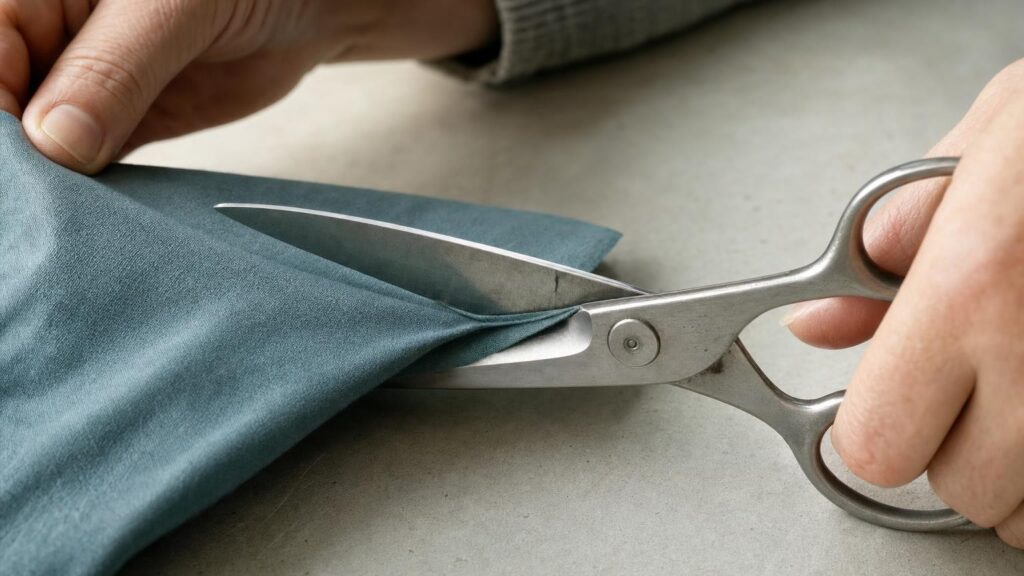
A pair of scissors can have edges that feel keen to the touch and still fold fabric, snag paper or trap plastic between the blades. That is because scissors are not simply two knives joined at a pivot. They are a cutting system in which blade shape, alignment, pressure, leverage and hand position all have to work together.
Understanding that system helps explain why sharpening is not always the answer. It also gives shoppers better criteria for choosing scissors suited to a particular material, deciding whether an existing pair can be adjusted and recognising when replacement or professional servicing is more sensible.
Why “sharp” scissors can still fail to cut
Sharpness usually describes the condition of an individual cutting edge. Scissor performance depends on something more: the two edges must cross while remaining in controlled contact. If they separate as the handles close, even finely sharpened edges may push material into the gap rather than cut it.
This is why running a finger carefully along a stationary blade reveals little about how the complete pair will perform. One blade may feel sharp, but that does not show whether the blades meet at the correct angle, whether the pivot holds them together or whether their shape maintains contact from the heel to the tip.
The material also matters. Thin fabric can expose a contact problem that stiff card partly disguises. Flexible materials tend to bend away from unsupported edges, while thicker materials may force loose blades apart. A pair that cuts one material acceptably may therefore struggle with another without either blade being obviously blunt.
Scissors cut by shearing, not like two knives
A knife generally cuts by pressing or drawing one edge through material against a surface or under tension. Scissors use two crossing blades. As the handles close, the point at which the blades intersect moves from near the pivot towards the tips. Force is concentrated around this moving contact point, shearing the material between the edges.
For this to work, the material must remain supported on both sides of the cut. The blades should meet closely enough that the material cannot escape between them. If there is excessive lateral movement or a gap, flexible material can fold, slide ahead of the crossing point or become pinched without separating.
This explains several familiar symptoms:
- Material folds between the blades: the blades may be separating under load, often because of pivot play, alignment or hand pressure.
- The cut starts but does not continue: contact may be good near the pivot but lost farther along the blades.
- Only the tips fail: the blade ends may not meet, may be damaged or may have lost their intended set.
- The scissors chew or snag: the edges may be damaged, but dirt, corrosion, roughness or inconsistent blade contact can produce similar symptoms.
Blade curvature and set keep the edges in contact
Scissor blades are not necessarily meant to lie perfectly flat against each other along their whole length when open. Many pairs use a subtle bow, twist or offset, often described as blade set. This geometry creates progressive pressure at the crossing point as the handles close.
The effect can be difficult to see. A small amount of controlled curvature may be intentional, while an obvious irregular bend is not. What matters is whether the edges meet progressively and consistently. If the geometry is correct, contact travels towards the tips without requiring every part of the blade faces to rub heavily together.
When the set is altered, the scissors may cut only in certain zones. A pair might work close to the pivot, where leverage and pressure are greatest, but allow material to fold near the middle or tips. Alternatively, damaged or misaligned tips may cross incorrectly even though the rest of the blades work.
This is one reason aggressive bending or improvised repair can make matters worse. Restoring blade set requires more than making both blades look straight. The blades need the appropriate relationship to one another throughout the closing movement.
Edge geometry matters as much as edge sharpness
A cutting edge has a shape, not just a degree of sharpness. Its bevel angle, thickness and finish influence how readily it enters material and how well it withstands demanding use. A very keen, fine edge may suit controlled work on light materials, while a more robust edge may better tolerate thicker or tougher material. Neither approach is automatically superior.
The blade behind the edge matters too. Thicker construction may resist flexing but can add weight and increase the force needed for some tasks. Thinner blades can feel precise and move easily through light material, yet they may be less suitable where the work tends to twist or spread the blades. Intended use is more informative than thickness alone.
Sharpening also has to preserve the geometry required by the scissors. Treating a scissor blade exactly like a general-purpose knife can change its bevel or remove material from the wrong surface. Removing too much metal may alter how the edges overlap, particularly at the tips. Polishing away features that help grip slippery material can also change cutting behaviour.
A freshly abraded edge can therefore feel sharp while the pair performs worse. Effective servicing considers both the edge and the way the blades meet.
The pivot controls pressure, play and smoothness
The pivot determines how freely the blades rotate and how firmly they are held in lateral contact. When it is too loose, the blades can move apart as material pushes between them. The handles may rattle or shift sideways, and cutting may improve temporarily if the user deliberately squeezes the blades together.
A pivot that is too tight creates a different problem. Excessive friction makes the scissors tiring to operate and can disguise the smooth progression of the blades. Tightening a loose screw as far as possible is therefore not a complete fix. The aim is controlled movement with enough contact pressure, not maximum resistance.
Construction affects maintenance. An adjustable screw pivot gives the owner or a technician some ability to correct ordinary play as the scissors wear. A fixed rivet or permanently assembled pivot may be simple and secure, but routine adjustment is less accessible. That does not make every screw-pivot pair better; the quality of the blade geometry, fastening and intended use still matters. It does, however, affect how maintainable the scissors are over time.
Before adjusting a pivot, it is worth checking for adhesive, fibres or dirt around the joint. Contamination can make movement feel tight or uneven even when the mechanical tension is reasonable. Cleaning should follow the maker’s care guidance, especially where coatings or specialised materials are involved.
Alignment problems that sharpening cannot fix
Misalignment is often mistaken for bluntness because both produce incomplete cuts. The difference is that a blunt but correctly aligned pair may require more force or leave a rougher edge, while misaligned blades often fold or trap material in a particular section.
Useful signs to inspect include:
- an uneven gap that appears and disappears as the blades close;
- tips that meet too early, fail to meet or pass each other incorrectly;
- side-to-side movement at the pivot;
- a blade that is visibly kinked, twisted or bent differently from its partner;
- nicks, rolled areas or corrosion along the cutting edges;
- cutting that consistently fails at the same point along the blade.
Cleaning away residue and making a careful pivot adjustment may solve minor performance issues on suitable adjustable scissors. Sharpening may help when the edges are genuinely worn but alignment remains sound. Bent blades, altered set, damaged tips or a worn fixed pivot are different problems. Further honing can remove useful metal without restoring contact and may make later repair more difficult.
Higher-quality or specialised scissors may justify professional servicing because the technician can assess geometry, set and pivot condition together. For inexpensive general-use scissors with damaged construction, replacement may be more proportionate than repeated attempts to sharpen them.
Leverage, blade length and the material being cut
Scissors are levers as well as shearing tools. Cutting near the pivot generally provides greater mechanical advantage than cutting at the tips. That is why the heel of the blade is useful for controlled cuts through more resistant material, provided the scissors are designed for that task.
The tips trade some leverage for reach and manoeuvrability. They can be useful for small details, starting cuts in accessible material or working in confined areas, but they are not necessarily the strongest part of the cutting stroke. Trying to force demanding material through the tips can spread or twist unsuitable blades.
Long blades can cover more distance per closure and may support smooth, extended cuts. Shorter blades can offer close control. However, blade length alone says little about cutting quality. Long blades require consistent alignment over a greater distance, while heavy construction can become tiring if it is unnecessary for the job.
Shoppers should therefore match the proportions to the task. Repeated long cuts, small detail work, packaging, paper and textiles impose different demands. It is also important to consider whether the material contains adhesive, abrasive particles or hard inclusions, as these can affect edge condition and movement. Separate scissors for materially different tasks can help avoid transferring residue and subjecting a fine edge to unsuitable work.
Handedness changes how the blades are forced together
Handle shape and blade orientation are separate aspects of handedness. Some scissors have handles that feel usable in either hand but retain a blade arrangement intended for right-handed operation. These are better described as having ambidextrous handles than as true left-handed scissors.
With true left-handed scissors, the blade orientation is reversed. This can improve the user’s view of the cutting line and lets natural hand pressure encourage the blades to remain together. When scissors are used in the opposite hand from the orientation for which they were designed, hand pressure may tend to separate the blades instead. Flexible material can then be pushed into the gap.
This explains why one person may find a pair satisfactory while another finds that it folds fabric or wanders from the line. The difference is not necessarily grip strength or technique. For frequent use, shoppers should check both handle comfort and actual blade orientation rather than relying only on a claim that the handles suit either hand.
How to judge scissors before replacing them
Start by identifying the intended material and where the failure occurs. Test only on appropriate scrap material rather than assuming one sheet of paper represents every task. Notice whether cutting is consistent near the pivot, through the middle and towards the tips. Folding in one area points towards contact or alignment; uniformly heavy cutting may indicate edge wear, unsuitable geometry or a pivot that is too tight.
When comparing a new pair, consider the complete system:
- Purpose: choose blade proportions and construction suited to the materials and style of cutting.
- Blade contact: look for smooth, progressive closing without obvious lateral play or irregular gaps.
- Pivot design: decide whether adjustability and future maintenance matter for the expected use.
- Leverage and comfort: handles should allow controlled pressure without forcing an awkward grip.
- Handed configuration: check blade orientation as well as the symmetry of the handles.
- Maintainability: consider cleaning needs and whether sharpening or servicing is realistic.
Sharpness remains important, but it is only one part of why scissors cut. A well-functioning pair guides two appropriately shaped edges through material while maintaining pressure at a moving contact point. When that relationship is lost, sharper edges alone cannot compensate. Evaluating alignment, pivot control, geometry, leverage and handedness leads to a more reliable choice than judging scissors by sharpness claims or blade size alone.
Continue exploring on Frowse
Discover More Frowse Insights
- Airflow, Airspeed and Nozzle Shape: How to Judge a Leaf Blower’s Real Capability
- HDMI ARC, eARC or Optical: Which Soundbar Connection Do You Need?
- Machine-Woven, Tufted and Hand-Knotted Rugs: What Construction Changes
- How an Electric Kettle Knows When the Water Has Boiled
- How Backhaul Determines Mesh Wi-Fi Performance