




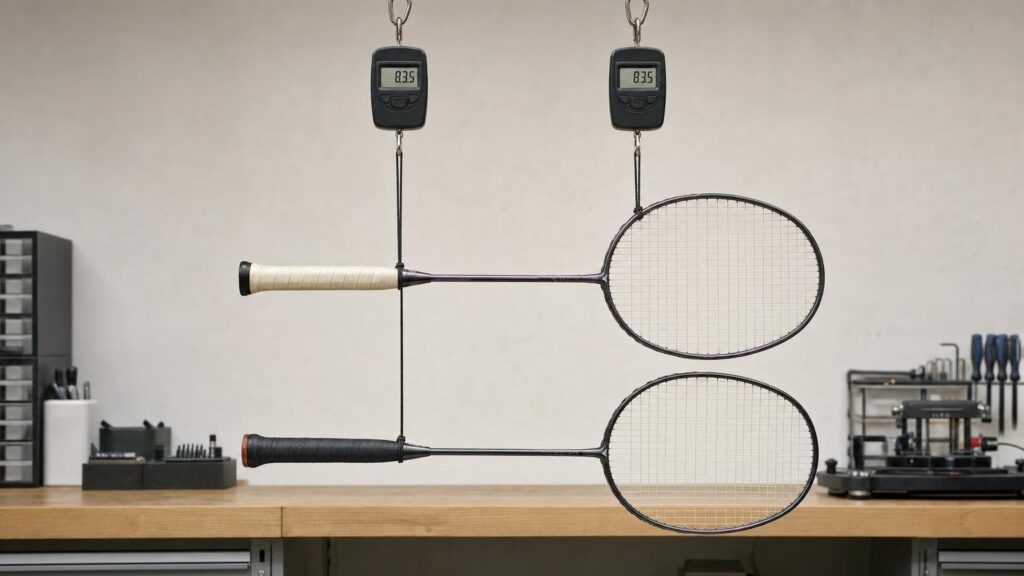
A badminton racket’s weight label is useful, but it tells only part of the handling story. Two rackets in the same nominal weight class can feel strikingly different once they are moving. One may be quick during defensive exchanges, while another feels more deliberate but carries momentum smoothly through a full stroke.
The difference comes from the racket as a complete system. Total mass matters, but so do the location of that mass, the shaft’s behaviour, frame geometry, grip build and string set-up. Understanding these interactions helps shoppers look beyond a single specification and choose a racket that suits their timing and preferred situations on court.
What badminton racket weight classes actually tell you
Labels such as 3U and 4U group rackets into nominal weight ranges. They are a convenient starting point for comparing broadly lighter or heavier options, but they do not describe balance, swing weight, stiffness or aerodynamic behaviour. The precise ranges and measurement conventions may also vary between manufacturers or markets, so apparently matching labels are not always directly equivalent.
It is also important to check what the quoted weight represents. A listing may refer to an unstrung racket without additional grip material, while the racket used on court includes strings, a replacement grip or overgrip, and perhaps protective tape. These additions increase its ready-to-play weight.
Manufacturing tolerances can create smaller differences between individual examples of the same model as well. The label should therefore be treated as a category rather than a guarantee that every racket bearing it will weigh and handle identically.
Balance point: where the weight sits changes the feel
Balance describes how mass is distributed between the handle and head. Rackets are commonly characterised as head-heavy, even-balance or head-light, although these descriptions cover a spectrum rather than three perfectly distinct categories.
Head-heavy balance
At a given total weight, more mass towards the hoop usually makes the racket head feel more present during a swing. That mass can help the head retain momentum through contact, particularly in longer strokes. The trade-off is that starting, stopping and redirecting the racket may demand more effort, which can become noticeable during quick exchanges or repeated defensive reactions.
Even balance
An even-balance racket aims for a less pronounced bias towards either the head or handle. It may provide a useful middle ground for players who move between full overhead strokes, drives, blocks and net play. However, the label alone does not guarantee neutral handling because swing weight, shaft response and frame shape remain influential.
Head-light balance
Moving more of the mass towards the hand can make a racket easier to reposition and shorten the sensation of recovery after a shot. This may suit rapid grip changes and compact swings. Yet head-light does not automatically mean fast in every respect: a thick frame, flexible shaft or relatively high total mass can still affect timing and resistance through the air.
Nor should balance be reduced to a simple power ranking. Shuttle speed depends on racket-head speed, timing, technique, contact quality and the way the racket rebounds. A player who consistently arrives late with a head-heavy racket may produce a weaker result than with a more manageable alternative.
Swing weight: how heavy a racket feels in motion
Static weight is measured while the racket is at rest. Swing weight concerns resistance to rotation, which is closer to what a player experiences while accelerating the racket around the hand.
Mass placed farther from the hand has a disproportionate effect on this resistance. Adding a small amount near the top of the hoop can therefore change swing feel more noticeably than adding the same amount around the handle. This explains why two rackets with the same ready-to-play weight can require different levels of effort to accelerate.
Balance point and swing weight are related but not interchangeable. Balance identifies the point at which the racket balances, whereas swing weight reflects the distribution of mass throughout the handle, shaft and frame. Two rackets can have similar overall weights and balance points but different swing behaviour because their mass is concentrated in different locations.
In practical terms, higher swing weight may provide a stronger sensation of momentum and steadiness, while lower swing weight can make acceleration and recovery feel easier. Neither is inherently superior. The useful question is whether the racket’s rotational resistance matches the player’s stroke length, tempo and ability to prepare repeatedly.
Shaft stiffness and flex: timing matters as much as strength
The shaft bends as forces build during a stroke and then returns towards its original position. How much it bends, how quickly it recovers and how that response aligns with contact all affect feel.
A more flexible shaft can load noticeably during a smoother or less abrupt swing. Some players find that this helps them access useful rebound without creating all of the acceleration themselves. Others may feel that the head lags behind their hand or that the response is less immediate, especially during sharp, compact actions.
A stiffer shaft generally deforms less and can provide a more direct relationship between hand movement and racket-head position. Players with suitable acceleration and consistent timing may appreciate that precision. If the player cannot load it effectively or regularly contacts the shuttle late, however, it may feel demanding rather than powerful.
Medium stiffness can offer a compromise, but even that description is relative to a manufacturer’s range. Stiffness labels are not universal laboratory grades, and the apparent response also depends on shaft length, head mass, frame design and strings.
Consequently, a stiff racket is not automatically more powerful, and a flexible one is not automatically easier. The better match is the shaft that returns predictably within the player’s usual swing rhythm.
Frame geometry alters speed, stability and feedback
The frame must move through the air while supporting a tensioned string bed and resisting twisting at impact. Its head shape, cross-section, thickness and material placement can all influence how it performs these jobs.
A streamlined profile may reduce the sensation of drag and help the racket pass through the air cleanly. A more substantial hoop may feel steadier, particularly when contact is away from the centre, although its aerodynamic character can be different. These are design trade-offs rather than fixed rules because material lay-up and mass distribution can change the outcome.
Head shape also affects the geometry of the string bed and the character of the effective hitting area. Some frames may feel forgiving over a broader region, while others provide a more concentrated response when the shuttle meets the preferred contact point. Torsional stability matters here: if the frame resists twisting well, the racket can feel more composed during imperfect contact.
These features help explain why two rackets with matching weight and balance figures can still deliver different feedback. One may feel crisp and quick, while another feels solid and damped. Neither sensation alone proves better performance; it indicates how clearly and comfortably a player perceives impact.
Grip size and handle build-up can transform a racket
Grip circumference affects how securely the racket sits in the fingers and how easily the hand can switch between relaxed and firm holds. A grip that is too large for a player may limit finger movement and make rapid changes awkward. One that is too small may encourage excessive squeezing or feel unstable, although preferences and hand sizes differ.
Replacement grips, overgrips and additional underlayers change more than comfort. They add mass close to the hand, increasing total weight and often shifting the measured balance towards the handle. Because this mass is near the axis of rotation, its effect on swing weight is usually smaller than an equivalent addition near the frame.
This creates a potentially confusing result: a racket can become heavier on the scales yet feel more head-light by balance measurement, without becoming proportionally harder to swing. Grip thickness can also alter leverage and feedback, so two players testing the same frame with different handle builds may form very different impressions.
Strings add another layer of response
Strings contribute mass around the head and create the surface that actually meets the shuttle. String type, gauge, tension and condition therefore influence both feel and handling.
A higher-tension string bed generally deforms less at impact and may provide a firmer, more immediate response. It can also make precise contact more important. A lower-tension bed generally deflects more and may feel softer or offer a more accommodating effective hitting area. The practical result still depends on the string, frame, technique and quality of contact, so tension should not be treated as a universal power control.
Gauge and construction affect texture, feedback and durability characteristics, while tension changes with use and time. Strings also add some weight to the head, which can subtly influence balance and swing weight.
String-bed response should be separated conceptually from shaft flex. Both can create sensations described as soft, firm, lively or muted, but they originate in different parts of the racket. Comparing two frames strung with different strings, at different tensions or at different stages of wear can therefore produce a misleading verdict about the underlying rackets.
How to compare rackets without relying on one number
A useful comparison controls as many variables as practical and then focuses on repeatable timing rather than first impressions alone.
- Check the basis of the specifications. Note whether weight is quoted for an unstrung racket and whether grip size is included in the model description.
- Compare ready-to-play set-ups. If possible, use similar strings, tensions and grip builds. Record any added tape or handle layers.
- Consider weight, balance and swing behaviour separately. Static weight says how much mass exists; balance indicates its broad bias; swing feel reveals how strongly the racket resists acceleration and redirection.
- Try compact movements. Short drives, blocks, interceptions and defensive reactions expose manoeuvrability and recovery behaviour.
- Try full strokes. Clears and other longer swings help reveal whether head momentum and shaft recovery align with the player’s natural tempo.
- Notice imperfect contact. Deliberately avoid judging only the cleanest shot. Off-centre hits provide information about twisting, feedback and the usable hitting area.
- Look for consistency. A spectacular occasional result matters less than reliable preparation, contact and control over repeated strokes.
Shoppers buying without a court test can still make a more informed shortlist by considering their current racket as a reference. Rather than asking only for something lighter or heavier, identify whether the desired change concerns faster recovery, more head presence, a firmer shaft, a different grip or a more forgiving string-bed response.
Choose the complete handling system
A badminton racket does not play as a weight label. Its handling emerges from the interaction of total mass, balance, swing weight, shaft stiffness, frame geometry, grip build and strings. Altering just one of these can change timing and feedback, while altering several can make two nominally similar rackets feel unrelated.
Specifications remain useful for narrowing the field, but no isolated number can identify the best match. A sound choice is one that supports repeatable preparation, comfortable grip changes and dependable contact in the situations the player encounters most often. It should also account for adjustable elements: strings and grips can refine the set-up, but they cannot completely rewrite the frame’s underlying mass distribution and structural response.
Continue exploring on Frowse
Discover More Frowse Insights
- Ballpoint, Rollerball and Gel Pens: How Tip and Ink Design Change the Writing Experience
- Single-Coil, Humbucker and Active Pickups: How the Hardware Shapes the Signal
- Fixed-Speed vs Inverter Air Conditioners: What Compressor Modulation Really Changes
- Why a “High-Pressure” Showerhead Cannot Create More Water Pressure
- Roller Skate Wheels Explained: Diameter, Hardness, Profile and Hubs