




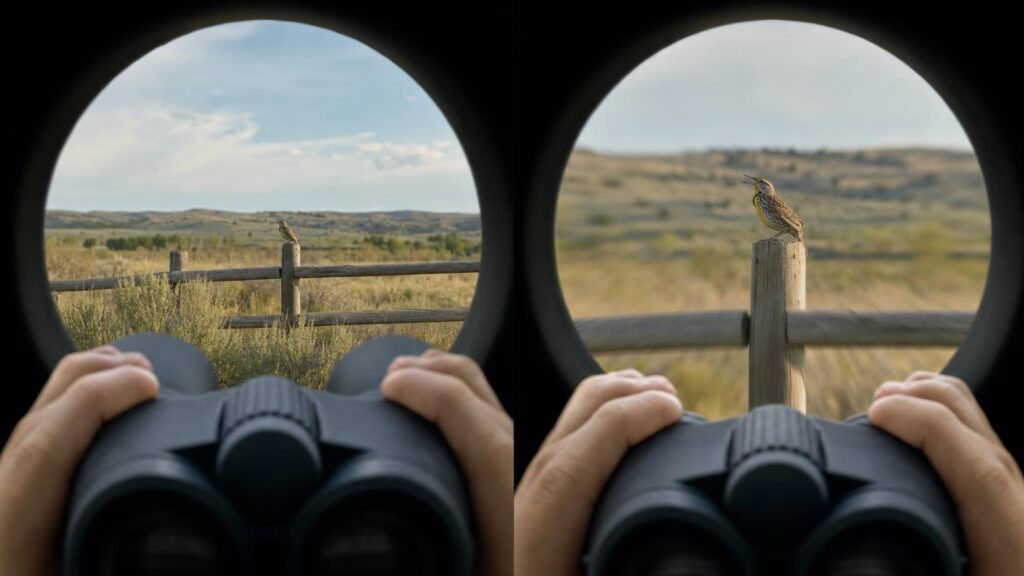
Binocular specifications are best read as a description of the viewing experience, not as a scorecard. Magnification, objective diameter, exit pupil and field of view interact, while eye relief, focusing controls and body shape determine whether the binoculars are comfortable and practical to use.
A higher number is not automatically better. Increasing one capability may introduce a disadvantage elsewhere, such as more visible hand shake, additional weight or a narrower viewing area. The useful question is therefore not which binoculars have the biggest figures, but which combination suits the subjects, light and viewing conditions you expect.
Magnification: More Detail, Less Steadiness
The first number in a description such as 8×42 or 10×42 is the magnification. An 8x binocular makes a subject appear approximately eight times larger in angular terms than it does to the unaided eye, while a 10x model provides greater image scale.
Greater magnification can reveal more distant detail when the optics, viewing conditions and user’s steadiness support it. However, it also magnifies hand movement. A small tremor that is barely noticeable at lower power becomes more disruptive as magnification rises, potentially cancelling out some of the expected detail advantage.
Higher magnification can also make finding and following subjects more difficult. The visible area is often narrower, and apparent movement across the image is faster. That matters when watching birds in flight, following sport or scanning a wide landscape. Lower magnification commonly produces a calmer view and can be easier to hold for prolonged periods.
The best choice depends on how the binoculars will be used. More magnification may be valuable for distant, relatively stationary subjects, particularly when the binoculars can be supported. A steadier, wider view may be more useful for handheld observation or moving subjects. Magnification should therefore be judged alongside field of view, weight and intended viewing position.
Objective Diameter: Light-Gathering Versus Bulk
The second number is the diameter of each objective lens in millimetres. In an 8×42 binocular, for example, each front objective is 42 mm across. A larger objective can collect more light than a smaller one of otherwise comparable design, helping the optical system maintain a useful image as ambient light falls.
The cost is physical. Larger lenses require a larger body and add glass, weight and bulk. This can affect packing, grip and handheld steadiness. A binocular that performs well at dusk may be less appealing if it is frequently left behind because it is inconvenient to carry.
Objective diameter alone does not determine brightness or image quality. Magnification affects how the collected light reaches the eye, while glass, baffling, prism design and optical coatings influence transmission, contrast and reflections. Bright daylight can also reduce the visible difference between objective sizes because the observer’s pupil is already constricted.
Think of objective diameter as setting part of the binocular’s light-gathering potential and physical format. It is not a guarantee that one model will look brighter, sharper or more colourful than another.
Exit Pupil: Connecting Aperture, Magnification and Brightness
Exit pupil is the diameter of the small circle of light leaving each eyepiece. It is calculated by dividing objective diameter by magnification:
- 8×42: 42 divided by 8 gives an exit pupil of 5.25 mm.
- 10×42: 42 divided by 10 gives an exit pupil of 4.2 mm.
- 8×25: 25 divided by 8 gives an exit pupil of about 3.1 mm.
A larger exit pupil can make eye positioning more forgiving because the eye has a larger disc of light with which to align. It can also help preserve perceived brightness in dim conditions, provided the observer’s pupils open widely enough to accept the available light.
If the binoculars produce an exit pupil larger than the eye’s pupil at that moment, some of the light cannot enter the eye. In bright daylight, a very large exit pupil may consequently offer little visible brightness advantage. Pupil size also varies with age, individual physiology and lighting, so exit pupil should not be treated as a universal brightness rating.
Smaller exit pupils can still work well in good light and allow more compact designs, but eye alignment may feel less forgiving. This can be noticeable on a moving platform or when raising the binoculars quickly. Exit pupil is most useful when interpreted as a link between magnification, objective size, light conditions and ease of alignment.
Field of View: How Much of the Scene Fits In
Field of view describes the width of the scene visible without moving the binoculars. It may be given as an angle in degrees or as a linear width at a stated distance, such as metres at 1,000 metres. Both formats describe the same basic characteristic from different perspectives.
A wider field helps users locate subjects, scan terrain and follow movement. It can make the view feel more open and reduces the amount of panning needed to inspect a scene. A narrower field places less surrounding context around the subject and may make a fast-moving target easier to lose.
Magnification and field width often pull in opposite directions, so higher-powered binoculars frequently show a smaller area. Optical design also matters, however, meaning two binoculars with the same magnification can have different fields of view.
The headline width does not reveal how the whole field performs. The centre may be sharp while detail softens or bends towards the edges. Some viewers prioritise a very wide field for tracking and immersion, while others care more about consistent edge definition. Published field measurements describe coverage, not necessarily sharpness across that coverage.
Eye Relief, Eyecups and Interpupillary Fit
Eye relief is the distance between the eyepiece and the position where the eye can see the full field. It is particularly important for people who wear spectacles, because the lenses of the glasses prevent the eyes from getting as close to the eyepieces.
Insufficient usable eye relief may cause the outer portion of the view to be cut off, an effect often called vignetting. Too much distance or poor positioning can produce dark areas or momentary blackouts as the eyes move away from the optical axis. The quoted figure is useful, but eyecup shape, lens recess and facial features can alter how it feels in practice.
Adjustable eyecups help establish the correct viewing distance. Spectacle wearers generally use a lower setting, while users without glasses usually extend the cups. Multiple firm positions can make repeatable alignment easier, although comfort still depends on the shape and diameter of the eyecups.
The two barrels must also match the spacing between the viewer’s pupils. If the interpupillary distance cannot be adjusted to suit the user, the two circular images may not merge cleanly. Poor alignment can cause shadowing, an incomplete field and discomfort during extended viewing. These fit factors are a strong reason to treat personal handling as part of specification checking rather than an optional extra.
Close Focus and the Focusing Mechanism
Close focus is the shortest distance at which the binoculars can produce a focused image. It matters for nearby subjects such as insects, flowers, museum details or objects viewed in a garden. Someone interested only in distant landscapes may place less value on an exceptionally short close-focus distance.
The shortest quoted distance is not automatically superior. Focusing very close may require the eyes to converge strongly, which some users find less comfortable, and the specification says nothing about sharpness, field flatness or handling at that distance.
Most general-purpose binoculars combine a central focus wheel with a dioptre adjustment. The centre wheel focuses both barrels as subject distance changes. The dioptre compensates for a difference between the user’s eyes and is normally set once before routine focusing.
Focus-wheel behaviour affects real use. A fast mechanism can move quickly between near and distant subjects, while a slower mechanism may make small adjustments easier. Wheel size, resistance, position and grip matter when wearing gloves or tracking movement. These qualities cannot always be inferred from a close-focus number.
Roof and Porro Prisms in Practical Terms
Prisms turn the inverted image produced by the objective lenses into an upright view and allow the binoculars to fit into a manageable body. The two common layouts are roof and Porro prisms.
Roof-prism binoculars usually have relatively straight, closely aligned barrels. This supports a slim profile that can be convenient to pack and hold. The optical path places greater demands on alignment and prism treatment, so manufacturing quality and appropriate coatings can have a significant effect on the result.
Porro-prism binoculars use an offset optical path, giving them their familiar stepped shape. The wider body may feel secure in some hands, although it is generally less streamlined. The layout can deliver effective optical performance without the same phase-correction requirement found in common roof-prism systems, but build quality and alignment remain important.
Prism type alone does not rank image quality. References to particular prism glasses may indicate material choices, but a glass label cannot describe polish, dimensions, alignment or the rest of the optical system. In roof designs, phase-correction coatings can help preserve contrast and fine detail affected by the prism path. Reflective coatings on relevant prism surfaces influence how much light is directed towards the eyepiece.
What Coating Terminology Can – and Cannot – Tell You
Every air-to-glass surface can reflect some light rather than passing all of it through. Anti-reflective coatings are intended to reduce those losses and suppress internal reflections, supporting brightness, contrast and a clearer image in difficult lighting.
Common terminology describes how extensively coatings have been applied:
- Coated: at least one optical surface has a coating.
- Fully coated: air-to-glass surfaces are described as receiving a single coating layer.
- Multi-coated: at least one surface has multiple coating layers.
- Fully multi-coated: air-to-glass surfaces are described as receiving multiple coating layers.
More comprehensive treatment can be beneficial, but these labels do not specify coating formulation, effectiveness, durability or consistency. Nor do they account for internal baffling, glass quality, prism treatment and mechanical alignment.
Phase-correction coatings address effects within roof-prism optical paths rather than serving as ordinary anti-reflective layers. Dielectric-style reflective coatings may be applied to suitable roof-prism surfaces to improve reflection efficiency. Their presence can be relevant, but terminology still cannot establish the overall viewing quality on its own.
Putting the Specifications Together
Start with the conditions and subjects rather than a preferred number. For daylight travel, portability and a steady view may matter more than a large objective. A compact body can be easier to keep available, although its smaller exit pupil may demand more precise eye placement.
For moving wildlife or sport, moderate magnification, a generous field of view, intuitive focusing and comfortable alignment may be more useful than maximum image scale. For observation around dawn or dusk, a larger objective and suitably large exit pupil become more valuable, but only if the additional weight remains manageable.
Use a simple sequence when comparing binoculars:
- Choose a magnification you can hold steadily for the intended subject.
- Balance objective size against low-light needs and carrying comfort.
- Calculate exit pupil and consider the lighting in which it will be used.
- Compare field of view for locating, scanning and tracking.
- Check eye relief, eyecup adjustment and interpupillary fit.
- Match close focus and focus-wheel behaviour to likely viewing distances.
- Treat prism and coating labels as design information, not proof of total quality.
No single specification defines a good view. The most suitable binoculars combine enough detail and brightness with steadiness, field width, personal comfort and a form that the user is willing to carry. Reading the numbers as connected trade-offs makes it easier to identify that balance.
Continue exploring on Frowse
Best Sellers · Top Rated · Best Value · Under £50 · Fresh Finds · Premium Picks
Discover More Frowse Insights
- What a Surge Protector’s Joule Rating Means and Why Protection Wears Out
- Why Bathroom Scales Give Different Readings on Different Floors
- Where Ink Goes When an Inkjet Printer Is Not Printing Pages
- Oscillating, Impact and Rotary Sprinklers: How Their Watering Patterns Differ
- How Steam Irons Produce, Control and Lose Steam