




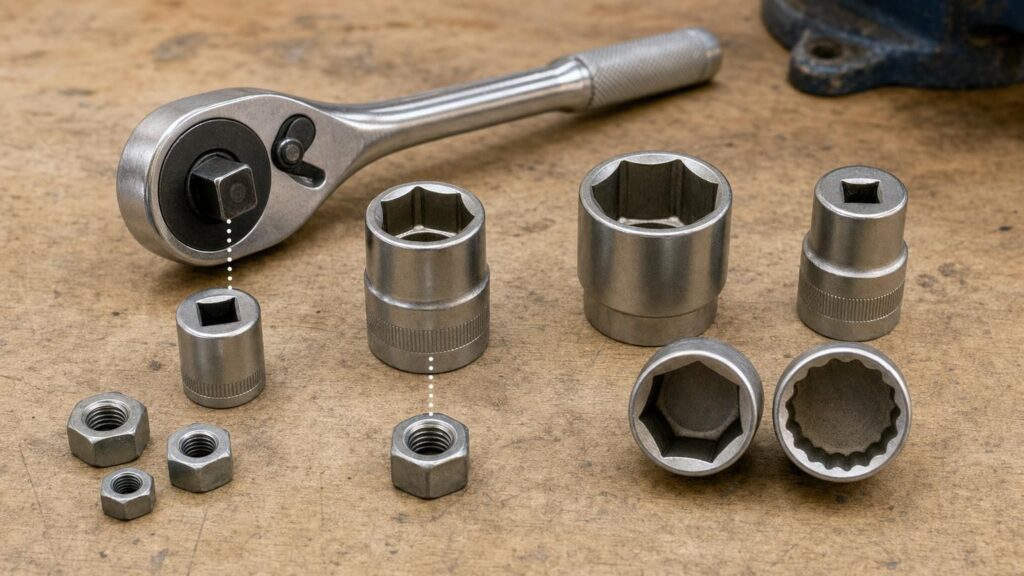
A socket has to make two physical connections and provide the right type of engagement for the job. Its square drive must fit the ratchet, breaker bar or powered tool. Its opening must match the nut or fastener head. Its internal point profile must also engage that fastener appropriately.
These are separate decisions. A socket may attach perfectly to a ratchet yet be the wrong size for the fastener. It may have the correct measurement but be too deep, too wide or the wrong profile to work in the available space. Understanding all three fits makes it much easier to compare socket sets and avoid treating physically connectable parts as automatically suitable.
Drive size connects the tool to the socket
The drive is the square connection between a socket and the tool turning it. Both parts must use the same drive size unless an adaptor is added. Drive size is independent of the measurement printed on the working end of the socket.
For example, two sockets may both fit the same size of nut but have different square drives. Conversely, a group of sockets can share one drive size while covering many different fastener sizes. This is why a label such as 10 mm does not tell you which ratchet the socket accepts.
Smaller drive systems generally make it easier to build a compact tool stack for confined spaces and smaller fasteners. Larger drive systems tend to be associated with bulkier tools and sockets intended for more demanding applications. This is not simply a question of choosing the largest drive available. A large ratchet head or socket body may not fit around a recessed or obstructed fastener, while a very small drive system may be inappropriate for the load involved.
Drive adaptors can join components that would not otherwise connect. However, an adaptor does not upgrade the capacity of the smaller tool, drive or socket. It can also add length, width or movement to the assembly. That may reduce access or make the setup less direct, particularly when extensions and universal joints are already involved.
When choosing a set, consider the tools you own and the work you expect to do. A set based around one drive may be convenient, while a multi-drive set can cover a wider range of access and load requirements. More drive sizes are useful only if the set also includes suitable ratchets, adaptors or other turning tools.
Socket size must match the fastener across the flats
The size marked on an ordinary hex socket refers to the distance across the opposing flat faces of the nut or fastener head it is designed to fit. It does not describe the square drive, outside diameter or overall length of the socket.
A well-matched socket should seat fully and engage the intended faces without obvious looseness. If it is too small, forcing it into place can damage the fastener or socket and may prevent full seating. If it is too large, it can rock around the head and concentrate force near the corners. That poor contact makes slipping and rounded fastener corners more likely.
Dirt, corrosion, paint, plating damage or an already distorted head can make a nominally correct size difficult to fit. Before assuming the socket marking is wrong, check that the fastener and socket are clean and that the opening is not obstructed. A socket should not be hammered onto an ordinary fastener merely to overcome a clear size mismatch.
Not every fastener with a socket-like appearance is a standard external hex. External Torx, spline, square and other profiles require sockets made for those shapes. A conventional hex socket that can be pushed onto a different profile is not necessarily engaging it correctly.
Metric and imperial sizes are not interchangeable systems
Metric sockets are marked in millimetres, while imperial sockets use fractional-inch sizes. Some measurements from the two systems are visually close, but closeness is not the same as a correct match.
A near-equivalent socket may appear to fit yet leave enough play to reduce face contact. Another apparent equivalent may be fractionally too small and fail to seat fully. The consequences depend on manufacturing tolerances, wear, coatings and the condition of the fastener, so a conversion chart should not be treated as permission to substitute one system routinely for the other.
If you work only on equipment that consistently uses one standard, a single-system set may be simpler and avoid duplicated sizes. If you maintain a mixture of vehicles, machinery, furniture or older equipment, separate metric and imperial ranges are more practical than relying on approximate conversions.
Look carefully at how a mixed set is organised. Clear markings and distinct storage positions make it easier to avoid confusing similar-looking sockets. It is also worth checking whether the range has meaningful coverage in both systems rather than a large headline piece count created mainly by accessories or duplicated components.
Six-point and 12-point sockets engage differently
A six-point socket has a hexagonal internal profile corresponding to a standard hex nut or fastener head. It typically provides broad engagement against the fastener flats and is often the straightforward choice for ordinary hex fasteners, especially when they are tight, worn or vulnerable to corner damage.
A 12-point socket has twice as many engagement positions. On a hex fastener, this can make alignment easier because the socket needs less rotation before it drops into place. That can be useful where movement is restricted or where placing the socket on the fastener is awkward. A 12-point socket may also be required for a matching 12-point fastener.
The higher point count does not automatically mean greater strength or broader suitability. On a standard hex head, the engagement geometry differs from that of a six-point socket. For demanding work, positive contact and fastener condition may matter more than the convenience of extra indexing positions.
Ratchet mechanism and socket point count should also be considered separately. The number of positions available inside the socket determines how it can be placed over the fastener. The ratchet mechanism determines how far the handle must swing before it engages the next position. A fine-action ratchet can therefore improve access without requiring a 12-point socket.
Shallow, deep and wall thickness determine access
Once drive, fastener size and profile are correct, the socket still has to reach the fastener. Socket depth and outside dimensions can decide whether it does.
Shallow sockets
A shallow socket keeps the working assembly relatively short. This can help where there is limited space above the fastener or where a deep socket would place the ratchet against a nearby panel, bracket or component. Shallow sockets are often convenient for exposed nuts and bolt heads without a long stud protruding through them.
Deep sockets
A deep socket provides internal clearance for a long bolt or stud and can reach nuts recessed below surrounding surfaces. However, depth alone does not guarantee access. The internal bore must accommodate the protruding stud, and the socket body must fit into the recess. A deeper socket also increases the overall height of the tool stack.
Wall thickness and outside diameter
Two sockets with the same drive, fastener size and depth can have different outside dimensions. A thicker-walled socket may be unable to enter a narrow counterbore or fit between a fastener and an adjacent obstruction. A slim socket may offer better access, but it should still be suitable for the tool and load involved.
Do not assume that changing to a smaller drive will always solve a clearance problem. It may reduce the size of the ratchet head or upper part of the socket, but the working end still needs enough material around the fastener opening. Product dimensions are useful when access is known to be tight.
Hand sockets and impact sockets are not the same construction
Hand sockets are intended for tools such as ratchets, breaker bars and torque wrenches used by hand. Impact sockets are designed and marked for the repeated shock loading produced by impact wrenches. Equal drive and fastener measurements do not make the two constructions interchangeable for impact work.
Impact sockets commonly differ in material treatment, wall thickness, finish and the way they can be retained on the tool. Some include holes or grooves for pins, rings or other retention systems. Ordinary hand sockets often use a polished finish, but appearance alone is not a reliable rating. Dark colour does not by itself prove that a socket is impact-rated, and a shiny finish does not provide complete information about construction.
Check the socket marking and manufacturer information rather than judging from shape or colour. Extensions, adaptors, universal joints and reducers in the same assembly must also be intended for impact use if they will be exposed to an impact tool. One correctly rated socket does not make every other component in the stack suitable.
Impact construction may also affect access. The body can be bulkier than that of a comparable hand socket, which matters around recessed fasteners. The right choice therefore depends on both the method of driving the socket and the available clearance.
Check the complete tool stack, not just the socket label
Before buying a set or starting a job, work through the connection from tool to fastener:
- Confirm the turning tool. Identify its square-drive size and whether it is a hand tool or an impact tool.
- Identify the fastener system. Determine whether the required size is metric or imperial rather than selecting a close visual match.
- Check the profile. Decide whether the fastener is a standard hex, 12-point or another design needing a dedicated socket.
- Measure the fastener correctly. For a standard hex head, use the distance across opposite flats and account for corrosion or damage that may affect fit.
- Consider depth. Look for protruding studs, recessed nuts and overhead restrictions that may favour a deep or shallow socket.
- Check surrounding clearance. Consider socket outside diameter, wall thickness, ratchet-head size and nearby obstructions.
- Review every accessory. Extensions, adaptors and universal joints add reach but can also add bulk, movement and another compatibility interface.
- Match construction to use. Use appropriately marked impact components for impact tools rather than assuming any socket that attaches is suitable.
It is also useful to consider storage and identification. Clear size markings and an orderly case can reduce trial and error, particularly in sets containing both metric and imperial sockets. When comparing sets, focus on the combinations you will actually use: appropriate drives, a sensible progression of fastener sizes, useful depths and the necessary profiles.
Compatibility means more than being attachable
Correct socket selection starts with three separate fits. The tool drive must match the socket, the socket size must match the fastener, and the point profile must provide suitable engagement. Metric and imperial measurements should be treated as distinct, not as a collection of guaranteed substitutes.
Depth, wall thickness, outside diameter and construction then determine whether that correctly sized socket can reach the fastener and cope with the intended method of use. Adaptors and extensions can solve particular connection or reach problems, but they do not remove the limitations of the components around them.
The most useful socket set is therefore not simply the one with the largest piece count. It is the one that supplies the right interfaces, profiles and dimensions for the tools, fasteners and spaces you expect to encounter.
Continue exploring on Frowse
Discover More Frowse Insights
- Why Scissors Stop Cutting Even When the Blades Still Feel Sharp
- Why Replacement Zip Sliders Are So Difficult to Match
- How Fabric Softener Affects Absorbency, Static and Fabric Feel
- What Makes a Backpack Water-Resistant – and Why the Protection Wears Out
- Why a Tent’s Waterproof Rating Is Only Part of Its Rain Protection