




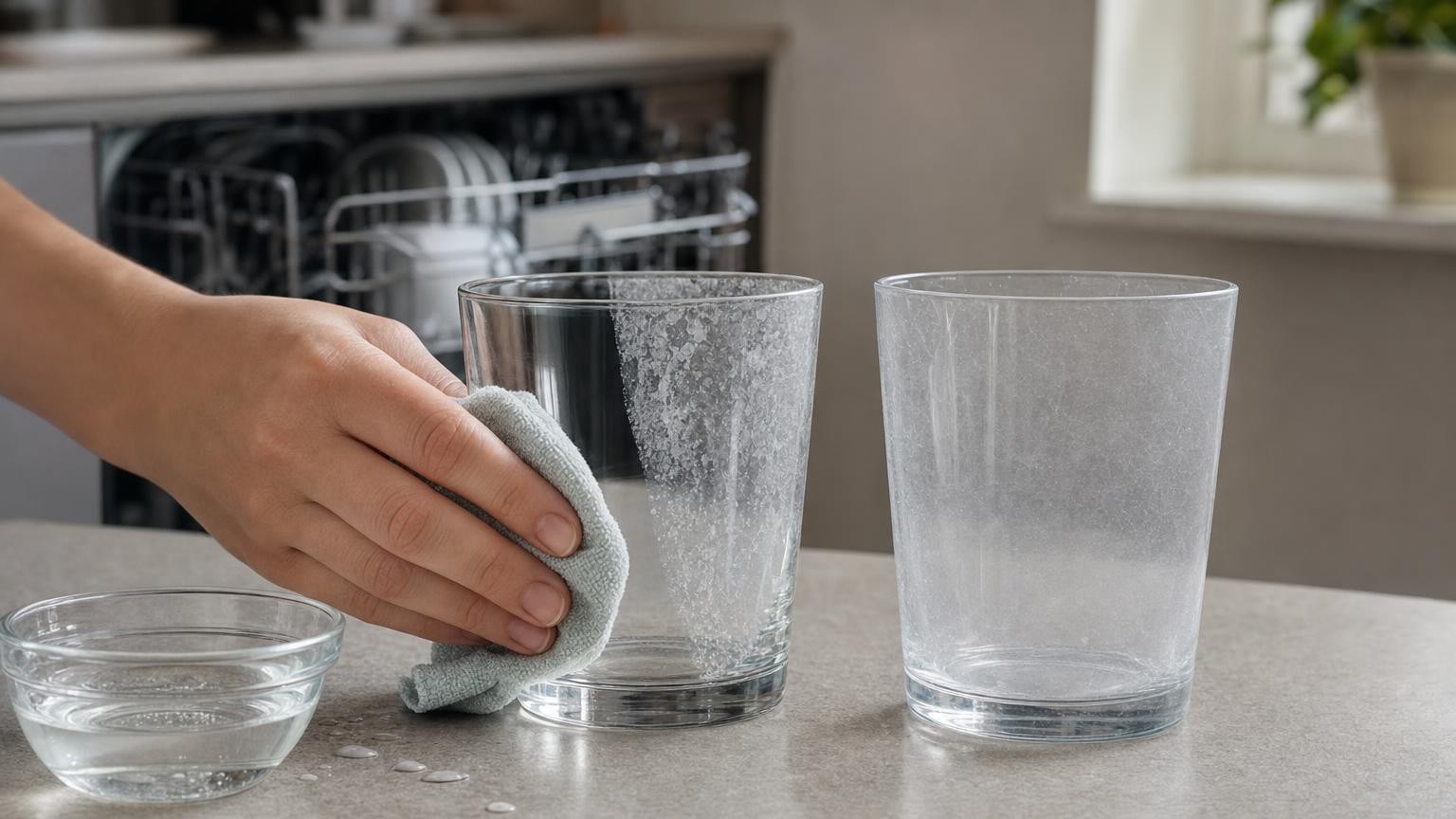
A cloudy drinking glass may be covered by a removable mineral film, or its surface may have been permanently altered. The two problems can look surprisingly similar, but they call for different responses. Deposits can often be dissolved and prevented through better water and detergent management. Corroded or etched glass generally cannot be returned to its original clarity.
Identifying which problem you have is therefore more useful than immediately adding detergent, selecting a hotter programme or replacing the dishwasher. It can also help you choose glassware whose material, construction and care requirements suit the way you intend to wash it.
Why dishwasher-washed glasses lose their clarity
Most dishwasher cloudiness falls into two broad categories. The first is material left on the glass, including calcium and magnesium compounds from hard water, detergent residue or a combination of the two. This may appear as spots, streaks or a chalky film.
The second is damage to the glass surface. Often called etching or glass corrosion, it develops when repeated chemical and thermal exposure changes the outermost layer of the glass. Microscopic surface irregularities then scatter light instead of transmitting it cleanly, producing a milky, finely scratched or sometimes iridescent appearance.
Both problems may develop gradually across several washes. They can also occur together: a glass with some permanent etching may still acquire a removable mineral film. That is why a simple cleaning test is more dependable than judging by appearance alone.
The simple test: deposits or permanent corrosion?
Begin by examining the glass in good light. Distinct water spots, rough patches or a chalky coating suggest deposits, although appearance is not conclusive. A more uniform haze, very fine lines or rainbow-like surface changes may indicate etching.
- Hand-wash one test glass. Use warm water, ordinary washing-up liquid and a soft cloth or non-abrasive sponge. Rinse and dry it with a clean, lint-free cloth. If the cloudiness disappears, it was probably a surface residue.
- Try a mild acid on a small area. If ordinary washing does not work, apply diluted white vinegar to an inconspicuous part of an undecorated glass. Keep this separate from dishwasher chemicals, and rinse the glass thoroughly afterwards. Follow the manufacturer’s care instructions and avoid testing delicate decoration unless its care guidance allows it.
- Compare the treated patch. A clearer patch suggests that acid-soluble mineral deposits are present. If there is no meaningful change, particularly where the haze looks uniform or finely scratched, the surface is more likely to be permanently etched.
Abrasive powders, scouring pads and aggressive polishing are poor diagnostic tools. They may create additional scratches or remove decorative finishes, making the original cause harder to identify.
How hard water leaves a removable film
Hard water contains dissolved minerals, principally calcium and magnesium compounds. During washing and drying, these minerals can remain on glass if the dishwasher’s detergent and water-softening systems do not control them effectively. Droplets that dry in place may leave obvious spots, while repeated cycles can build a more even haze.
Detergent dose matters, but too little detergent is only one possible cause. The appropriate amount depends on the detergent formulation, local water hardness, the programme and how dirty the load is. A dose that works in hard water may be unnecessarily strong in naturally soft or mechanically softened water.
Some dishwashers have a built-in ion-exchange water softener that uses dishwasher salt. If so, its hardness setting should reflect the local supply, and the salt reservoir should be maintained according to the machine instructions. Dishwasher salt is intended for this system; ordinary table salt is not a substitute. Machines without this feature need to be managed according to their own instructions and the detergent guidance for the local water conditions.
Rinse aid can help water spread and drain from surfaces rather than remaining as beads. This can reduce spotting and support drying, although it cannot reverse etched glass. Its setting may also need adjustment if glasses emerge with persistent droplets, streaks or residue.
Why some cloudy glasses never become clear again
Irreversible haze is not a coating waiting to be washed away. It is a change in the glass itself. Dishwasher detergents are commonly alkaline because alkalinity helps remove food and grease. Over many cycles, however, alkaline chemistry can attack susceptible glass surfaces, particularly when combined with heat, long exposure and repeated washing.
Glass is a solid network containing several constituents rather than a perfectly inert, uniform substance. Chemical exposure can remove or rearrange some components near the surface. The resulting microscopic roughness and compositional changes affect how light passes through the glass. To the eye, this appears as lost brilliance, milkiness, fine lines or iridescence.
The process is cumulative. One cycle may cause no visible change, while frequent exposure gradually makes damage apparent. Once the surface has been materially altered, vinegar, extra detergent and rinse aid will not rebuild it. Attempting to scour away the haze usually adds mechanical scratches instead.
Glass composition and construction make a difference
Material labels are useful clues, but none should be treated as an unconditional guarantee of permanent dishwasher brilliance. Formulation, manufacturing quality, surface finishing, shape and washing conditions all contribute to long-term appearance.
Soda-lime glass
Soda-lime glass is widely used for everyday drinkware. Its dishwasher performance varies with the exact formulation and production process. A robust-looking tumbler may tolerate handling well but still develop surface haze under unsuitable chemical conditions. Conversely, a finer glass may have been designed with dishwasher use in mind. The maker’s care guidance is more informative than thickness alone.
Crystal formulations
Crystal glassware is chosen for optical brilliance, light refraction and its feel, but the word covers different formulations. Traditional and modern crystal compositions can respond differently to detergent and heat. Some ranges are presented as dishwasher suitable, while others call for hand-washing. Shoppers should not assume that every item described as crystal has the same composition or care requirements.
Borosilicate glass
Borosilicate glass is often valued for its behaviour under temperature change, which can make it useful for certain hot and cold applications. Thermal performance does not automatically mean complete resistance to alkaline detergent, abrasion or decorative damage. A borosilicate label therefore does not replace product-specific care instructions.
Thickness, rims and shape
Heavy construction can feel durable and may better tolerate everyday handling, but it does not by itself prevent chemical corrosion. Thin rims and delicate stems are more vulnerable to chipping or contact damage during loading and unloading. Deep bowls and narrow shapes may also retain water, affecting drying and spotting. Construction should be considered alongside composition rather than used as a shortcut for judging dishwasher durability.
Detergent, temperature and cycle choices: the key trade-offs
Successful dishwashing is a balance between enough cleaning power and no more chemical or thermal stress than necessary. Stronger detergent, a larger dose and the hottest, longest programme are not automatically better for glassware.
Hard water may require sufficient detergent and correctly configured softening to prevent deposits. In soft water, an excessive detergent dose can create unnecessarily aggressive conditions and may leave residue if rinsing is inadequate. The detergent maker’s dosing guidance and the dishwasher manual provide the best starting points, adjusted for actual water hardness rather than guesswork.
Higher temperatures and longer cycles can help with heavily soiled cookware, but lightly used drinking glasses rarely present the same cleaning challenge. Where the machine and glassware instructions permit it, a glassware, delicate or lower-temperature programme may reduce exposure. This does not mean that the coolest possible wash will always clean effectively; the aim is to select an appropriate cycle for the load.
Mixed loads introduce another compromise. A programme chosen for baked-on pans may be unnecessarily intensive for delicate glasses. Separating items with very different cleaning needs can make it easier to protect glassware without accepting poor cleaning elsewhere.
Abrasion, loading and decorated glassware
Not every cloudy or dull area is chemical corrosion. Glasses that touch during a cycle can rub or knock together as spray arms move water around the cabinet. Fine scratches scatter light and can make an otherwise clear surface look hazy. Gritty food residues and rough cleaning tools can have a similar effect.
Load glasses securely with space between them. They should not touch neighbouring glassware, cutlery or hard ceramic edges. Tall items should be stable and should not obstruct a spray arm. After washing, careful unloading matters too, especially for fine rims and stems.
Decoration adds another layer of vulnerability. Printed motifs, painted details, metallic rims and applied finishes may fade, lift, tarnish or wear even when the underlying glass remains clear. Frosted effects can also make diagnosis difficult because some surface texture is intentional. Damage to a decorative layer is distinct from corrosion within the glass body, although both can occur on the same item.
If decoration is important to the glass’s appearance, check whether the care instructions explicitly permit dishwasher use. A general assumption based on the material of the glass may not protect an applied finish.
What to look for when choosing glassware
Before buying, consider how often the glasses will be used and whether hand-washing is realistic. Useful decision points include:
- Clear care instructions: Look for credible guidance on dishwasher use, programme choice and any special treatment. Vague material descriptions tell you less than specific care information.
- Material and finish: Consider whether the item is soda-lime glass, a crystal formulation or borosilicate, but avoid assuming the label alone predicts durability.
- Decoration: Painted, printed and metallic details may require gentler care than plain glass.
- Rim and stem delicacy: Fine rims and slender stems can offer a refined drinking experience but need more careful loading and handling.
- Shape: Stable bases and shapes that drain freely may be easier to wash and dry consistently.
- Replacement expectations: Everyday glasses exposed to frequent machine washing face different demands from occasional glassware that can be washed by hand.
“Dishwasher safe” or “dishwasher suitable” indicates intended compatibility under the stated care conditions. It should not automatically be read as a promise of indefinite optical perfection under every detergent, hardness level, temperature and programme.
A care routine that protects clarity for longer
Start with local water hardness and the instructions for the dishwasher, detergent and glassware. Use an appropriate detergent dose rather than adding extra as a precaution. If the machine has a softening system, keep it supplied and correctly set. Maintain rinse aid where relevant, and investigate recurring spots before they become a heavy mineral film.
Choose a gentler glassware programme when it is suitable for the load, and avoid putting delicate glasses through an intensive cycle intended for heavily soiled cookware. Load each glass securely without contact, remove gritty residues from the machine and use soft, non-abrasive tools for hand care.
Particularly delicate, valuable or decorated pieces may be better hand-washed if their instructions recommend it. Drying with a soft cloth can prevent water spots, but twisting a cloth inside a delicate bowl while gripping the stem can place stress on the glass, so handle stemware carefully.
Most importantly, respond to the type of cloudiness actually present. Mineral deposits can often be dissolved and controlled by improving hardness management, dosing and drying. Permanent etching is a change to the surface and generally cannot be restored. Recognising that distinction helps prevent ineffective cleaning attempts and makes it easier to choose glassware and care routines that preserve clarity for longer.
Continue exploring on Frowse
Best Sellers · Top Rated · Fresh Finds · Under £50
Explore products on Amazon
Looking for products related to this guide? to enter your own search term.
Discover More Frowse Insights
- Why the Hook on a Tape Measure Is Supposed to Move
- Lumens, Candela and Beam Distance: How to Read Flashlight Specifications
- End Grain, Edge Grain and Face Grain Cutting Boards Explained
- Why a Replacement Door Handle Must Match More Than the Existing Screw Holes
- What a Watch Water-Resistance Rating Actually Tells You