




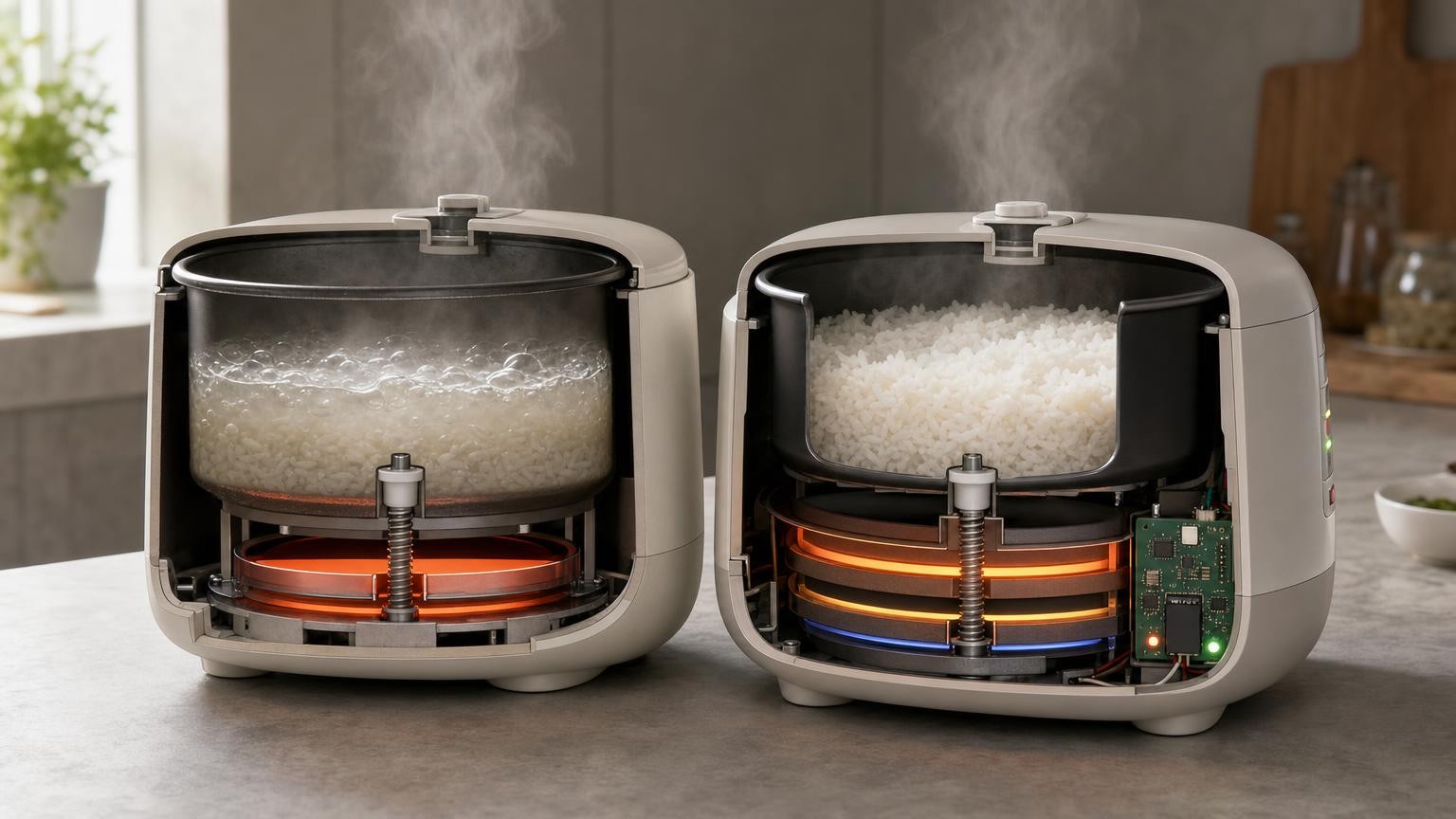
An automatic rice cooker appears to solve a surprisingly difficult problem with one switch: heat rice and water, stop cooking at the right moment, then keep the rice warm. Yet a basic model does not see the rice, measure its softness or directly detect an empty reservoir. Instead, it watches temperature.
While free water remains in the inner pot, that water limits how quickly the pot can become hotter. Once most of it has been absorbed by the rice or turned into steam, the pot temperature starts to rise more sharply. A simple cooker uses that change as its signal to leave the cooking phase. More advanced models interpret temperature over time, vary the heating pattern and apply programmed rules. Understanding these differences makes it easier to decide whether a one-touch cooker is sufficient or whether features such as fuzzy logic, induction heating and pressure are useful for the way you cook.
Why the pot stays near boiling temperature while water remains
At the beginning of a cycle, the heater transfers energy through the inner pot to the water and rice. The temperature rises until the water reaches its boiling region. The exact boiling temperature varies with atmospheric pressure, but the important principle is that liquid water moderates the pot temperature.
Additional energy is then used in several ways. It continues heating the food, helps water move into the grains and converts some liquid water into steam. Because evaporation consumes energy, the bottom of the pot does not immediately climb far beyond the temperature associated with boiling water under those conditions.
Eventually, very little free water remains against the heated surface. Some has entered the rice, some has escaped as steam, and a small amount may remain elsewhere in the food. With less liquid water available to absorb energy and moderate the temperature, the base of the pot becomes hotter more quickly. That change provides a useful endpoint signal.
This is why saying that a rice cooker knows when the water is “gone” is convenient but not completely literal. The rice is not dry, and moisture remains throughout the pot. The cooker is inferring that the main absorption and evaporation stage has ended from the thermal behaviour at its sensor.
How a basic rice cooker switches from cook to keep warm
A conventional one-touch cooker typically combines a heating element beneath the inner pot with a temperature-sensitive control. A spring-loaded sensor in the centre of the heater assembly presses against the underside of the pot. The spring helps maintain contact when the correctly fitted pot is placed in the cooker.
During cooking, the control keeps the main heater operating. Once the sensed temperature rises beyond the cooker’s switching point, a thermostat or related mechanical mechanism releases the cook switch. The appliance then turns the main cooking heat off or changes to a much lower keep-warm heat.
This is a feedback system, even though it is simpler than electronic control. The cooker does not need a preset cooking time for every batch. A larger quantity of rice and water generally takes longer to reach the endpoint, while a smaller quantity reaches it sooner. The thermal response determines when the switch occurs.
Contact between the pot and sensor matters. Rice grains, dried residue or moisture on the outside of the pot can interfere with seating or heat transfer. A dented or incompatible inner pot may also make poor contact. The pot should normally sit flat, move freely into its intended position and have a clean, dry exterior before cooking. The manufacturer’s instructions remain the authority for fitting, cleaning and operating a particular appliance.
What the automatic switch can – and cannot – judge
Temperature-based switching is effective at recognising a broad physical endpoint. It is not the same as judging whether the texture suits a particular person. A basic cooker cannot taste the rice or inspect individual grains. If the starting ratio is unsuitable, it can still switch exactly as designed while producing rice that feels too firm, soft, wet or dry.
Results can be affected by:
- Rice type: grain size, processing and starch characteristics influence water uptake and texture.
- Rinsing: rinsing changes the loose surface starch and can alter how sticky or foamy the cooked rice seems.
- Soaking: pre-soaked grains begin the heating cycle with water already absorbed, which can change cooking time and texture.
- Water ratio: too little or too much water cannot always be corrected by endpoint detection alone.
- Batch size: very small or very large loads may behave differently, particularly near an appliance’s stated limits.
- Resting time: residual heat and trapped steam can continue redistributing moisture after the main heater switches off.
Simple cookers therefore tend to work best when the user follows suitable measurements and refines them for a preferred rice and texture. Their value lies in automating heat control, not in eliminating preparation choices.
What fuzzy logic changes
In rice-cooker language, fuzzy logic refers to a control approach that allows a microprocessor to respond to sensor information with more nuance than a single mechanical threshold. The term can sound as though the appliance thinks like a person, but it is still following engineered rules and programmed heating routines.
Instead of treating the process as only “below the switching temperature” or “above the switching temperature”, an electronic controller can examine how temperature changes over time. It may alter heater output, extend a stage, insert a resting period or respond differently when the observed heating curve varies from the expected profile. This can provide some tolerance for ordinary differences in starting temperature, quantity or water measurement.
For example, a programme might use an initial warming or soaking phase, increase heat for boiling, reduce it to control the active cooking stage, and then allow a final rest before keep warm begins. These stages are not necessarily present in every fuzzy-logic model, and their details vary by design. The key distinction is that the controller can make graduated adjustments within its programmed boundaries rather than relying solely on one mechanical transition.
Fuzzy logic cannot rescue every mistake. It does not mean the cooker has identified the rice variety, measured each grain or calculated the exact amount of missing water. A severe measurement error, unsuitable ingredient or load outside the intended range can still produce a poor result.
Sensors, programmes and the limits of automation
Electronic rice cookers may combine temperature readings with elapsed time and stored heating profiles. Depending on the appliance, selectable programmes may be provided for different rice styles, porridge-like dishes or texture preferences. A programme is best understood as a planned sequence of heating, control and resting decisions.
The label on a button does not necessarily mean the cooker can recognise what has been put inside it. Selecting a programme tells the machine which routine to apply. The user must still choose the appropriate setting, measure ingredients and observe any preparation instructions.
When comparing models, consider whether the programmes match foods you genuinely prepare. A large menu is not automatically more useful than a few clear controls. Also check whether settings are easy to select, whether the display is legible, whether a preferred programme is remembered, and how much interaction is required for everyday cooking.
Conventional heating versus induction heating
In a conventional electric cooker, a resistive element heats the base of the inner pot by direct contact. Heat then spreads through the pot and its contents. This approach is mechanically straightforward and can be entirely adequate for routine rice cooking.
An induction rice cooker uses an electromagnetic field to generate heat in a compatible metal cooking vessel. Because the intended pot participates in heat generation, the system can be designed to heat a broader area and change output responsively. Electronic control can then vary the power during different stages of a programme.
The practical trade-offs extend beyond cooking performance. Induction systems generally require particular pot construction and additional power electronics, which can increase appliance cost and weight. The supplied inner pot is an integral part of the heating system, so replacing it with a visually similar but incompatible vessel may not work correctly. Shoppers should consider replacement-pot availability, pot weight and ease of handling as well as the heating label.
Induction does not guarantee ideal rice. Measurements, programming, pot design and user preferences still matter. Its main advantage is the greater flexibility it can give designers over where and how responsively heat is produced.
What pressure adds to the cooking process
A pressure-capable rice cooker introduces a sealed cooking environment. As pressure increases, water can remain liquid at a higher temperature than it would in an open or normally vented pot. This changes the relationship between temperature, steam and cooking time, allowing manufacturers to use different heating profiles and potentially create different textures.
Pressure is separate from both fuzzy logic and induction. A cooker may combine these technologies, but they perform different jobs. Fuzzy logic concerns control decisions, induction concerns heat generation, and pressure changes the cooking environment.
Pressure also adds components and operating steps. The lid must seal and release pressure in a controlled way, while seals, valves and related parts require appropriate cleaning and inspection. Programme behaviour becomes especially important because opening the lid during a pressure stage is not equivalent to lifting the lid of a simple cooker. Anyone considering this type should review the operating sequence, cleaning access and manufacturer guidance rather than focusing only on the promise of an advanced cooking method.
Keep warm is a separate performance question
Detecting the end of cooking and holding rice afterwards are two different control tasks. The first requires enough heat to finish the absorption and evaporation stage without continuing at full power for too long. The second requires sufficient warmth for holding while trying to limit further drying and browning.
Rice continues to change during extended warming. Moisture can migrate or escape, grains near the pot may dry, and the bottom can develop a crust. Colour and aroma may also change over time. A basic cooker may apply a low continuous heat, while an electronic model can use sensor-regulated or intermittent heating. Actual behaviour depends on the design rather than simply on whether “keep warm” appears in the feature list.
Think about how the appliance will be used. If rice is normally served soon after cooking, sophisticated holding control may be less important. If meals are staggered, look more closely at keep-warm controls, elapsed-time displays, reheating functions and cleaning. A removable inner lid or accessible steam components can matter more in daily use than an extra programme that is rarely selected.
Choosing the level of control that matches how you cook
A simple thermostat cooker suits straightforward routines, especially when you regularly cook the same rice and are willing to fine-tune the water ratio. Its automatic switch responds to the physics of the pot rather than relying on a fixed timer, but it offers limited control over the cooking profile.
A microprocessor or fuzzy-logic model is worth considering when you use several rice styles, value programmed texture options or want more active management of heating and resting stages. Induction is principally about responsive heat generation and distribution, while pressure creates another cooking environment with additional mechanisms and maintenance.
Headline technology should not overshadow practical fit. Check usable capacity rather than assuming bigger is always better. Consider the weight and durability of the inner pot, the clarity of its measurement markings, the accessibility of removable parts and the space needed for the lid. Controls should make common tasks easy, and parts that collect starch or condensation should be convenient to clean.
Ultimately, every rice cooker is managing heat, water and time. The basic model identifies a temperature rise after free water stops moderating the pot. More advanced models add sensors, programmed judgement and different ways of delivering or containing heat. The best level of complexity is the one that addresses your normal rice, batch sizes, holding habits and willingness to clean and maintain the appliance.
Continue exploring on Frowse
Discover More Frowse Insights
- Why a Power Bank Delivers Less Capacity Than Its Label Suggests
- What Makes a Paintbrush Hold Paint, Cut Cleanly and Keep Its Shape?
- Why Headphone Impedance Alone Does Not Tell You How Hard They Are to Drive
- How an Electric Kettle Knows When the Water Has Boiled
- Why Paper Weight Alone Cannot Tell You How Printer Paper Will Perform