




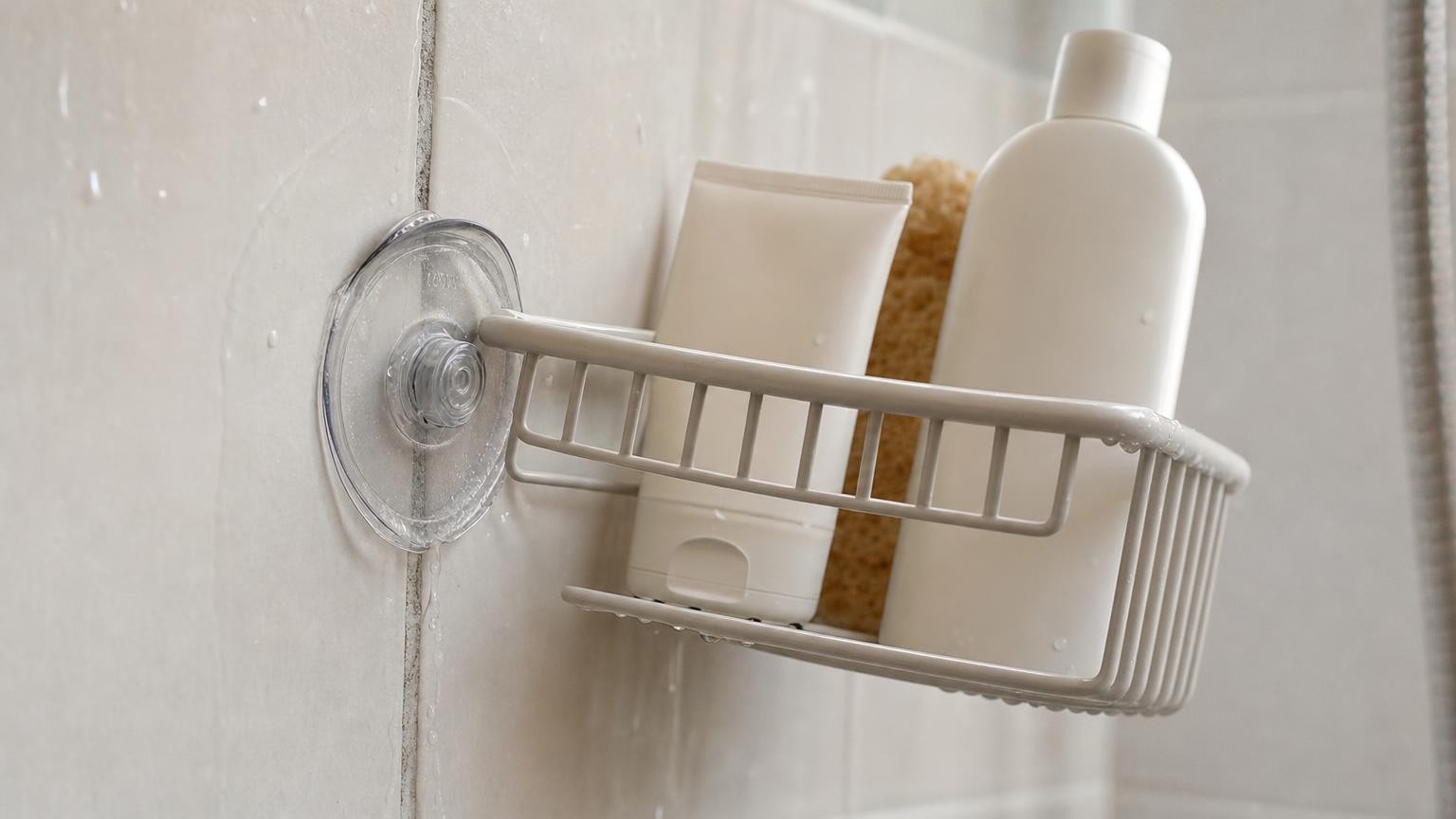
A suction-mounted accessory can feel remarkably secure when first installed, yet slide or fall hours or days later. This is not necessarily mysterious or random. A suction cup holds only while it maintains a pressure difference and an effective seal against the mounting surface. Small leaks, changing loads and gradual deformation can all weaken that arrangement.
For shoppers, the important lesson is that initial grip is not the same as dependable long-term holding power. Cup design matters, but so do the wall or worktop, the direction of the load, the surrounding conditions and the way the mount is installed and maintained.
Why suction mounts can feel secure – until they suddenly do not
When a suction cup is pressed against a surface, some of the air beneath it is displaced. If the flexible rim then forms a seal, the pressure under the cup remains lower than the pressure in the surrounding air. The higher external air pressure pushes the cup against the surface.
The mount continues to hold only while that pressure difference and seal are preserved. Air can slowly enter through microscopic gaps around the rim, reducing the pressure difference. Meanwhile, the loaded cup may stretch, creep or begin to peel. Failure can appear sudden even though the seal has been deteriorating gradually.
This explains why a quick tug immediately after installation reveals only part of the picture. It can identify an obviously poor attachment, but it does not reproduce hours of leakage, repeated handling, temperature changes or sustained loading.
The physics of the hold: pressure difference, seal and usable cup area
A suction cup does not actively pull on a wall. It creates conditions that allow surrounding air pressure to push it against the mounting surface. In simplified terms, the potential holding force depends on the pressure difference multiplied by the effective sealed area.
A larger cup can offer more usable area, but diameter alone does not guarantee better performance. If part of its rim crosses a grout line, texture or uneven joint, the effective seal may be poor. A smaller cup placed entirely on smooth glass may perform more consistently than a larger one spanning an unsuitable surface.
The theoretical force also differs from the load an installed accessory can safely support. Real mounts experience leakage, material deformation, movement and forces acting at awkward angles. Published holding figures, where provided, are most meaningful when their stated surface, installation method and load direction resemble the intended use.
Cup material and shape determine how well the seal forms
The cup must be flexible enough to conform to minor surface imperfections. A soft rim can adapt to small variations and may seal with modest installation pressure. However, excessive softness can allow the cup to distort, creep downward or peel more readily under a sustained or off-centre load.
A firmer material may resist deformation and retain its shape better, but it can struggle to seal if the surface is not very flat or if the rim has become hardened. The useful balance is therefore not simply “softer is better”. It is a combination of conformity, resilience and resistance to long-term distortion.
Shape matters too. The curvature of the cup stores elastic tension after it has been pressed flat or activated by a mechanism. Rim width, thickness and smoothness affect how evenly the seal contacts the surface. Any moulding defect, nick, crease or warped section at the rim can become an air path.
Geometry should also suit the mount itself. A cup attached to a rigid fitting may be stressed unevenly if the accessory twists, sags or is installed against a slightly curved surface. Multiple cups can improve stability, but only if each cup sits flat and shares the load rather than leaving one attachment to carry most of it.
Why smooth, non-porous surfaces work best
Glass, glazed tile and other flat, non-porous finishes are generally favourable because the cup rim can make continuous contact and air cannot readily pass through the material. The exact finish still matters: decorative texture, scratches, limescale or surface damage can interrupt the seal.
A surface that feels smooth to a hand is not always smooth enough at the sealing rim. Fine texture can contain connected channels through which air gradually enters. Porous stone, unfinished wood, some laminates and painted finishes may also permit leakage or provide an unstable top layer.
Tile dimensions and grout spacing deserve attention. A cup should normally sit fully within a smooth tile rather than overlap grout. Joints, bevelled edges and uneven transitions create obvious leak paths. Curved shower panels, appliance doors and furniture surfaces may also prevent the entire rim from sitting in one plane.
Surface condition is separate from structural suitability. A cup may seal to a coating that is poorly bonded to the material beneath it. If the coating lifts or flakes, the suction seal can remain attached to the detached finish rather than to the wall.
Cleanliness, moisture and installation technique
Dust, grease, soap residue and trapped fibres prevent intimate contact between the rim and the surface. Bathroom and kitchen surfaces can look clean while retaining a thin film from cleaning products, cooking vapour or personal-care products. Cleaning both the mounting area and the cup helps make performance more consistent.
After cleaning, follow the mount’s instructions about drying or moistening. A very thin film of water can help some simple cups conform by filling tiny irregularities, but this is not a universal rule. Excess water may reduce friction and encourage a heavily loaded cup to slide. Cleaners can also leave residues or affect some cup materials.
Installation pressure should be even. Place the cup on a flat area, expel air as directed and engage any lever or pump fully. Avoid trapping an edge, hair or fibre under the rim. Once installed, allow the cup to settle for any period specified by its instructions before adding the load.
If a mount repeatedly fails, merely pressing it back onto the same unprepared spot is unlikely to solve the underlying issue. Inspect the rim, clean both surfaces and reconsider whether the location is genuinely smooth, flat and non-porous.
Load direction matters as much as load weight
A headline load weight does not describe the complete mechanical challenge. A force pulling directly away from the centre of the cup differs from a downward force trying to make it slide. More importantly, a force applied near the edge can start peeling the rim, admitting air and rapidly weakening the seal.
Accessories that project far from a wall create leverage. Even a moderate object at the end of a long arm can produce a turning force at the cup. Keeping the load close to the mounting surface generally reduces this peeling tendency.
Repeated movement adds another difficulty. Pressing a dispenser, lifting items from a basket, adjusting a mirror or opening an attached fitting can create brief forces greater than the object’s resting weight. Side-to-side movement can also make the rim flex repeatedly, gradually opening a leakage path.
When comparing mounts, consider:
- the total loaded weight, not just the empty accessory;
- how far the load sits from the surface;
- whether normal use involves pushing, pulling or twisting;
- whether the load could swing or be knocked;
- whether multiple cups are positioned to resist rotation.
Simple cups, locking levers and pump mechanisms
A simple suction cup is usually pressed directly onto the surface. Its performance depends heavily on manual installation pressure, cup resilience and rim condition. It can be adequate for suitable surfaces and modest loads, but there may be no obvious indication of how much pressure difference remains.
A locking lever mechanically deforms the cup after placement. This can make installation more repeatable and helps maintain tension in the cup. The lever does not create a permanent bond, however. If air can pass under the rim, the pressure difference will still diminish.
A pump mechanism removes additional air through repeated operation and may include a way to indicate or refresh the vacuum. This can be useful where regular monitoring is practical. It does not make a textured, porous or dirty surface airtight, and it cannot indefinitely overcome excessive leverage or a damaged rim.
Mechanisms also introduce ownership considerations. They must be accessible enough to operate and inspect. A more elaborate mount may be worthwhile when it offers controlled installation or easy reseating, but complexity alone is not evidence that the complete installation suits the intended load.
Heat, cold, humidity and time: why a good seal deteriorates
Temperature affects both the trapped air and the cup material. Heat can soften some flexible materials, increasing deformation or creep. Cold can make a cup less compliant and less able to follow tiny surface irregularities. Temperature changes can also alter the pressure beneath the cup and repeatedly stress the seal.
Humidity does not automatically strengthen suction. Condensation can change friction at the surface, carry contamination towards the rim or contribute to slipping. In bathrooms and kitchens, cycles of warming, cooling, wetting and drying may be more demanding than stable indoor conditions.
Even without obvious environmental changes, tiny leakage can accumulate. Flexible materials under constant strain may undergo creep or stress relaxation, gradually changing shape and reducing the force that keeps the rim seated. This is why a mount can survive an initial test and still let go later.
Ageing, inspection and realistic ownership expectations
Suction cups are not immune to ageing. Exposure to heat, sunlight, cleaning chemicals and repeated installation can lead to hardening, stretching, clouding, cracking or loss of elasticity. A rim may also acquire a permanent crease while stored or develop small cuts during removal.
Periodic inspection is therefore part of owning a suction-mounted accessory. Remove the load before checking the cup, particularly if the mount has shifted. Look for a lifted edge, downward movement, a loose lever, cracking, distortion or contamination around the rim. Clean and reseat the mount according to its instructions rather than waiting for it to fall.
Replace a cup that no longer returns to its intended shape, has a damaged rim or repeatedly loses its seal on a confirmed suitable surface. Suction alone is also a poor choice where a falling object could cause significant injury or damage. Fragile, valuable, sharp or heavy items may justify a mechanically fixed support or a secondary restraint.
Choosing by conditions, not by headline holding claims
The most useful buying decision begins with the installation rather than an impressive load number. Identify the exact mounting surface, including texture, joints, curvature and coating condition. Then consider the cup’s material, rim design, activation mechanism and accessibility for inspection.
Next, assess the real load: its filled weight, projection from the wall, direction of force and movement during normal use. Account for temperature changes, moisture, contamination and how willing you are to clean, check or repump the mount.
A credible suction installation is a complete system. A well-designed cup cannot fully compensate for a leaking surface, poor placement or severe leverage. Conversely, a modest mount may work consistently when fitted to clean glass, loaded close to the surface and checked regularly. Choosing according to those conditions provides a more realistic guide than judging by initial grip alone.
Continue exploring on Frowse
Best Sellers · Top Rated · Fresh Finds · Under £50
Explore products on Amazon
Looking for products related to this guide? to enter your own search term.
Discover More Frowse Insights
- Inside a Fishing Reel: What Drag, Gear Ratio and Spool Design Actually Change
- Why a New Toner Cartridge Does Not Renew Every Wearing Part in a Laser Printer
- What Changes Inside a Quartz Clock When the Second Hand Sweeps Instead of Ticks
- PTFE vs Ceramic Non-Stick Pans: What the Coatings Really Are
- Fixed-Speed vs Inverter Air Conditioners: What Compressor Modulation Really Changes