




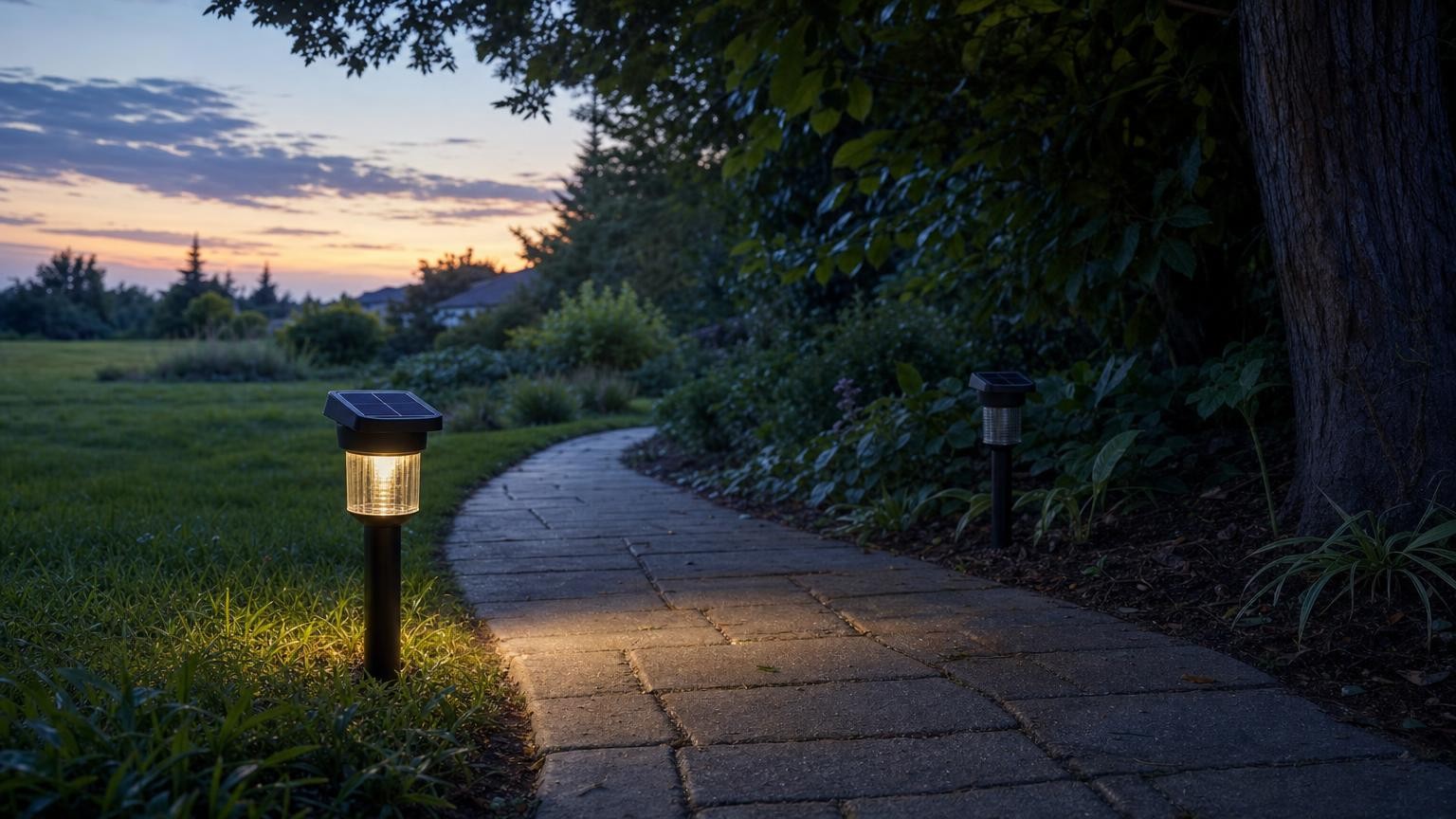
A solar garden light that shines brightly after dusk but fades several hours later is not necessarily defective. Its overnight performance depends on an energy budget: how much sunlight the panel collects, how much energy the battery can store and how quickly the LEDs use it.
This balance changes with placement, weather, season, brightness and operating mode. Understanding that chain helps you compare lights more meaningfully and decide whether a product can cover the hours that matter to you.
Why “all night” is an energy-budget question
Solar lighting cannot draw unlimited energy from the mains. Every evening it starts with a finite amount of energy collected during the day. If the LEDs and control electronics consume that stored energy before sunrise, the light must dim, change mode or switch off.
An overnight runtime claim therefore needs context. A light may last until dawn after a clear summer day but stop earlier following winter cloud or partial shade. The selected lighting mode matters too: continuous high brightness can use substantially more energy than a low decorative glow or brief motion-triggered illumination.
Sunset-to-sunrise duration also varies through the year. Just when winter provides fewer charging hours and weaker sunlight, the light may be expected to operate through a longer night. This makes year-round, all-night performance a more demanding requirement than occasional summer lighting.
Follow the energy from sunlight to the LED
A typical solar garden light contains several linked parts:
- Solar panel: converts incoming light into electrical energy.
- Charge-control electronics: regulate energy going into the rechargeable battery and help prevent unsuitable charging or discharge conditions.
- Rechargeable battery: stores energy for use after dark.
- Light sensor or panel-sensing circuit: detects the transition from day to night and controls automatic operation.
- LEDs and driver electronics: turn stored electrical energy into light at a controlled output.
Energy is lost at each stage. A panel’s output varies with light conditions, the charging circuit has limits, a battery cannot return every unit of energy supplied to it, and the LED driver also consumes power. As a result, not all daylight falling on the panel becomes usable illumination that evening.
The components must be appropriately matched. A large battery offers little benefit if a small or shaded panel cannot recharge it. Equally, a good panel cannot deliver long runtime if the battery has deteriorated or the LEDs consume stored energy too quickly.
Panel size, placement and the difference between daylight and direct sun
Panel area and electrical rating help determine how much energy can be collected under suitable conditions. However, placement often matters as much as the specification. A panel under dense foliage may be visibly illuminated while receiving far less useful solar energy than one exposed to sustained direct sunlight.
Bright ambient daylight is not the same as direct sun. A north-facing corner, covered porch or position beside a fence may look bright to a person but still provide weak charging. Shadows can also move during the day, so a location that is sunny in the morning may be shaded during the most productive hours.
When assessing a location, consider:
- whether nearby buildings, fences or trees block the sun;
- how the sun’s path changes between summer and winter;
- whether leaves, dust, bird deposits or water marks obscure the panel;
- whether the panel angle allows it to face useful sunlight;
- whether new plant growth will create shade later.
Lights with an integrated panel are simple to install, but the best position for illumination is not always the best position for charging. A separate panel connected by a cable can offer more flexibility: the lamp can sit by a shaded path while the panel occupies a sunnier location. The cable length, routing and permitted separation still need to suit the installation.
Battery capacity is only part of the runtime story
Battery capacity is relevant, but it should not be treated as a direct promise of runtime. Usable energy also depends on battery voltage, chemistry, condition, charge level, temperature and the limits imposed by the control circuit.
A battery may not receive a full charge on an overcast day, even if its headline capacity is large. It may also retain less usable energy as it ages. Repeated charging and discharging gradually reduce battery performance, while prolonged exposure to unsuitable conditions can accelerate deterioration.
Solar garden lights commonly use rechargeable cells from several chemistry families, including nickel-metal hydride and lithium-based types. Neither a chemistry name nor a capacity figure establishes overall product quality. The charging electronics must be designed for the exact cell type, and replacement batteries must be compatible with the product’s requirements.
For ownership, clear battery information is especially valuable. Look for the chemistry, voltage and capacity rather than a vague reference to a “rechargeable battery”. A user-replaceable cell can extend the useful life of the light, provided the manufacturer intends replacement and the correct specification is followed. In a sealed unit, battery decline may eventually make the whole light impractical to repair.
Brightness, lighting modes and overnight power demand
LEDs are efficient, but they still require energy. Brighter output, more LEDs and continuous operation generally increase consumption. A compact accent light designed to mark a path has a different energy requirement from a security-style light intended to illuminate a broad area.
Operating modes can change that demand considerably:
- Steady high output provides the most consistent illumination but usually places the greatest continuous load on the battery.
- Dim or economy mode reduces consumption and may extend useful runtime at the cost of lower visibility.
- Decorative flashing or pulsing can reduce the time LEDs spend fully illuminated, although actual consumption depends on the control design.
- Motion-triggered operation can preserve energy by using high output only when movement is detected.
- Dim-to-bright motion mode maintains a low background level and temporarily increases brightness when activated.
Motion lighting introduces further questions. A light facing a busy walkway, road, moving vegetation or animals may activate frequently and consume more energy than expected. Sensor range, detection angle, high-output duration and the background mode all affect overnight demand.
Why runtime changes with weather and the seasons
Solar performance is inherently variable. Cloud reduces the energy reaching the panel, and several dull days can leave a battery progressively undercharged. Rain itself is not necessarily the main issue; the associated cloud and lower light levels are usually more important to charging.
Winter combines several disadvantages. Days are shorter, the sun is lower, shadows may extend farther and nights are longer. Deciduous trees may lose their leaves, but buildings and evergreen planting can still block low-angle sun. Cold conditions can also affect the amount of energy a battery can deliver.
Consequently, a light that operates until dawn in summer may fade well before morning in winter without having developed a fault. If winter performance is essential, judge the installation by its least favourable realistic conditions, not by its best summer evening.
How lights manage a low battery
Products do not all respond to declining battery charge in the same way. Some gradually dim as battery voltage falls. Others maintain a steadier output and then switch off abruptly. More sophisticated controls may reduce brightness, shorten high-output periods or prioritise motion-triggered light over continuous background illumination.
These behaviours can help protect the battery or extend the remaining runtime, but they may also make diagnosis less obvious. A regular reduction in brightness late at night may be intentional energy management. Early shut-off following dull weather is more likely to indicate inadequate charging than a broken LED.
Persistent poor performance deserves a basic check. Consider whether the panel is clean and receiving direct sun, whether a mode has changed, and whether the battery is ageing. If a previously reliable light fails after a strong charging day, a battery, connection, sensor or electronic component may need attention.
Specifications that support a meaningful comparison
No single figure captures real-world solar-light performance. A claimed runtime is more useful when accompanied by clear charging conditions and mode information. When comparing products, look for disclosed details such as:
- panel dimensions or power rating;
- battery chemistry, voltage and capacity;
- whether the battery is replaceable;
- light output and whether it changes by mode;
- continuous, dim, decorative or motion-triggered settings;
- motion-sensor behaviour and illumination duration;
- stated charging conditions behind runtime estimates;
- the ability to position the panel separately from the light.
Be cautious about comparing battery capacity alone. A higher-capacity battery may support longer operation, but only if the panel and charging conditions can replenish it and the light does not consume the extra energy through higher output. Similarly, two lights quoting the same runtime may provide very different brightness or use different test conditions.
Serviceability and long-term ownership
Routine care can improve charging and help distinguish maintenance issues from component failure. Wipe the panel carefully using methods suitable for its surface, remove obstructions and reassess shade as plants grow or outdoor structures change. Inspect accessible contacts for dirt or corrosion and check that covers and seals are seated as intended.
If the product is designed for battery replacement, use only a compatible rechargeable battery of the specified chemistry and voltage. A physically similar cell is not automatically electrically suitable. Non-rechargeable cells should not be substituted in a solar charging system.
Construction affects repairability. A replaceable battery compartment can make routine renewal straightforward, while permanently sealed construction may offer fewer service options. Outdoor protection still matters, so any battery access or removable cover must close correctly after maintenance.
Choosing for the night you actually need to cover
Start with the job rather than the boldest runtime claim. Decide whether the light is decorative, marks a path, supports occasional movement or must provide useful illumination until early morning. Then consider the darkest season, the available direct sun and the brightness you are willing to trade for longer operation.
For all-night background lighting, prioritise balanced panel, battery and output specifications alongside an efficient lower-brightness mode. For brief high-intensity illumination, motion-triggered operation may fit the energy budget better. Where the intended lamp position is shaded, a separately positioned solar panel may be more practical than an integrated design.
Dependable pre-dawn lighting comes from balancing collection, storage and consumption. A realistic choice accounts for winter sunlight, installation constraints, battery serviceability and the hours when light is genuinely needed – not simply the largest battery number or the longest headline runtime.
Continue exploring on Frowse
Discover More Frowse Insights
- Why Vacuum-Sealer Bags Are Textured – and Why Smooth Bags Often Do Not Work
- Why Vacuum Storage Bags Slowly Reinflate – and What to Check Before Buying
- Why Floating Floors Need Expansion Gaps – and What Happens When They Cannot Move
- Why Hair-Dryer Wattage Does Not Tell You How Fast It Will Dry
- Why Mechanical Pencil Leads of the Same Diameter Perform Differently