


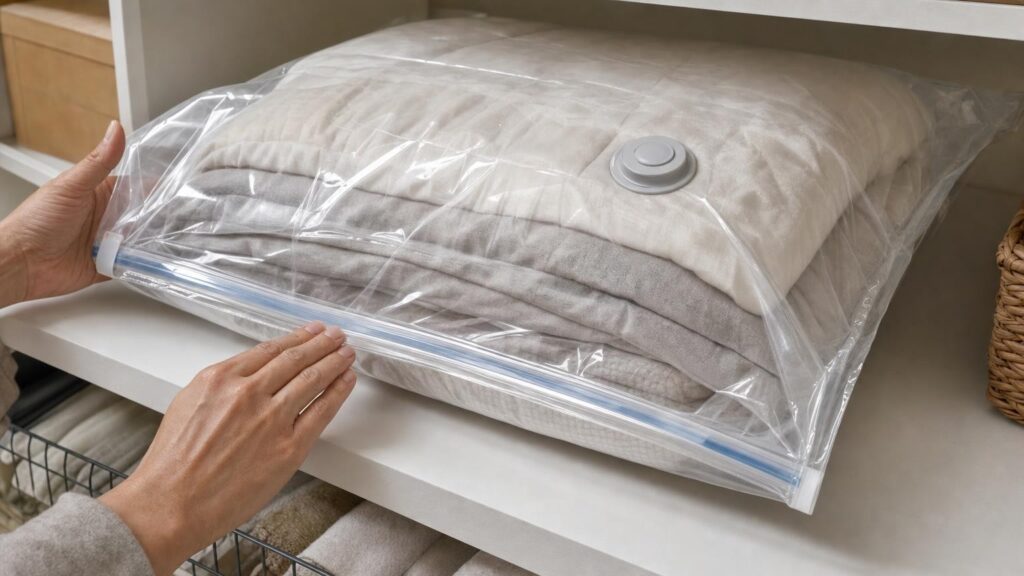
A vacuum storage bag may appear tightly compressed after the air is removed, then gradually become softer or puffier over time. That does not always mean the bag suffered an immediate or obvious failure. Household storage bags reduce the amount of air around their contents, but they do not create a permanent laboratory vacuum.
Air retention depends on an entire sealing system: the plastic film, welded perimeter seams, press-to-close zip and one-way valve. Loading and handling matter too. Understanding how these parts work makes it easier to identify leaks, compare bag designs and choose reliable compression rather than simply chasing the smallest possible package.
Why a vacuum bag can look sealed and still regain air
An instant loss of compression usually points to a substantial opening. The zip may be partly unclosed, the valve may not be seated correctly, or the film may have a puncture. The bag can visibly expand soon after extraction because air has a relatively easy route back inside.
Slow reinflation is less straightforward. A very small leak may admit too little air to produce an immediate change. Air can also migrate gradually through materials and interfaces that are not perfectly impermeable. A bag might therefore remain compressed enough to be useful while becoming less rigid over an extended period.
The contents can affect its appearance as well. Soft textiles shift after extraction, while resilient materials such as duvets and padded clothing continually push outwards as they try to recover their shape. Even a minor leak becomes more noticeable when the contents exert this restoring force.
It is more useful to ask how quickly and how extensively a bag regains air than to treat every slight change as identical. Rapid expansion suggests a closure, valve or puncture problem. A modest long-term loss of compression may reflect a very small leak or gradual air transmission.
How the bag’s four-part sealing system works
Multilayer film
The bag body must contain the load, resist handling damage and slow the movement of air. Multilayer construction can combine different properties, such as toughness, flexibility, barrier performance and the ability to form reliable heat-welded seams. The film also needs to conform around soft contents without becoming excessively stressed at corners or folds.
Welded perimeter seams
Most of the bag is permanently enclosed by welded edges. These are structural seals created during manufacture rather than closures the user opens. A sound weld spreads force along the edge, but it can be weakened by excessive loading, stretching or a sharp object pressing against it.
Press-to-close zip
The zip is the main user-operated seal. Its interlocking tracks must meet continuously across the full opening. A section can look closed while a short area remains misaligned, particularly near the ends. Unlike a welded seam, this seal is repeatedly opened, handled and exposed to lint.
One-way valve
The valve allows air to leave when suction is applied and is intended to resist air travelling back in afterwards. It normally includes a moving or flexible sealing element as well as the visible valve body and cap. The cap may provide protection or a secondary seal, but it cannot compensate for every problem within the valve or where the valve joins the film.
These components perform different jobs, and the system is only as dependable as its weakest interface. Thick film cannot correct an open zip, while an effective valve cannot prevent air entering through a damaged seam.
Where air most commonly gets back in
The closure is a sensible first inspection point. The tracks may be incompletely engaged, or lint, hair, thread and fabric fibres may interrupt contact. Moisture or residue can also prevent the surfaces from meeting cleanly. Running the supplied slider or fingers along the closure more than once can help, but the important point is to confirm that the tracks are aligned rather than merely applying greater force.
At the valve, air can return if the internal seal does not settle after extraction, if the cap is cross-threaded or loose, or if material is trapped around the sealing surface. The valve-to-film junction is another interface: twisting the valve or dragging a heavily loaded bag by it can place stress around its base.
Welded seams should be checked for separation, stretching or whitening that indicates local stress. Punctures can be difficult to see, especially when they are small or hidden beneath the contents. Zips, buckles, hooks and stiff garment details are common sources of concentrated pressure, as are rough shelves and hard debris on the storage surface.
Not every loss of firmness reveals a visible hole. Plastic film and seals can permit extremely gradual air migration. This is one reason no universal storage duration can be inferred from the fact that a bag initially compressed well. Temperature changes can also alter the apparent firmness of the bag and the volume of trapped air.
Why overfilling, uneven contents and sharp folds cause trouble
Overfilling does more than make a bag difficult to close. Bulky contents push outwards against the zip and welded seams. If the opening must be pulled together under tension, the closure tracks are less likely to align evenly and more likely to be disturbed when the bag is moved.
Uneven loading concentrates pressure. A soft, level stack of textiles distributes force more gently than a lumpy bundle containing hard fasteners or tightly rolled items. Before loading, close zips and hooks where practical, tuck rigid details inwards and avoid placing buttons, buckles or decorative parts directly against the film.
Sharp folds create similar stress concentration. Folding the bag tightly around a hard corner can form a crease that repeatedly flexes during handling. A fold across the valve base or the end of the zip can also distort a critical sealing area. Compression should come primarily from extracting air, not from forcing the filled bag into shape with tight bends.
Leave enough unfilled material near the opening to bring both sides of the zip together flat and without pulling. The valve area should also lie reasonably level so the pump or hose can form a stable connection. If the load cannot be arranged without tension, a different size or shape is likely to be more dependable than forcing in the final item.
Film construction, thickness and flexibility: the real trade-offs
Film thickness is easy to compare when sellers provide it, but it does not establish overall quality by itself. Performance also depends on the materials used, how layers are bonded, resistance to puncture and tearing, seam quality and how well the film works with the closure and valve.
Supple film conforms readily around bedding and clothing, which can reduce awkward empty spaces and make a compressed bag easier to position. It may also be easier to manipulate when aligning the zip. However, very soft film still needs protection from sharp details and rough handling.
A stiffer construction can feel substantial and may resist some forms of handling damage, but it can pack differently. It may be less willing to wrap around irregular textiles and can form pronounced creases if forced into a confined space. Stiffness should not automatically be interpreted as either strength or superior air retention.
The useful comparison is therefore not simply thin versus thick. Consider whether the film combines barrier properties with enough toughness and flexibility for the intended contents, storage location and frequency of handling.
Valve design and pump compatibility
A one-way valve must open sufficiently when suction is applied, then close once extraction stops. The external appearance does not reveal every detail of how it operates. Some designs respond directly to airflow, while others may need a particular nozzle position or physical contact to open correctly.
Hand pumps offer controlled extraction without requiring another appliance, but they take more effort with large volumes. Electric pumps can provide a dedicated connection and consistent airflow if designed for the valve. Vacuum-cleaner hoses can remove air quickly, but the hose shape and diameter must form a useful seal around the valve.
A familiar-looking circular valve should not be assumed to work with every pump or cleaner. Nozzle fit, the method used to open the valve and available airflow all matter. A loose connection may draw room air around the nozzle instead of extracting efficiently from the bag. An unsuitable nozzle can also press awkwardly on the valve body.
Before buying bags for an existing pump, look for explicit compatibility information rather than relying on visual resemblance. If a pump is included, consider whether it will be convenient for the bag sizes and storage routine involved.
Bag shape and size affect sealing, not just capacity
Flat bags are straightforward to lay out and can work well for relatively even stacks of clothing or bedding. As they fill, however, a deep load can pull the upper and lower film panels towards one another at steep angles near the closure.
Gusseted or shaped bags provide additional depth and may accommodate bulky contents with less distortion. Their form can create a more regular package, although extra folds and corners still need careful loading. Shape also influences stackability, unused internal space and how easily the valve remains accessible during extraction.
An oversized bag is not automatically more practical. It can encourage overloading, take longer to evacuate and become difficult to lift without pulling on seams or the valve. Large soft contents can also shift while the zip is being closed. Several manageable bags may be easier to load, inspect and move than one extremely heavy package.
Conversely, a bag that is too small may place constant tension on the closure. The best size is one that contains the items without strain while leaving a flat working area around the zip and valve.
What reusable construction means in everyday ownership
A reusable label indicates intended repeat use, but actual service life depends on the whole construction and how the bag is treated. Each cycle flexes the film, operates the zip and exposes the sealing surfaces to fibres and dust. Reuse is therefore a maintenance issue as much as a product description.
After emptying a bag, inspect the film in good light. Look at welded edges, previous crease lines, the valve base and areas that contacted hard parts of the contents. A small puncture, spreading seam separation or distorted closure can make further use impractical even when most of the bag appears sound.
Keep the zip tracks clean and dry before resealing. Store empty bags without repeatedly folding them along the same tight line, especially through the valve or closure ends. Broad, loose folds or rolling may reduce concentrated flexing where space allows.
Handling habits matter once the bag is full. Support its weight rather than carrying it by the zip, valve or a loose corner. Avoid sliding it across rough surfaces, and do not assume that compression turns soft contents into a rigid parcel suitable for rough treatment.
Choosing for reliable compression rather than maximum compression
The smallest possible packed result is not necessarily the most dependable one. Extreme loading can place more force on every vulnerable point and make the bag harder to close, extract and move. Reliable compression leaves enough room for the closure to lie flat and for the film to settle around the contents without sharp stress points.
When comparing options, consider the system rather than one headline feature. Look for a closure that is easy to align and inspect, a valve compatible with the intended extraction method, a shape suited to the contents and a film construction that balances flexibility with resistance to handling damage.
Realistic expectations are equally important. Household vacuum storage bags are designed to reduce volume and protect stored textiles from ordinary exposure while sealed, not to maintain an absolute vacuum indefinitely. Slow reinflation can arise from a tiny fault, stressed construction or gradual air migration. Careful loading and inspection cannot eliminate every possible leak, but they give the complete sealing system its best chance to work reliably.
Continue exploring on Frowse
Discover More Frowse Insights
- Why Sandpaper Grit Numbers Do Not Tell the Whole Story
- PTFE vs Ceramic Non-Stick Pans: What the Coatings Really Are
- Cemented, Blake-Stitched and Welted Shoes: What Sole Construction Really Changes
- Why Mattress Firmness and Foam Density Are Not the Same Thing
- How to Read Bicycle Gearing Beyond the Number of Speeds