


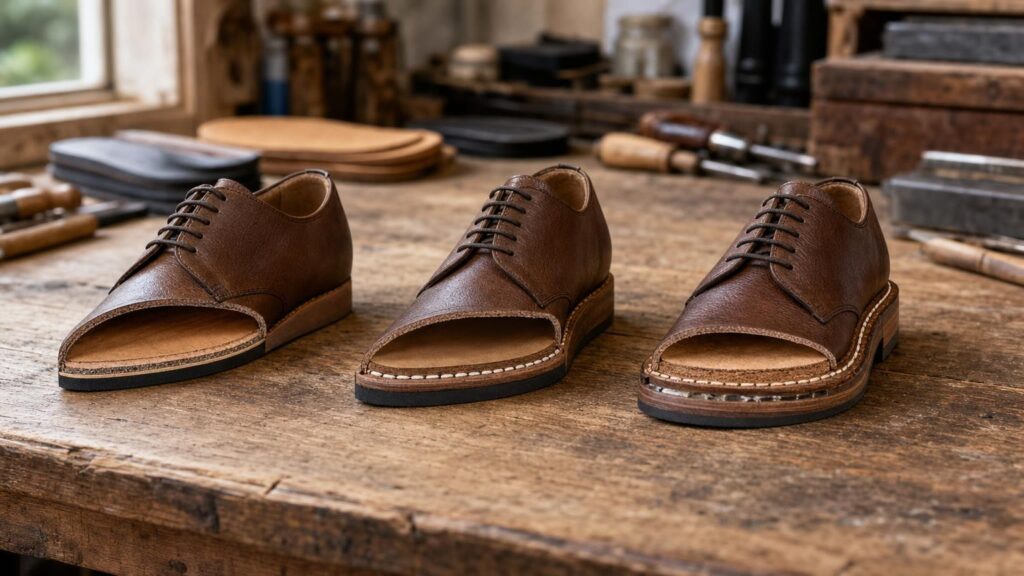
Sole construction describes how a shoe’s upper is joined to the layers beneath the foot. That choice can influence flexibility, weight, appearance, break-in and whether replacing a worn outsole is practical. It is useful information when comparing footwear, but it is not a complete measure of quality.
A well-made cemented shoe may suit its purpose better than a poorly executed stitched one. Fit, upper material, outsole compound, cushioning and the quality of assembly can all matter as much as the named construction. The useful question is therefore not which method is universally best, but which trade-offs fit the way you expect to wear and maintain the shoes.
Why sole construction matters – and what it cannot tell you alone
The attachment method helps determine how many layers and seams sit between the upper and outsole. A direct adhesive bond can keep a shoe slim and light, while a welted assembly usually introduces more components. Stitching may create a mechanically secure join and make parts easier to separate, but it does not guarantee that every material around that stitching is durable.
Construction also says little about fit. The last – the foot-shaped form around which a shoe is built – has a much greater effect on toe room, heel hold and overall shape. Insole thickness, lining, shank, heel structure and outsole geometry influence comfort and support. Two shoes using the same construction can consequently feel and perform very differently.
The basic anatomy of a shoe’s sole attachment
The upper is the part that surrounds the foot. Beneath it is the insole, which forms the internal foundation of the shoe. A removable cushioned insert is often called a footbed or sock liner, although product descriptions do not always use these terms consistently.
The outsole is the ground-contacting layer. Some shoes also have a midsole between the insole and outsole for cushioning, structure or easier assembly. A welt is a narrow strip around some or all of the perimeter that helps connect the upper to the sole.
The path of the stitch is important. In Blake construction, a structural seam generally runs through the outsole, upper margin and insole. In welted construction, one seam joins the upper to the welt and another joins the welt to the outsole. Cemented footwear primarily relies on adhesive rather than structural sole stitching.
Visible thread is not always evidence of a stitched attachment. An outsole may carry moulded imitation stitches or a decorative seam while the main join remains cemented. Conversely, a genuine structural stitch may be hidden by a sole channel, filler or internal covering.
Cemented construction: bonded for lightness and simplicity
In cemented footwear, the prepared upper is bonded directly to the sole unit with adhesive. This method accommodates many materials and sole shapes, including moulded units that combine the outsole, cushioning and heel structure in one component.
Because it does not require a welt or an internal stitching path, cemented construction can produce a relatively light, slim and flexible shoe. Many examples need little structural break-in, although thick leather uppers or rigid sole units can still feel firm. The process also works well for designs in which low bulk, cushioning or complex moulded shapes are priorities.
The main limitation is not that every adhesive bond fails quickly. A properly prepared bond can remain secure through substantial wear. Instead, the difficulty is what happens when the outsole wears out or the bond eventually separates. Heat, repeated flexing, moisture, contamination and material ageing may affect adhesion, while crumbling foam or a highly shaped sole unit can leave little suitable material to repair.
Some cemented shoes can be resoled or re-bonded by a capable repairer. Practicality depends on whether the old sole can be removed cleanly, whether a compatible replacement is available and whether the upper provides a sound bonding surface. Repair may be technically possible but uneconomical compared with the value and remaining condition of the shoe.
Blake stitching: a direct seam through the shoe
Blake construction uses a stitch that passes from inside the shoe through the insole and folded-under edge of the upper to the outsole. This creates a direct attachment without the projecting welt used in traditional welted construction.
The method supports a close-cut outsole and a streamlined profile. With fewer peripheral layers, a Blake-stitched shoe can be flexible and relatively light. These are tendencies rather than rules: a heavy outsole, reinforcing shank or thick upper can still produce a substantial shoe.
Because the stitching passes through the insole, its position may be detectable inside some shoes, although it is often covered by a sock liner. Poorly finished or inadequately covered seams could be noticeable underfoot. The perforations and stitching path may also provide a route for moisture if water reaches the sole seam, particularly after edge finishes and sole channels have worn.
Blake-stitched footwear can usually be resoled in principle, but the work commonly requires a machine capable of reaching inside the shoe to recreate the seam. Not every repairer has that equipment or wishes to work on every design. Repeated stitching can also enlarge or damage existing holes, so the condition of the insole and upper margin matters.
Welted construction: a layered, repair-oriented approach
In welted footwear, a separate strip provides an intermediate connection between the upper and outsole. The upper and insole structure are attached to the welt, and a second, more accessible stitch joins the welt to the outsole. The cavity within the assembly may contain filler, while the overall build can include a midsole and other structural layers.
In Goodyear-welted construction, machinery forms the welt seam around a prepared insole assembly. Many versions use a bonded rib beneath the insole to receive the stitch. In hand-welted construction, the maker traditionally cuts a holdfast into a sufficiently substantial insole and stitches the upper and welt to it by hand. These descriptions identify different methods, but they do not by themselves grade the leather, stitching, filler or finishing.
The layered structure often gives welted shoes a broader sole edge, more weight and greater initial firmness. Substantial leather components may gradually flex and conform with wear, creating a noticeable break-in period. However, some welted shoes are supple from the start, especially when they use flexible outsoles and lighter uppers.
Repairability is a major attraction. A repairer can often remove the outsole stitching and replace the outsole without disturbing the main upper-to-welt seam. That does not make resoling unlimited. A damaged welt may need replacement, and deterioration in the insole, lining or upper can make further work unsuitable or disproportionately expensive.
Flexibility, weight and break-in are not the same thing
These qualities are related, but they should be assessed separately. A shoe can be light yet stiff if it has a rigid moulded sole. It can be heavy but flexible if it uses thick, pliable rubber. Break-in may come mostly from the upper and heel counter rather than from the attachment method.
- Initial flexibility: Cemented and Blake constructions often bend readily because they can use fewer layers. Welted construction may feel firmer, but outsole material and thickness can overturn that expectation.
- Weight: Extra welts, midsoles, filler and substantial outsoles tend to add mass. Lightweight welted designs and heavy cemented footwear still exist.
- Break-in: Thick leather, a firm heel counter and a structured insole can require time to soften. Construction is only one contributor.
- Underfoot feel: Cushioning foam, footbeds, shanks and outsole compounds generally have a more immediate effect than whether the attachment is adhesive or stitched.
When shopping online, consider descriptions of the entire sole package. Terms such as leather outsole, rubber outsole, cushioned footbed and supportive shank provide different information from the construction label. Product weight and flexibility should not be inferred from one term alone.
Water entry: seams, channels and maintenance
No one of these constructions is automatically waterproof. Water resistance depends on the upper material, seam treatment, tongue design, sole condition and how long the shoe is exposed to wet conditions.
Stitched soles contain needle holes and thread paths through which moisture may travel. Welted construction can keep one principal seam farther from direct ground contact, but water may still enter at the welt, through the upper or around the tongue. Blake stitching creates a more direct route towards the inside if the sole seam becomes saturated and is not effectively sealed.
A cemented sole has no structural stitch holes through the join, but that does not make it immune to leaks. Edge separation, cracks, worn outsole areas and deterioration in the upper can all admit water. Once part of a bond lifts, flexing and trapped debris may worsen the opening.
Maintenance therefore matters across all three methods. Allowing wet footwear to dry gradually, keeping appropriate upper materials conditioned and checking worn sole edges can help preserve the assembly. Treatments should be suitable for the specific leather, textile or synthetic material; a general construction label does not determine which care product is appropriate.
Durability versus repairability
Durability concerns how long the original shoe remains serviceable. Repairability concerns whether worn or damaged parts can be restored at a sensible cost. They are not interchangeable.
A cemented shoe may provide long service before its outsole is exhausted, even if replacement is difficult. A welted shoe may be designed for resoling, yet still become unrepairable if the upper cracks, the insole fails or the welt suffers extensive damage. Blake construction sits between these common perceptions: it is mechanically stitched and potentially resoleable, but access and machinery can limit local repair options.
Repeated resoling also has limits. Stitch holes can weaken, welts can become too damaged to reuse and the shape of a shoe can change through wear. A repairer must judge whether the supporting structure is sound rather than simply confirm the presence of stitches.
If long-term repair is important, it is worth asking a local cobbler before purchase which constructions they service and whether replacement soles are realistic for the style in question. A conventional flat outsole is usually a more straightforward proposition than an unusual moulded unit, irrespective of the marketing label.
Choosing the right trade-off for everyday use
Cemented construction is often a sensible choice when low bulk, immediate flexibility, cushioning or a sculpted sole unit matters more than repeated outsole replacement. It is common across many casual and lightweight designs, but the actual materials and bond quality remain decisive.
Blake stitching suits shoppers who want a genuinely stitched build with a neat, close-cut profile and the potential for good flexibility. The relevant compromises are the internal stitching path, possible moisture entry and the need to find a repairer with appropriate machinery.
Welted construction is attractive when a structured feel and future outsole replacement are priorities. The buyer should be comfortable with the possible extra weight, firmer initial feel and cost of eventual specialist repair. Paying for a repair-oriented method makes most sense when the upper fits well, uses maintainable materials and is likely to remain worth preserving.
For everyday wear, fit should come first. A theoretically long-lasting shoe is poor value if its shape causes discomfort or prevents regular use. Intended conditions matter too: office wear, prolonged walking and exposure to wet or abrasive surfaces place different demands on the same construction.
Read construction labels as clues, not guarantees
Before buying, use the construction term as the start of the assessment rather than the conclusion:
- Check whether visible stitching is described as structural or merely decorative.
- Look for information about the upper, insole, outsole and cushioning, not just the attachment method.
- Expect hybrid builds. Blake-Rapid, stitched-and-cemented and other combinations may not fit neatly into one category.
- Do not assume that welted means waterproof, that cemented means disposable or that Blake always means lightweight.
- Consider access to a suitable cobbler and the likely cost of repair before treating resoling potential as a major benefit.
- Prioritise fit, comfort and suitability for the conditions in which the shoes will actually be worn.
Cemented, Blake-stitched and welted constructions each solve the attachment problem differently. Their labels reveal useful tendencies in flexibility, bulk and repair access, but execution and materials determine how those tendencies appear in a particular shoe. The best choice is the one whose comfort, upkeep and likely lifespan match your real use rather than an assumed hierarchy of construction methods.
Continue exploring on Frowse
Discover More Frowse Insights
- A Travel Plug Adapter Does Not Convert Voltage: What to Check Before You Travel
- Clumping Clay, Silica and Plant Fibre: How Cat-Litter Materials Behave Differently
- Why a Tripod’s Load Rating Does Not Tell You How Steady It Will Be
- PTFE vs Ceramic Non-Stick Pans: What the Coatings Really Are
- Airflow, Airspeed and Nozzle Shape: How to Judge a Leaf Blower’s Real Capability