


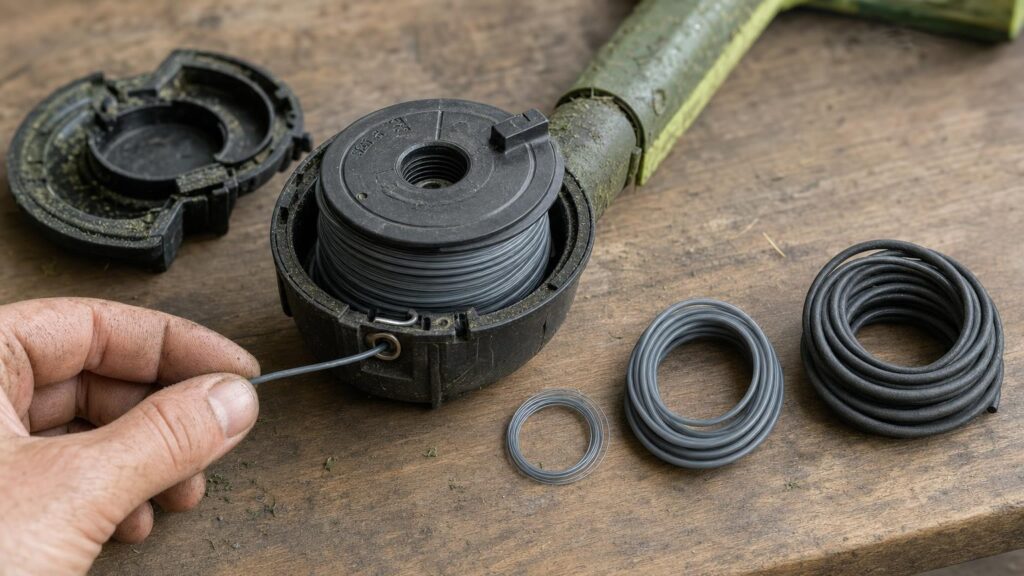
It is easy to assume that thicker string-trimmer line must cut better and last longer. Extra diameter can improve resistance to wear and breakage in some conditions, but it also adds mass, stiffness and aerodynamic drag. If the trimmer or cutting head was not designed for it, thicker line may rotate too slowly, feed poorly or place an unnecessary load on the machine.
The most effective line is therefore not the thickest option that can be pushed through the eyelets. It is the line that suits the trimmer’s supported range, its head design and the vegetation being cut. Diameter is important, but profile, material, winding quality and feed reliability can matter just as much.
What Line Diameter Changes in Practice
A larger-diameter line contains more material per unit of length. That usually makes it heavier and potentially more resistant to abrasion, but the trimmer must accelerate and keep that additional mass moving at cutting speed. Thicker line also presents a larger surface to the air and vegetation, increasing resistance as it rotates.
These effects create several practical trade-offs:
- Potentially greater durability: More material can take longer to wear through when cutting coarse plants or repeatedly brushing against abrasive surfaces.
- More rotational load: The motor or engine must work harder to accelerate and maintain the speed of heavier line.
- Greater drag: Increased diameter and aggressive profiles can encounter more aerodynamic and cutting resistance.
- Reduced responsiveness: A lightly powered trimmer may take longer to recover its speed after the line enters dense growth.
- Lower spool capacity: Thick line occupies more space, so less length fits on a spool of a given size.
Cutting depends heavily on tip speed. A thicker line that causes the head to slow may perform less effectively than a lighter line rotating at the speed for which the machine was designed. The extra material is useful only when the trimmer has enough power and the head can handle it reliably.
Match the Line to the Trimmer’s Available Power
String trimmers are designed as systems. The motor or engine, drive components, cutting head, guard and line specification are selected to work together. The manufacturer’s supported line diameter should therefore be treated as an operating constraint, not merely a suggestion about what will physically fit.
Light-duty cordless and mains-electric machines are often intended for lawn edges, soft grass and routine garden maintenance. Adding heavier line can increase load, heat and energy demand. On a battery model, a higher load may also affect operating time, although the result depends on the machine, battery, head and working conditions.
More powerful cordless or petrol machines may support heavier line for dense vegetation, but this does not make every thick line appropriate. A head may have narrow eyelets, limited internal clearance or a feed mechanism designed around a particular diameter range. Even when the power unit can turn the line, the head still has to store and release it correctly.
Always check the specification for both the trimmer and any separately fitted head. An aftermarket head can have different limits from the original one. If several diameters are supported, the lower part of that range may suit routine grass work, while the upper part may be more appropriate for demanding vegetation or abrasive conditions.
The Cutting Job Matters More Than Maximum Thickness
Line should be selected for the work done most often rather than the toughest plant that might occasionally appear.
Soft grass and lawn edges
Routine trimming generally benefits from a line that accelerates easily and maintains speed. A compatible lighter line can give responsive cutting, make efficient use of the spool and place less demand on the power unit. Extra thickness may add little value if the line is cutting soft material without frequent breakage.
Dense weeds and fibrous growth
Coarser vegetation creates more resistance and may wear or snap light line quickly. Moving to a thicker diameter within the approved range can improve durability. However, the line still needs enough rotational speed to cut cleanly. If it repeatedly bends vegetation rather than severing it, excessive load or unsuitable technique may be part of the problem.
Walls, paving and fences
Hard surfaces are highly abrasive. Thicker line may survive contact for longer, but no flexible trimming line is immune to wear against masonry, concrete, metal or rough timber. Continually striking obstacles can consume even heavy line quickly and may also increase vibration or breakage. Better control of the cutting arc is usually more effective than relying solely on extra diameter.
Some growth may be beyond the intended capability of a line-trimmer setup. Do not assume that fitting the most aggressive line available turns a light machine into a heavy brush-clearing tool.
Round, Twisted, Square and Edged Profiles
Diameter is only one part of line geometry. Two products with a similar nominal diameter can behave differently because of their cross-sectional shape.
- Round line: Its smooth surface can feed easily through many conventional heads and has no corners to catch inside a spool or eyelet. It is a straightforward choice for general trimming, although its rounded surface may produce a less pronounced cutting edge than shaped alternatives.
- Twisted line: The spiral form is intended to change how the line moves through the air. Depending on the trimmer and design, this may influence noise, drag and vibration. Compatibility and maintained line speed remain more important than the shape alone.
- Square line: Defined corners can present sharper edges to vegetation. Those same corners may increase drag, wear against eyelets or make the line less cooperative in a head with tight internal clearances.
- Star-shaped or otherwise edged line: Multiple edges may engage tough growth effectively, but complex profiles can be stiff and bulky relative to their nominal size. They are not automatically suitable for every automatic-feed or bump-feed head.
An aggressive edge does not guarantee faster cutting. If the additional drag causes the head to lose speed, any theoretical advantage may disappear. Profile should be considered only after diameter and head compatibility have been established.
Material and Construction: Why Equal Diameters Behave Differently
Most replacement line uses polymer-based material, but formulation and construction vary. Flexibility, stiffness, surface finish and resistance to abrasion can all change how line behaves, even when two options carry the same diameter marking.
A flexible line may tolerate bending and impact without snapping readily, but a very soft line can deform or wear quickly. A stiffer line may hold its cutting path well, yet it can be harder to wind and more prone to retaining the coil shape in which it was stored. Cold conditions, age and storage can also alter handling characteristics.
Some lines use multiple materials, internal cores or reinforced construction. These designs may aim to balance toughness, flexibility and wear resistance, but construction type alone is not proof of superior performance. It must still suit the machine, head and task.
Material also affects feeding. A line that is too stiff for a compact spool may resist unwinding, while a surface that grips neighbouring coils can encourage sticking. Conversely, a very slippery or springy line can loosen if wound without controlled tension. Diameter is therefore an incomplete comparison unless material behaviour is considered alongside it.
Head Compatibility and Feed Mechanisms
Physical fit is not the same as reliable operation. Line must pass through the head’s eyelets, sit correctly on the spool, move through internal guides and advance using the intended feed system. It must also work with the guard and any fitted line-limiting cutter.
Automatic-feed heads
These heads release line according to their particular mechanism. Oversized, stiff or unusually shaped line may not move as expected, resulting in little or inconsistent advancement. A feed fault can therefore be a compatibility problem rather than evidence that the line is especially durable.
Bump-feed heads
A bump-feed head relies on its spool and indexing parts releasing a controlled amount of line. If the line binds between coils or jams at an eyelet, repeatedly bumping the head may not solve the underlying issue.
Fixed-line heads
These use individual lengths rather than a wound spool. They can avoid some winding problems, but each head still specifies suitable sizes and line types. A piece that fits through the opening may remain too stiff, heavy or poorly retained for dependable use.
Thick line also reduces the amount that can be wound onto a spool. That can mean more frequent rewinding, even if each exposed section lasts longer. Shoppers should weigh durability against spool capacity and maintenance effort rather than looking at breakage resistance alone.
When Winding Problems Look Like Bad Line
Many complaints about weak, tangled or non-feeding line originate with spool preparation. Correct line can perform poorly if it is installed badly.
- Wrong winding direction: Spools commonly indicate the required direction. Reversing it can prevent the feed mechanism from working correctly.
- Crossed coils: Random overlaps can trap lower layers and stop line from releasing smoothly.
- Loose winding: Slack coils can shift, spring out or tighten unevenly when the head accelerates.
- Excessive tension: Pulling too tightly can encourage coils to press into one another and bind.
- Overfilling: A spool packed to its limit may lack the clearance needed for line to move.
- Incorrect assembly: A spool, spring, cap or retainer that is not seated properly can imitate a line-feed fault.
Line welding occurs when adjacent coils stick together under heat and pressure. Friction, heavy loading, repeated stopping and starting, tightly compressed coils and the line material itself can all contribute. The result may look like random breakage or a failed feed system because the outer line cannot separate from the spool.
Before replacing a line type, unwind the spool and inspect it. Rewinding evenly in the marked direction, with consistent but moderate tension and enough free space, may resolve the problem. Pre-wound spools can reduce winding effort, but their exact compatibility with the trimmer and head should be confirmed.
A Practical Pre-Purchase Checklist
- Identify the exact trimmer and head. Check whether the head is original or an alternative fitted later.
- Confirm the supported diameter range. Do not select line solely because it passes through the eyelets.
- Define the usual job. Distinguish routine grass trimming from dense weeds, fibrous growth and work near abrasive surfaces.
- Choose diameter before profile. Start with a compatible size that suits the workload, then compare round, twisted or edged designs.
- Consider material behaviour. Think about flexibility, stiffness, abrasion, winding ease and the likelihood of coils binding.
- Check the feed mechanism. Confirm that the line type is appropriate for automatic-feed, bump-feed or fixed-line use.
- Compare usable format. Bulk line can be economical and flexible, while correctly matched pre-wound spools may be more convenient.
- Account for spool capacity. Thicker line means fewer metres on a spool and potentially more frequent rewinding.
- Plan storage. Keep replacement line away from excessive heat, direct sunlight and unsuitable conditions, and follow any care instructions supplied with it.
It can be sensible to begin near the middle of the machine’s supported range rather than automatically choosing the maximum. Actual results can then be judged by maintained cutting speed, feed consistency, breakage, line consumption and how hard the trimmer appears to work.
Choose the Best-Matched Line, Not the Thickest
Effective trimming comes from the interaction between the line, power unit, cutting head, spool setup and vegetation. Thicker line can be useful where abrasion or demanding growth quickly defeats lighter material, but it can also increase drag, reduce responsiveness, limit spool capacity and create feed problems.
Start with the trimmer and head specifications. Select a compatible diameter for the normal task, then consider profile and material as refinements rather than shortcuts to more power. Reliable feeding and maintained line speed will usually matter more than fitting the thickest or most aggressively shaped line available.
Continue exploring on Frowse
Discover More Frowse Insights
- Pressurised and Traditional Espresso Baskets Do Different Jobs
- Where Ink Goes When an Inkjet Printer Is Not Printing Pages
- Why Bathroom Scales Give Different Readings on Different Floors
- Why Baking Trays Warp in the Oven and Sometimes Flatten Again
- Single-Coil, Humbucker and Active Pickups: How the Hardware Shapes the Signal