


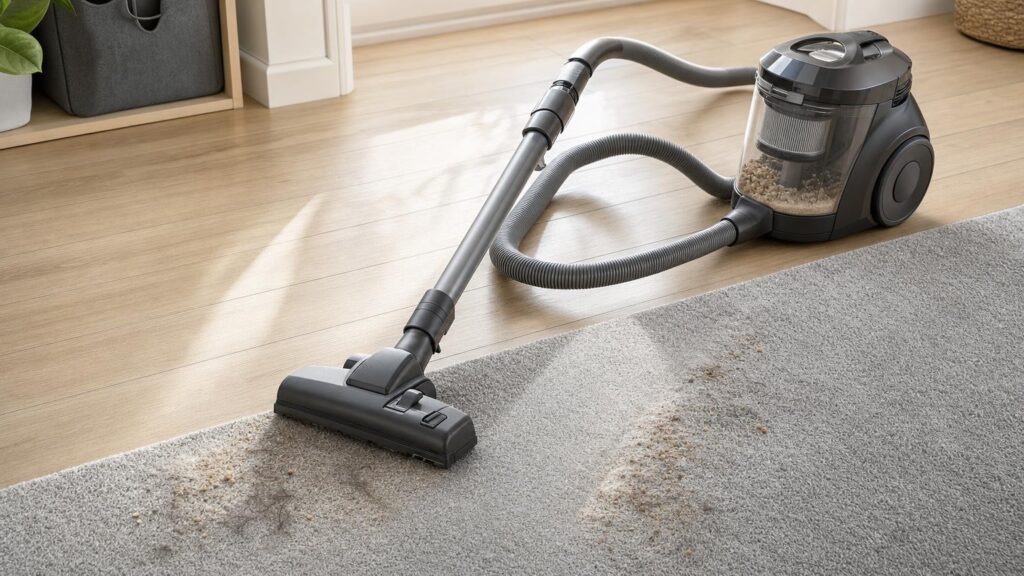
Vacuum cleaner specifications often reduce performance to a single prominent number. Depending on the model, that might be motor wattage, suction pressure, airflow or an air-watt-style figure. Each can reveal something about the machine, but none describes how effectively it will clean every type of floor.
Pickup happens through an entire system. The motor creates a pressure difference, moving air carries debris, the floorhead manages contact with the surface, and the air path directs dirt through the machine. Seals, filters, bags, bins and blockages all influence the result. Understanding how these parts interact is more useful than simply choosing the vacuum with the largest advertised number.
Why one headline number cannot describe cleaning performance
A vacuum cleaner does not clean at the motor. It cleans where the floorhead meets the floor, often at the far end of a hose, wand and series of bends. Performance at that point can differ substantially from a measurement taken at another part of the machine.
Electrical input wattage is primarily a measure of the power the appliance consumes under specified conditions. It does not directly state how much useful suction or airflow reaches the floor. Motor efficiency, internal design, filtration and floorhead construction all affect how electrical input translates into cleaning.
Suction and airflow figures are more closely related to the movement of air, but they still need context. A sealed-suction test examines the pressure a machine can produce when airflow is heavily restricted or stopped. That is different from normal cleaning, when air must keep moving through an opening. An airflow figure measured without a floorhead or filter load may also be difficult to relate to real use.
Air-watt-style measurements attempt to combine airflow and pressure into one indication of pneumatic power. This can be informative when measurements use comparable methods and locations, but it still does not account fully for brush agitation, nozzle geometry or the way a head behaves on different surfaces.
Suction and airflow do different jobs
In everyday language, “suction” is often used to describe everything a vacuum does. Technically, it is helpful to separate pressure difference from airflow.
The vacuum motor lowers the pressure inside the air path relative to the surrounding room. The resulting pressure difference encourages air to move through the floorhead. This pressure can help dislodge particles and maintain airflow when the path meets resistance, such as dense carpet or a partly loaded filter.
Airflow is the volume of air moving through the system over time. Once dust, crumbs or hair enter the airstream, that moving air transports them through the wand or hose and into the bag or bin.
Both are necessary. Strong pressure measured against a sealed opening does not guarantee effective pickup if the working air path is too restricted to carry debris. Conversely, high airflow through a wide, unrestricted opening may achieve little if the floorhead cannot concentrate it where dirt is located.
The balance also changes during use. A head that seals tightly against a smooth floor may produce a strong feeling of suction at the handle, yet become difficult to move. If too little air can enter around the nozzle, useful flow may fall. Ease of movement is therefore not merely a comfort issue – it can reveal how well the head manages contact and incoming air.
The air path: where performance is gained or lost
To understand a vacuum, follow the air from the floor to the exhaust. It enters through the floorhead, passes through a wand or hose, reaches a bag or separation chamber, moves through one or more filters and finally exits the machine.
Every component introduces some resistance. Resistance is unavoidable because the vacuum needs tubes, bends, dirt separation and filtration, but thoughtful design can limit unnecessary losses. Tight bends, narrow passages and abrupt changes in internal shape can make it harder to sustain airflow. Long hoses may also add resistance, although their reach can improve practical usability.
Leaks create a different problem. Air entering through a poorly fitted hose, loose bin seal or incorrectly installed filter bypasses the floorhead. The motor may still move air, but less of that effort is applied at the cleaning surface. Secure connections and sound seals are therefore important even when the motor itself is powerful.
Obstructions can have an immediate effect. Hair around a brush roll, a lodged object in a bend, compacted debris in a hose or an overloaded filter can restrict the path. Shoppers should consider whether common blockage points are accessible and whether parts can be removed without a complicated disassembly process.
Floorheads turn motor performance into floor cleaning
The floorhead controls how air enters and how the vacuum interacts with debris. Its opening size, internal channels, seals, wheels, brushes, height and ability to pivot all influence pickup.
A narrow opening can increase air speed locally, but it must still admit the debris being collected. A broad opening covers more floor but may spread the available airflow too thinly if it is poorly designed. Edge channels can help direct air towards skirting boards, while front or side gaps allow enough air to enter when the main body of the head is close to the surface.
Floorhead height is equally important. Too large a gap can weaken pickup at the floor because air enters without passing close to debris. Too little clearance can cause the head to clamp onto the surface, reduce manoeuvrability or push larger particles ahead rather than admitting them.
Suction-only and brush-driven heads
A suction-only head depends mainly on airflow and its contact geometry. It can be simple, light and suitable for many hard surfaces, especially when soft strips or brushes help maintain an appropriate gap.
A brush-driven head adds mechanical action. A rotating brush can disturb carpet fibres, loosen hair and move embedded particles towards the airflow. This means cleaning is not produced by suction alone. Brush pattern, stiffness, speed, floor contact and resistance to hair wrapping can matter as much as a motor specification.
Brushes are not automatically suitable for every floor. Some surfaces or rugs require gentler contact, while a rotating brush may scatter certain particles on hard flooring if its design or speed is poorly matched. The ability to stop, slow, replace or exchange a brush head can therefore be valuable in a mixed-floor home.
Why carpets and hard floors need different airflow management
Carpet is porous and variable. Air can pass through and around its fibres, while pile depth and density affect how closely the floorhead sits. A setting that works on low-pile carpet may make a head difficult to push on a thicker surface.
Height adjustment helps control this relationship. Raising a head can restore airflow and movement on deep pile, while lowering it can improve contact on flatter carpet. Some heads use automatic movement, flexible seals or pressure-relief openings instead of a manual height control. The relevant question is whether the head can maintain useful contact without becoming stuck to the surface.
Brush agitation is often particularly important on carpet because debris can settle below the visible tips of the fibres. A well-matched brush can expose this material to the airstream. However, agitation and airflow must work together: loosening debris is of limited value if the air path cannot transport it away.
Hard floors are less porous, so a floorhead can form a much tighter seal. Controlled gaps are needed to admit air and debris. Larger crumbs may be pushed in front of a head with very low front clearance, whereas channels, gates or a suitable roller can help them enter.
Fine dust presents another challenge because it can collect in joints, textured surfaces and along edges. Useful airflow close to the floor, combined with suitable brushes or soft contact materials, can help reach these areas. Shoppers with several surface types should look beyond a general “multi-floor” description and examine what adjustment or alternative heads are actually provided.
Filters, bags and bins: cleanliness versus resistance
Filtration is essential to the operation of a vacuum. It keeps captured material in the machine, protects appropriate internal components and controls what leaves through the exhaust. Filtering moving air inevitably creates resistance, however, and that resistance can rise as material accumulates.
In a bagged vacuum, the bag is part of the air path and usually contributes to filtration. As it fills, the effect on airflow depends on how debris is distributed, the bag material and the machine’s design. A bag may still have visible space while fine dust has begun to load its filtering surface.
Bagless machines typically use a separation chamber, often with cyclonic airflow, to remove much of the debris before air reaches the filters. Separation can reduce the amount of material reaching a filter, but it does not eliminate maintenance. An overfilled bin, obstructed shroud or loaded filter may still restrict airflow.
Filter instructions matter. Some filters are washable and must be completely dry before refitting; others are intended for replacement rather than washing. Cleaning a filter in a way the manufacturer does not specify can damage it or change its performance. Maintenance cost, access and recommended intervals are therefore legitimate buying considerations, not minor afterthoughts.
What specifications can – and cannot – tell a shopper
Specifications are most useful when treated as separate pieces of evidence:
- Input wattage indicates electrical power consumption under stated conditions, not floor pickup by itself.
- Sealed suction indicates the pressure difference the system can create under a highly restricted test condition. It can suggest an ability to work against resistance, but it does not show working airflow on its own.
- Airflow indicates how much air moves through a stated point, but the test location and fitted components affect its relevance.
- Air-watt-style figures combine pressure and airflow, but comparisons are strongest only when test methods and measurement points are equivalent.
Ask where and how a figure was measured. A result at the motor inlet is not the same as a result at the end of a hose or at a fitted floorhead. Results obtained with clean filters and an empty bin also do not necessarily describe how performance is sustained as the machine collects dirt.
Important qualities may not appear in headline data at all. These include floorhead adjustment, brush action, edge access, resistance to clamping, ease of pushing, seal quality and the accessibility of the air path. A lower headline figure paired with an effective floorhead can be more useful than a larger figure that is poorly delivered to the surface.
Judge the vacuum as a complete, maintained system
Start with the floors you actually have. For mainly hard flooring, examine front clearance, soft contact points, debris channels and whether a rotating brush can be controlled. For substantial carpeting, consider agitation, height management and how easily the head moves across different pile depths. Mixed surfaces may justify interchangeable heads or meaningful adjustment.
Then consider the complete route taken by air and debris. Check how securely components join, whether the bin or bag is easy to fit correctly, and whether likely blockage points are reachable. Look at how brushes are cleared of hair and how filters are cleaned or replaced. A design that makes routine upkeep straightforward is more likely to be maintained properly.
Finally, treat physical usability as part of cleaning performance. A head that articulates under furniture, stays in useful contact while turning and moves without excessive effort may clean more consistently in an ordinary home. Weight distribution, hose flexibility and control placement can determine whether the available performance reaches awkward areas.
No single number captures all of this. Effective vacuum cleaning depends on balanced pressure and airflow, an air path with controlled resistance, a floorhead suited to the surface and regular maintenance. Specifications can help narrow the choice, but the most informative question is not “Which vacuum has the most suction?” It is “How well does the complete machine deliver and sustain useful cleaning at my floors?”
Continue exploring on Frowse
Discover More Frowse Insights
- Why Garden Hoses Lose Flow and Why Their Connectors Do Not Always Fit
- Why Baking Trays Warp in the Oven and Sometimes Flatten Again
- Beyond GSM: What Really Makes a Towel Absorbent, Soft and Slow to Dry
- Why a Desk Lamp’s Lumen Rating Does Not Reveal How Well It Lights a Work Surface
- Why Hand-Blender Wattage Does Not Predict Blending Performance