


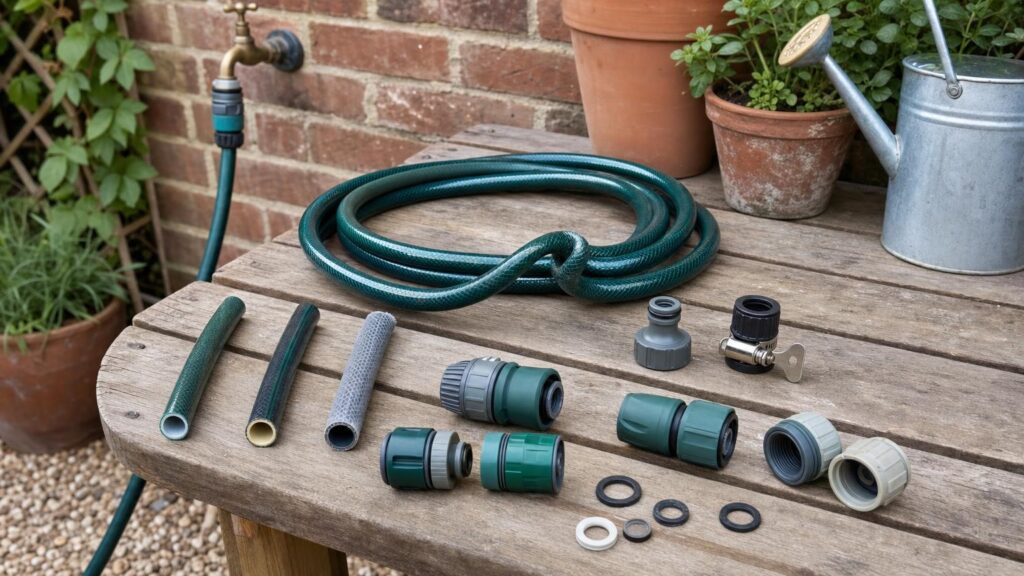
A tap can deliver plenty of water yet seem disappointing once a hose, several connectors and a spray nozzle are attached. The reason is that pressure at the tap is only one part of the story. Hose length, internal diameter, bends and fittings all influence how much water reaches the outlet while it is running.
Compatibility can be equally confusing. A hose size may describe its nominal bore, a tap adaptor may use a thread designation that does not match a ruler measurement, and two quick-connect fittings may look alike without sealing or locking together. Treating the installation as a complete system makes both flow and fit easier to understand.
Why a Hose Can Feel Weaker Than the Tap Supplying It
Static pressure is the pressure available when water is not flowing. Delivered flow is the amount of water that passes through the system during use. Once the tap is opened, water encounters resistance from the hose walls, connectors, valves, bends and outlet attachment. The pressure available at the far end therefore depends on the whole water path.
This explains why a tap may fill a bucket quickly on its own but produce a weaker stream through a long hose. It also explains why a narrow spray pattern can feel forceful even though it uses relatively little water: a nozzle can convert the available flow into a faster, smaller jet. That is different from supplying a high volume to a sprinkler or filling a container rapidly.
It helps to think of every component as part of a chain. The most restrictive section can set a practical limit for everything downstream. A generous hose bore cannot fully compensate for a narrow valve, small repair fitting or partially blocked nozzle.
Length and Internal Diameter: The Main Sources of Flow Loss
Water loses energy through friction as it travels along a hose. A longer hose creates more contact with the internal wall, so flow loss generally increases with length. Buying much more hose than the job requires may be convenient for reach, but the unused length still adds resistance if water must travel through it.
Internal diameter is especially important. A smaller bore gives the water less space to pass through and creates greater resistance. The difference becomes more noticeable over long runs or when an attachment requires substantial flow. A short, narrow hose may be adequate for gentle watering, while a longer run supplying a sprinkler or cleaning attachment can benefit from a more open water path.
Shoppers should distinguish internal diameter from external diameter. Thick walls, reinforcement and protective layers can make two hoses look similar from the outside even when their internal bores differ. Nominal size is also a category description rather than a promise that every product has an identical measured opening. Construction tolerances, liners and end fittings may reduce the usable passage.
Length and bore should therefore be considered together. A longer route makes bore restrictions more consequential, while choosing only the largest hose can add weight, storage bulk and handling effort that a small garden does not require.
How Wall Construction Changes Handling and Flow
Hose construction affects whether the bore remains open during real use. A lightweight hose is often easier to carry and coil, but a very flexible wall may flatten where it bends, twists or passes around an obstacle. Reinforcement and multilayer construction can help a hose retain its shape, although they usually add weight and may make cold-weather handling less supple.
Common construction trade-offs
- Lightweight hoses: easier to move and store, but their resistance to crushing, twisting and sharp bends depends heavily on wall design.
- Reinforced or multilayer hoses: generally offer more structural support, but can be heavier and less convenient for frequent repositioning.
- Expandable hoses: compact when empty and designed to lengthen under water pressure. Their flexible inner tube and outer covering create different handling and repair considerations from a conventional hose.
- Very stiff hoses: may resist flattening but can be awkward to route, especially around corners or in confined storage.
A stated hose size does not reveal all of these behaviours. What matters in use is whether the waterway stays reasonably round and open. A hose with a suitable nominal bore can still perform poorly if its wall folds at the reel, twists near the tap or collapses beneath a wheel.
Kinks, Coils and Routing Matter More Than They Seem
A kink is a local narrowing of the hose, and even a short narrowing can have a pronounced effect. Tight storage coils can encourage repeated bends, while pulling a hose from a reel without allowing it to unwind may introduce twists. Routing it around a sharp corner or beneath furniture can create another restriction.
Kink resistance is not exactly the same as stiffness. A stiff hose may resist folding but be difficult to manoeuvre. A soft hose may feel pleasant in the hand yet need more careful routing. Good handling depends on a balance between flexibility and enough structural support to preserve the bore.
Before blaming the tap, fully uncoil the hose and remove twists. Use broad curves rather than sharp turns, avoid crushing it under doors or wheels, and check the short section nearest each coupling. Ends are common stress points because the rigid fitting and flexible hose meet there.
The Hidden Bottlenecks in Couplings, Valves and Nozzles
The opening through a connector can be substantially smaller than the hose attached to it. Shut-off valves, reducers, repair joiners and quick-connect mechanisms all occupy space inside the water path. Some accessories also contain strainers, non-return components or flow-control parts that add resistance or collect debris.
This does not make such components undesirable. A shut-off valve can be convenient, and a reducer may be necessary to join unlike sizes. The important point is that convenience and maximum flow are separate considerations. If high delivery matters, inspect the narrowest internal passage rather than judging a coupling by its outside diameter.
Nozzles and spray attachments deliberately restrict or reshape flow. A fine mist, concentrated jet and open outlet will behave differently on the same hose. Sprinklers can also require a certain combination of flow and operating pressure to work as intended. Testing the hose with no attachment is therefore a useful way to distinguish a supply problem from an accessory restriction.
Why Nominal Sizes and Threaded Taps Cause Confusion
Hose bore size, connector size and thread designation describe different things. A hose label commonly refers to a nominal internal size. A connector may be described by the hose size it accepts, the interface it plugs into or the thread on its other side. These labels are not interchangeable.
Thread names can be particularly misleading because a nominal designation does not necessarily equal the diameter measured across the outside of the thread. Thread compatibility also depends on profile, pitch, diameter and whether the seal is formed by the threads or by a separate washer or gasket.
Different markets commonly use different tap and hose-thread conventions. For example, British Standard Pipe terminology is widespread in many regions, while North American garden hose connections follow another convention. Similar measured diameters do not prove that two threaded parts are compatible.
Before buying an adaptor, identify the local tap standard and whether the tap has an internal or external thread. Check the product’s stated thread specification rather than relying only on a ruler or on terms such as “standard tap”. Where possible, retain the tap’s original documentation or compare it with a known compatible adaptor.
Quick-Connect Systems: Similar Appearance Does Not Ensure a Match
A typical quick-connect arrangement has several distinct interfaces. A threaded adaptor attaches to the tap. A hose-end connector grips the hose and locks onto the adaptor’s plug. At the other end, another connector accepts the plug fitted to a nozzle, sprinkler or other accessory.
Each interface must be correct. The tap adaptor needs the right thread and seal. The hose connector must suit the hose’s size and wall construction. The plug and socket must have compatible profiles, diameters and latch positions.
Many quick-connect products follow broadly familiar shapes, but visual similarity is not a guarantee of compatibility. Small differences can prevent the latch from engaging, compress an O-ring incorrectly or allow a connection to blow apart under pressure. A fitting that clicks into place may still leak if its sealing surface or O-ring position differs.
The safest approach is to verify an explicit compatibility statement for the relevant system or use matching components. If mixing components, test the connection gently before relying on it, and do not force parts that fail to engage smoothly.
Coupling Materials, Seals and Repairability
Plastic and metal coupling bodies each involve trade-offs. Plastic can be light, comfortable to handle and resistant to some forms of corrosion. Metal can provide robust threads and a solid feel, but material quality, finish and exposure to moisture all affect durability. Metal is not automatically leak-free, and plastic is not automatically weak.
Look beyond the body material to the complete connection. Useful details include a collar that is easy to grip when wet, effective hose retention, a suitable strain-relief section and seals that can be replaced. A well-designed connector should hold the hose without cutting or crushing it excessively.
Washers and O-rings are small but important. A missing, hardened, damaged or displaced seal can cause leaks even when the fitting itself is sound. Keeping suitable replacement seals may extend the useful life of the system.
Repairability differs by construction. Reusable ends can sometimes be removed and refitted after a damaged hose section is cut away. Repair joiners can reconnect two sound sections, though the joiner may introduce a narrower passage and another potential leak point. Factory-crimped ends can be neat and secure but may be harder to replace without cutting the hose.
Expandable and specialised hoses may require construction-specific repair parts. A generic joiner designed for a conventional hose should not be assumed to work with a flexible inner tube or unusual wall structure.
Diagnosing Poor Flow and Choosing a Compatible Setup
A step-by-step test can locate a restriction without replacing the whole system:
- Test the tap directly. Observe the supply with the hose removed. If flow is poor here, the hose is not the primary cause.
- Connect only the hose. Fully straighten it, open the tap and compare the outlet with the direct tap flow.
- Inspect the route. Remove kinks, twists, tight reel bends and crushed sections.
- Check connectors and seals. Look for displaced washers, swollen or damaged O-rings, debris and internal parts that have shifted.
- Clean accessible strainers. Tap adaptors, valves and attachments may contain screens that collect particles.
- Add components one at a time. Refit valves, joiners and the final nozzle separately. A noticeable change after one component identifies a likely bottleneck.
- Check for leaks. Escaping water reduces delivery and may indicate a poor seal, incompatible interface or damaged hose end.
Before choosing a replacement or new setup, record the required reach without excessive spare length, the hose’s stated and actual bore information, the tap’s thread standard and orientation, and the quick-connect system used by existing accessories. Also compare the internal passages of valves and fittings, not just their external size.
Finally, consider maintenance. Replaceable washers, available O-rings, reusable hose ends and compatible repair joiners can make a system easier to keep working. The best choice is not simply the hose with the largest label or the heaviest connector. It is a set of components whose water passages, interfaces and handling characteristics suit the intended route and task.
Continue exploring on Frowse
Best Sellers · Top Rated · Best Value · Under £50 · Fresh Finds · Premium Picks
Discover More Frowse Insights
- Why a Tripod’s Load Rating Does Not Tell You How Steady It Will Be
- Why Battery Voltage Does Not Tell You How a Cordless Lawn Mower Will Cut
- Why Identical-Looking Concealed Cabinet Hinges May Not Be Interchangeable
- What a Surge Protector’s Joule Rating Means and Why Protection Wears Out
- Why Reflective Privacy Window Film Stops Being Private at Night