


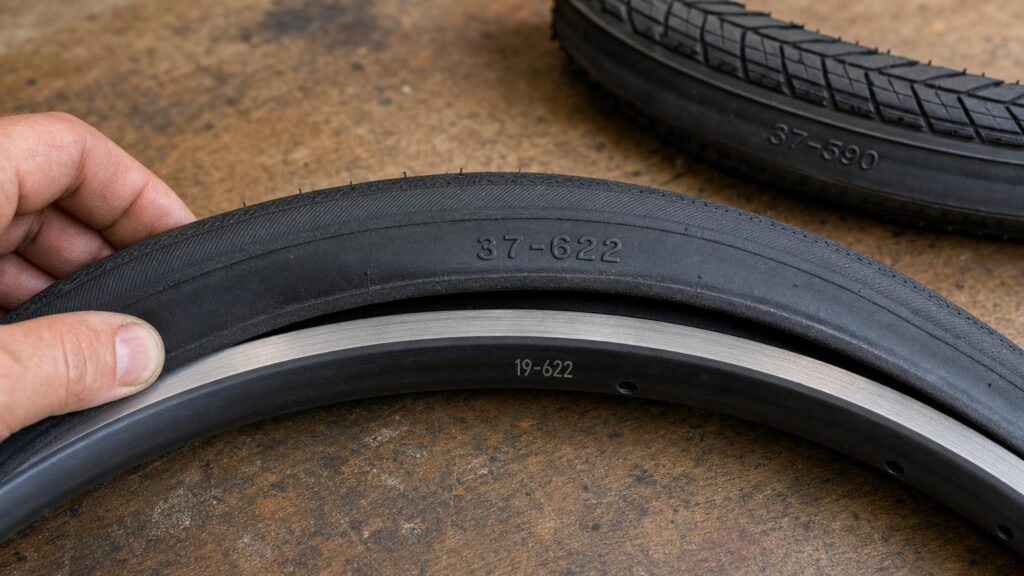
A bicycle tyre label can look reassuringly simple, yet familiar names such as 26-inch, 28-inch, 29-inch, 650B and 700C do not always identify the dimension that determines whether the tyre will mount on a particular rim. Some are historical size names, while others refer loosely to an approximate outside diameter that changes with tyre width.
The most useful starting point is the ETRTO size printed on the tyre sidewall. It identifies the tyre’s nominal width and, crucially, its bead-seat diameter. That diameter must match the rim exactly. Width, bicycle clearance, tube sizing and tubeless construction must then be checked before the complete setup can be considered compatible.
Why familiar tyre labels do not always describe the same fit
Traditional tyre names are useful shorthand when comparing products within a known bicycle category. The problem comes when they are treated as precise rim measurements.
An inch label may refer to the approximate outside diameter of an inflated tyre rather than the rim diameter. Because wider tyres create a larger outside diameter, more than one tyre-and-rim combination can end up carrying a similar inch-based name. Historical naming practices also developed differently across road, touring, mountain and utility bicycles.
French labels present a similar issue. In a designation such as 700C, the number belongs to a historical sizing system and the letter is a legacy size classification. It should not be interpreted as a direct measurement of the tyre bead or rim.
Consequently, tyres with similar traditional names can require different rims. Conversely, tyres marketed under different names may share the same bead-seat diameter. Visual comparison is not enough because even a small diameter difference prevents the tyre bead from seating as intended.
How to read an ETRTO tyre size
An ETRTO tyre marking usually contains two numbers separated by a hyphen. Consider 37-622 as a representative example:
- 37 is the tyre’s nominal width in millimetres.
- 622 is the bead-seat diameter in millimetres.
The bead seat is the part of the rim where the tyre beads sit when installed. The second number therefore determines basic rim-diameter compatibility. A 37-622 tyre needs a rim with a 622 mm bead-seat diameter. A tyre ending in another number is not a substitute, regardless of how similar its inch or French label appears.
The first number is still important, but it serves a different purpose. It describes nominal tyre width rather than the exact width the tyre will measure on every bicycle. Actual mounted width can vary with the rim’s internal width, tyre casing, inflation and manufacturing variation.
ETRTO markings are normally found on the tyre sidewall. A rim may have its dimensions printed on a sticker, etched into the rim or included in the manufacturer’s technical information. Rim descriptions do not always display the numbers in the same order or style as tyre markings, so identify the stated bead-seat diameter rather than matching two labels by appearance alone.
Inch, fractional and French sizes: where confusion begins
Decimal and fractional inch labels
Decimal and fractional tyre names are not necessarily alternative ways of writing the same measurement. For example, a label written with a decimal width should not automatically be treated as equivalent to one using a fraction, even if both begin with the same nominal wheel diameter.
The broad label “26-inch” has been used for several distinct bead-seat diameters. This is especially relevant when replacing tyres on older mountain bikes, touring bicycles and utility bikes. Buying another tyre simply because it says 26-inch can therefore produce a tyre that is plainly too large or too small for the rim.
28-inch, 29-inch and 700C
Many tyres described as 28-inch, 29-inch or 700C use the same 622 mm bead-seat diameter. The different names often reflect bicycle category and tyre volume: 700C is familiar in road and hybrid cycling, 28-inch appears in various regional and utility contexts, and 29-inch commonly describes larger-volume mountain-bike tyres.
This overlap illustrates why the ETRTO marking is more informative. A shopper may encounter tyres with very different tread patterns and nominal widths, all ending in 622. They share the basic rim diameter, but that does not mean all of them are suitable for the same rim or bicycle.
650B and 27.5-inch
Similarly, 650B and 27.5-inch are commonly associated with a 584 mm bead-seat diameter. Once again, the traditional names describe a size family rather than giving the measurement needed for a definitive check. Always confirm the number printed on the specific tyre.
Bead-seat diameter is necessary, but not sufficient
An exact bead-seat diameter match is the first non-negotiable step. A tyre intended for a smaller diameter rim cannot simply be stretched into service, and one intended for a larger rim cannot be made compatible by using a different tube or more inflation.
Once the diameter matches, four further questions remain:
- Is the tyre width permitted for the rim’s internal width?
- Will the inflated tyre clear the frame, fork, mudguards and brake hardware?
- Does the inner tube cover both the required diameter and tyre width?
- If used without a tube, are the tyre, rim and other components approved for the same tubeless system?
A shared final ETRTO number therefore identifies a possible diameter match, not automatic compatibility for the whole bicycle.
Matching tyre width to internal rim width
Rim width is usually discussed in terms of internal width – the distance across the inside of the rim between the bead areas. This dimension affects how the tyre casing is supported and what shape it takes when inflated.
A relatively narrow tyre on a very wide rim can adopt a flatter profile and may fall outside the tyre or rim maker’s approved combinations. A very wide tyre on a narrow rim can become more bulb-shaped, with greater casing movement and less predictable clearance. In either case, the tyre may also measure differently from the width stated on its sidewall.
There is no single universal ratio that covers every tyre, rim and intended use. Road, gravel, mountain, touring and cargo equipment can use different constructions and permitted ranges. The dependable approach is to consult both manufacturers:
- Find the rim’s stated internal width and permitted tyre-width range.
- Check whether the tyre maker approves that rim width for the chosen tyre.
- Use the narrower of any limits where the published ranges differ.
- Check for separate instructions applying to hooked or hookless rims.
This matters when fitting a substantially wider or narrower replacement, even if the existing tyre and proposed tyre share the same bead-seat diameter.
Checking frame, fork, mudguard and brake clearance
The nominal tyre width is not a promise that the installed tyre will measure exactly that amount. A wider rim can spread the casing, while tread blocks and protective layers can add height or width that is not obvious from the headline size.
Clearance should be assessed with the tyre correctly mounted and inflated, not while it is folded, uninflated or merely held next to the bicycle. Inspect the space around both sides and the top of the tyre, paying attention to:
- the fork legs and fork crown;
- the chainstays, seatstays and seat tube;
- mudguards, stays, bolts and mounting brackets;
- rim-brake calipers or other nearby brake hardware;
- any unusually close cables or accessories.
Rotate the wheel and check the full circumference. A wheel or tyre may have small variations, and clearance can change if the wheel is not perfectly centred. The bicycle, frame, fork or component manufacturer may specify a minimum clearance, which should take precedence over visual guesswork.
Do not assume that the largest tyre which appears to fit while the bicycle is stationary is necessarily an appropriate choice. Space may also be needed for normal wheel movement, flex and debris associated with the bicycle’s intended conditions.
Choosing an inner tube that fits the tyre and rim
Inner-tube packaging normally gives both a wheel-diameter designation and a supported tyre-width range. Both need to include the chosen tyre. A tube marked for a single broad inch family is not automatically suitable for every tyre carrying that inch label.
Where available, compare the tube’s ETRTO information with the tyre’s bead-seat diameter. Then confirm that the tyre’s nominal width falls within the tube’s stated range. A tube may cover several adjacent widths because it expands, but it should still be used within the maker’s specification.
The valve also needs attention:
- Valve type: Presta, Schrader and other valve types require a compatible rim hole and pump connection.
- Valve-hole fit: A valve should suit the existing hole rather than being forced into an unsuitable opening.
- Valve length: Deeper-section rims need enough exposed valve stem for straightforward inflation and pump attachment.
A correct tube cannot compensate for a tyre with the wrong bead-seat diameter, nor can it make an unsuitable tyre-and-rim width combination acceptable.
Tubeless-ready does not mean universally compatible
Tubeless compatibility is a separate question from whether the tyre diameter matches the rim. A functional tubeless setup generally requires a tubeless-compatible tyre, a suitable rim profile, correctly sized rim tape, an appropriate valve and sealant intended for the system.
The words “tubeless-ready” on one component do not confirm that every other tubeless-ready component can be combined without checking instructions. Rim profiles, tyre beads and permitted inflation limits can differ.
Hooked rims have bead hooks at the rim walls, while hookless rims use a different retaining profile. Hookless designs can impose particular tyre-size, construction and pressure requirements. Verify that the specific tyre is approved for the rim type and observe the lower of any applicable limits provided by the tyre and rim manufacturers.
Rim tape must also suit the rim’s internal width and cover the required openings without interfering with bead seating. Sealant and valves should be installed and maintained according to their makers’ directions. A tyre that fits perfectly with an inner tube is not necessarily approved for tubeless use on the same rim.
A label-to-bicycle compatibility checklist
- Read the tyre’s ETRTO marking. Record both the nominal width and bead-seat diameter.
- Identify the rim’s bead-seat diameter. Use the rim marking or reliable manufacturer documentation rather than measuring the outside of the wheel.
- Match the diameter exactly. The tyre and rim bead-seat diameter must be the same.
- Check the rim’s internal width. Confirm that both tyre and rim manufacturers permit the proposed width combination.
- Assess bicycle clearance. Consider the inflated tyre’s width and height around the frame, fork, mudguards and brakes.
- Select the tube or tubeless components. For tubes, match diameter, width range, valve type and valve length. For tubeless use, verify every part of the system.
- Review construction-specific instructions. Pay particular attention to hooked or hookless compatibility and published inflation limits.
Traditional tyre names remain useful for browsing, but they are not the final authority on fit. Start with the ETRTO bead-seat diameter, then work through rim width, mounted clearance, tube sizing or tubeless requirements. That sequence turns a potentially confusing collection of labels into a reliable compatibility check.
Continue exploring on Frowse
Discover More Frowse Insights
- Why an HDR Badge Does Not Guarantee a Convincing HDR Picture
- Cemented, Blake-Stitched and Welted Shoes: What Sole Construction Really Changes
- Porcelain, Stoneware and Earthenware: What the Names Really Mean
- Why a Desk Lamp’s Lumen Rating Does Not Reveal How Well It Lights a Work Surface
- Why Replacement Zip Sliders Are So Difficult to Match