


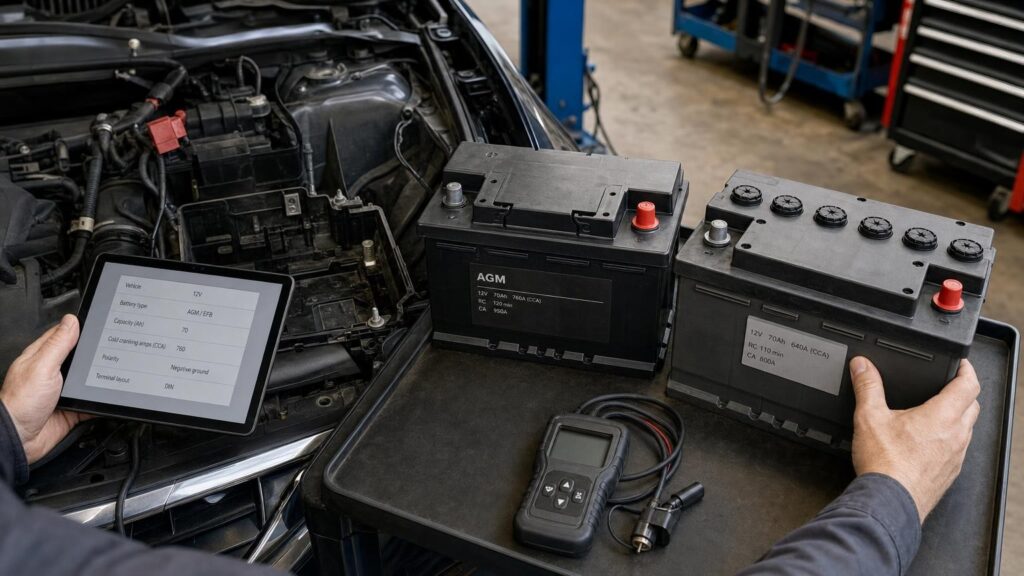
A replacement car battery can fit neatly into the tray, connect to the cables and start the engine, yet still be the wrong battery for the vehicle. Dimensions matter, but they are only one part of compatibility. Battery construction, terminal arrangement, cold-starting output, capacity, mounting details and charging-system requirements all influence whether a replacement is suitable.
This is particularly important in cars with start-stop technology or battery-management electronics. These vehicles may expect a particular battery type and may also require the replacement to be registered or adapted electronically after installation. Before buying, shoppers should therefore match the vehicle’s whole battery specification rather than treating the tray size as the deciding factor.
Flooded, EFB and AGM: What Actually Changes
Most car starter batteries use lead-acid chemistry, but that does not make every design interchangeable. Conventional flooded, enhanced flooded battery and absorbed glass mat batteries manage their electrolyte and internal construction differently. Those differences affect how they respond to repeated starts, partial states of charge and frequent charging and discharging.
Conventional flooded batteries
A conventional flooded lead-acid battery contains liquid electrolyte around its internal plates. It is widely used in vehicles with traditional starting and charging systems, especially where the engine is started once per journey and the alternator then replenishes the battery during normal driving.
For a vehicle designed around this battery type, a correctly specified flooded battery may be the appropriate and economical choice. Its limitation is that it is not normally intended for the more demanding cycling pattern created by modern start-stop operation. Physical fit does not compensate for that difference in duty.
Enhanced flooded batteries
An EFB remains a flooded design, but its internal construction is enhanced to tolerate more frequent cycling and to accept charge more effectively than a basic flooded starter battery. It is commonly associated with some start-stop systems and other applications that place greater demands on the battery.
EFB sits between conventional flooded and AGM designs in both capability and typical cost. It should not be interpreted simply as a marketing grade. If a vehicle specifies EFB, replacing it with an ordinary flooded battery can remove the cycling performance for which the charging and start-stop system was designed.
Absorbed glass mat batteries
In an AGM battery, the electrolyte is held within absorbent glass mat separators rather than remaining as freely moving liquid. AGM construction generally supports strong charge acceptance, repeated cycling and resistance to vibration. It is often specified for more demanding start-stop vehicles and cars with substantial electrical loads.
AGM batteries are usually more expensive than conventional flooded or EFB alternatives, so choosing one for a vehicle that does not require it may offer limited practical value. Equally, replacing a specified AGM battery with a cheaper flooded design is not a like-for-like substitution. Installation location, venting arrangements and the vehicle maker’s requirements must still be observed.
Why Start-Stop Systems Change the Decision
A conventional vehicle usually asks the battery to provide a large starting current at the beginning of a journey. A start-stop vehicle may switch the engine off repeatedly and restart it many times while continuing to power lighting, ventilation, infotainment and control systems during the stopped periods.
This produces a more demanding pattern than a single start followed by steady charging. The battery must cope with repeated shallow discharge and recharge cycles while retaining enough output for dependable restarting. The vehicle may also decide when start-stop operation is available according to battery condition, temperature and electrical demand.
If the vehicle was designed for EFB or AGM, an ordinary flooded replacement may start the engine initially but deteriorate more quickly under the intended duty. Conversely, changing from EFB to AGM should not be assumed to be an automatic upgrade. The charging strategy and battery-management configuration may be set for a particular technology. Follow the vehicle maker’s specification or dependable application data rather than making a chemistry change based only on price or headline performance.
Case Size Is More Than Length, Width and Height
Battery dimensions are an essential first check, but three measurements do not describe the entire casing. A compatible battery must sit correctly in the tray, clear surrounding covers and components, and work with the original retaining system.
Check the position and shape of any lower mounting ledge, the hold-down clamp arrangement and casing features that locate the battery. Two products with similar stated dimensions can have different bases or retaining details. Overall height also needs to include the terminals where relevant, since cables, covers or nearby bodywork may occupy the space above the case.
An undersized case is not necessarily acceptable just because it can be placed in the tray. The original clamp may not secure it correctly. A battery that is slightly too large may foul a cover, cable or other component, while the wrong base profile can prevent the hold-down from engaging. Case codes are useful, but shoppers should still compare the specified format and mounting details rather than relying on a rough tape-measure match.
Terminal Position, Type and Polarity
Batteries that share a case size may have different positive and negative terminal positions. When viewing the battery from the specified orientation, the positive post might be on the left in one layout and on the right in another. Vehicle cables are normally routed for one arrangement and may not safely reach a reversed battery.
Terminal type and dimensions matter too. Standard top posts are not the only connection style, and some batteries use different post sizes or side connections. Vent openings can also be positioned differently, which is relevant where the vehicle uses a vent tube to direct gases away from the installation area.
Do not treat stretched cables, strained connectors or improvised terminal adapters as normal solutions to a layout mismatch. Confirm all of the following before purchase:
- Positive and negative terminal orientation
- Terminal style and compatible post size
- Height and accessibility of the connections
- Location of any required vent connection
- Cable reach without pulling, twisting or rerouting
CCA, Capacity and Reserve Performance Are Different Specifications
Battery labels often display several electrical ratings, and they describe different aspects of performance. They should not be combined into a single idea of power.
Cold-cranking amps (CCA) indicate the battery’s ability to provide starting current under a defined cold test condition. This is especially relevant because engines generally become harder to crank and battery performance falls as temperatures drop. A replacement should meet the vehicle’s required starting specification rather than merely having a case that fits.
Ampere-hours (Ah) express stored capacity under a specified test procedure. Capacity affects how much electrical energy the battery can supply, but the printed Ah figure does not by itself show how effectively the battery will crank an engine in cold conditions or tolerate repeated start-stop cycling.
Reserve capacity, where quoted, describes sustained electrical supply under a defined load and test condition. It is another capacity-related measure, not a substitute for CCA or chemistry.
Higher figures are not automatically better in every situation. A battery with very high CCA but the wrong chemistry, terminal layout or charging compatibility remains unsuitable. A substantially different capacity may also be inconsistent with the vehicle’s charging strategy or available installation space. The sensible approach is to meet the specified ratings and use higher values only where reliable vehicle application guidance permits them.
Charging-System Compatibility and Battery Registration
Many modern vehicles adjust charging behaviour according to operating conditions and their estimate of the battery’s age, charge level and condition. Some systems also distinguish between battery technologies or capacities. This means installation can involve more than disconnecting the old unit and attaching the new one.
Battery registration generally tells the vehicle that a new battery has been fitted. Coding or adaptation may be needed when characteristics such as technology or capacity differ within the options approved for that vehicle. The terminology and procedure vary by manufacturer, so the relevant service information matters more than a universal rule.
Where registration is required, omitting it can leave the management system working from assumptions associated with the old battery. This may lead to inappropriate charging behaviour, inaccurate battery-condition decisions or unexpected start-stop operation. Registration cannot make an incompatible battery suitable; the correct battery must be selected first.
Shoppers should establish before buying whether the vehicle requires electronic registration and whether suitable diagnostic equipment is needed. This can affect the true cost and convenience of replacement, especially where professional installation is appropriate.
A Practical Compatibility Checklist Before Buying
- Start with reliable vehicle information. Consult the handbook, battery label, manufacturer guidance or dependable application data using the exact model, engine and production details.
- Identify the required technology. Confirm whether the vehicle specifies conventional flooded, EFB or AGM construction. Do not infer chemistry from case size.
- Check the complete physical format. Compare the case code, length, width, overall height, base profile and hold-down arrangement.
- Verify terminal layout. Confirm polarity, post position, terminal type, cable reach and any protective covers.
- Check venting. Make sure the required vent opening and tube connection are present in the appropriate location.
- Match the electrical ratings. Meet the specified CCA and capacity, while remembering that the two values measure different things.
- Confirm start-stop suitability. If the vehicle has start-stop, use the technology and duty rating specified for its system.
- Establish installation requirements. Determine whether battery registration, coding, adaptation or diagnostic checks are required.
If the existing battery, handbook and seller application data disagree, resolve the conflict before ordering. The fitted battery may itself be an incorrect earlier replacement, while broad model descriptions can overlook differences between engines, equipment levels and production dates.
Choosing an Equivalent Without False Economy
A genuine equivalent matches the vehicle’s functional requirements, not just the visible shape of the old battery. It should have the correct chemistry, mounting format, polarity, terminals, venting and electrical ratings, and it should be compatible with the vehicle’s charging strategy.
The cheapest physically similar battery can become poor value if it is unsuited to repeated cycling or requires improvised installation. Likewise, paying for the largest CCA or capacity number available does not correct the wrong terminal layout or battery technology.
A successful first start is not proof of long-term compatibility. Even a mismatched battery may initially crank the engine. Problems related to cycling durability, charging control, cable strain or management-system assumptions can emerge later. Evaluate the complete specification before using immediate starting performance as evidence that the choice was correct.
Conclusion: Match the Vehicle’s Whole Battery Specification
Choosing a starter battery requires several checks that work together. The case must fit and be securely retained, the terminals and venting must align, and the CCA and capacity must meet the vehicle’s needs. Just as importantly, the battery technology must suit the vehicle’s operating pattern and charging system.
For start-stop and battery-managed vehicles, confirm whether registration or adaptation is part of the replacement process. Use dimensions as confirmation, not as the sole basis for selection. The right battery is the one that matches the vehicle mechanically, electrically and electronically.
Continue exploring on Frowse
Discover More Frowse Insights
- Pressurised and Traditional Espresso Baskets Do Different Jobs
- Porcelain, Stoneware and Earthenware: What the Names Really Mean
- Why Vacuum-Sealer Bags Are Textured – and Why Smooth Bags Often Do Not Work
- Why a Washing Machine’s Kilogram Capacity Is Not the Size of Every Load
- Where Ink Goes When an Inkjet Printer Is Not Printing Pages